Good morning. I’m feeling energized today as we announce our third DTC Dines event in Austin, Texas. Vancouver and LA were both excellent gatherings of brand-side founders and growth team leaders. No agendas, just great people mixing it up and comparing notes on work and life (and what shows we’re streaming). Are you in the Lonestar State? Apply to join us!

⏯️ YouTube taking over top of funnel
I just got out of a meeting with several operators running eight and nine figure DTC brands plus a few agencies buying at scale. Chatham House rules, so no names. The topic was YouTube as top of funnel at scale, and the consensus was clear: YouTube is a great option to create demand now, and it's earning real top-of-funnel budget. Meta still captures demand better than anyone, it's just weaker at creating it. If you lean on Meta for the whole funnel, you're mostly paying to capture demand something else created.
The catch is YouTube's CPA will look worse, and you judge it anyway. One operator put YouTube CPAs 30 to 50 percent above Meta's, and it undercounts on top of that, since people watch on the TV and buy later on another device. That same operator saw their best Meta CPAs during their heaviest YouTube spend. So don't kill it on the in-platform number. Judge it on whether blended new-customer cost drops. Buying cycles got longer, so people have stretched their holdout windows to read it properly, and post-purchase surveys keep showing customers first heard of them months before buying.
Easiest way in is Demand Gen, run like Meta: one campaign, an ad set per offer and per creative batch, then leave it alone. The room touches budgets once a week at most and lets ads run for months. It's also the fix for brands too niche to scale on Meta. On creative, ripping your best TikToks over works to start, but the wins come from narrative built for the format: 40 to 45 seconds that tells a story and lands a payoff, not a static 15-second hook.
The other unlock is creator ad reads. Buy the baked-in read plus usage rights, cut it down, and run it as a Meta and YouTube ad. Give attribution room to breathe: one operator's six-figure Father's Day sponsorship looked dead by the deadline and pulled multiple six figures by Christmas on last-click. Pricing is the Wild West, so negotiate hard.
This week: pick your three top TikToks, build one Demand Gen campaign with an ad set per offer, set a holdout long enough to catch the tail, and leave it alone. Grade it on blended new-customer cost and your Meta CPA, not YouTube's in-platform number.
📦 Prime Day 2026 front-loaded
Prime Day 2026 closed at $26.4B in US retail spend over four days, up 9.3% YoY, with Day 1 setting a 2026 record at $8.3B.
The Pilothouse Amazon team shared that client accounts that ran deals were up YoY, several over 100%, one at +159% on a record Day 1.
They also told me that the end-of-event checkout surge that usually carries Day 4 mostly didn't happen. Days 1-3 beat expectations and Day 4 fell short.
Their read is shoppers have learned not to wait, helped along by Amazon swapping its subtle "Price History" line for a prominent blue badge next to the price, giving earlier visible proof the deal is real.
Analysts described the spend as pre-buying: shoppers pulling forward purchases they were going to make anyway. Shoppers used Prime Day to stock up on back-to-school, hygiene, and household staples (toilet paper, detergent, garbage bags) they were going to buy later anyway, stretching flat budgets across better deals.
For your 2027 planning, that means structuring deals and inventory around replenishment demand.
One more thing that held: brands with full-catalog enrollment showed up in deal-filter search and saw a halo into the days after, so partial enrollment left money on the table.
🤖 Even Amazon is paying to acquire customers outside Amazon
Amazon bought ads inside ChatGPT for Prime Day, directing shoppers back to its own storefront rather than relying on ChatGPT's native shopping experience.
Amazon spent decades building the default destination for online shopping. Buying ads on ChatGPT means they're now paying to influence the decision before someone chooses where to buy. Last year the company temporarily pulled out of Google Shopping before returning, another sign that even the largest players are constantly rethinking where their next customer comes from.
The move signals that Amazon no longer assumes the purchase journey starts on Amazon.
🎨 The 60-minute creative audit that finds your next scale opportunity
@nicktheriot_ runs this on every new client account before touching anything else.
Pull the last 30 days of ads and sort by spend, highest to lowest. Tag each ad by format: UGC, static, VSL, professional, IG trend, news-style. Then count how many different formats are running against your current winning messaging, and separately, how many photos versus videos are in market. The goal is identifying which formats have never been tested with the hook that's already working, then building those four to six missing combinations as the first creative drop.
Across every account he's audited, he's found at least three missing formats in accounts that were stuck. The winning hook is already there, the formats already exist in the account. The combinations just never got built. That makes it about as low-cost a scale test as you can run.
📧 Back in Stock pulls $8-9 revenue per recipient
@ecomchasedimond shared 2026 email benchmark numbers that put Back in Stock at $8-9 revenue per recipient, the highest of any flow. Price Drop and Referral are the other two sitting untapped.
His benchmark for whether you're behind: flows should pull 37-41% of email revenue off roughly 5% of your sends, with the top 10% clearing 50%. Under that, you've got automation gaps to close.
The Pilothouse Meta team ran a 14-day lifetime vs. daily budget test on a $50M health and wellness brand.
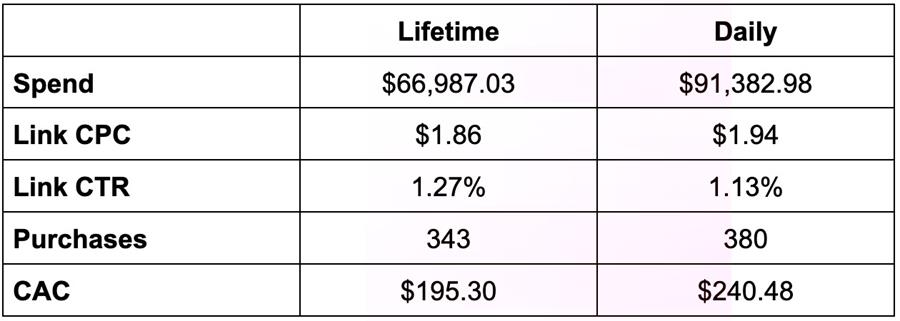
Over 14 days, lifetime budgets brought CAC down to $195 against $240 on daily. CTR ticked up too (1.27% vs 1.13%) and CPC came down slightly.
Why it works: Meta's delivery is mostly machine learning now, and a lifetime budget gives Meta room to concentrate spend on higher-converting days rather than distributing it evenly across every 24-hour cycle. Pilothouse shares the brand is shifting budget toward lifetime and easing off daily as it holds.
One thing to flag though: Lifetime also spent less over the window ($67k vs. $91k) and booked fewer purchases (343 vs. 380). Efficiency per order improved while total volume dropped. Anyone optimizing for volume over efficiency should factor in the purchase count difference before switching.
When a lifetime campaign nears its end date, push the date out 2-3 weeks and raise the budget instead of letting it run dry, which keeps the learnings and the momentum intact. Then do it again as the new end date approaches, as long as performance holds.
Worth a test if your CAC's been stuck.
Jordan shares a Shopify conversion optimization diagnostic framework brands can use to locate, measure, and fix conversion bottlenecks in a Shopify store.
Learn how to audit 10 critical power pages, track key metrics, and fix funnel leaks.
▶️ Watch here | 🎧 Listen on Spotify
Did you find this valuable? Support us by checking out our businesses:
Please note that items in this newsletter marked with * contain sponsored content.
.svg)


.svg)


.svg)


.svg)
.svg)
.svg)