Good morning. Have you caught World Cup Fever? I only have mild chills but if Canada makes it past the round of 16, I’ll call in sick.
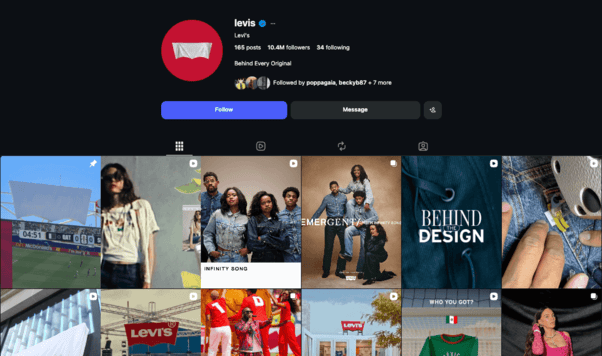
The biggest winner of the tournament might be Levi's, who paid FIFA nothing. Forced to tarp over their own logo at Levi's Stadium, they leaned in, matched their profile pic to the cover-up, and let everyone recognize the brand FIFA tried to hide. Official sponsors paid tens of millions for less buzz than Levi's got from a bedsheet.

📊 YouTube will now tell you who searched for you after seeing your ad
Google rolled out Attributed Branded Searches as a global metric in Ads this week. It tracks people who saw your ad, then went and searched for your product within 30 days.
Google says each extra branded search is worth $31 in sales. That's Google's number, treat it as a vendor estimate. The metric gives you a way to measure upper-funnel video performance you didn't have before.
The second change requires action. If you're running Video View campaigns opted into Shorts, Google now folds Shorts Ad Actions, likes, shares, comments, straight into budget optimization automatically. Your campaign just started chasing engagement it used to ignore. Check your settings and decide if that's the signal you want it chasing. A Short like and a product purchase are different signals.
📈 Stop pulling winners out of testing
Most operators pull a winning ad into a separate scaling campaign. @benradack scales it inside the same ad set it tested in, then duplicates it to scaling on top of that.
He calls it horizontal scaling and it works for two reasons. An ad that crushes at $200/day can completely fall apart at $600. He lets the winning ad sit at whatever budget it performs at. Twenty ad sets running $200-400/day adds up fast. Second, ads build engagement history inside their original ad set. Meta may not favor them in scaling right away, but accumulated social proof changes that over time.
My old friend @jordanhaswings (Instant Hydration) puts the budget math behind it, citing @IstvanicMarin's approach: a $5k increase to one campaign creates a large performance swing. Split across twenty ad sets at $250 each, the same increase stays small enough per ad set to avoid destabilizing performance.
Most accounts are hunting for the one ad that scales to $10k/day. The account running $4k/day across a testing campaign structured this way is already there.
🤖 Use AI to find the gaps between what you've told customers and what they're asking
Every brand has gaps between what customers need to know and what the brand has told them. @yojimmykim mapped this problem this week. Closing that gap means comparing every customer question against everything you've already published.
Here's the prompt he shared to have AI handle it:
"I'm giving you two datasets: all of our customer-facing content, emails, product descriptions, FAQs, blog posts, and all of our support tickets, specifically the questions people ask. Find the gaps. What are customers asking about that we haven't addressed? Where are they confused that we haven't clarified? What questions appear repeatedly that aren't answered anywhere in our materials?"
Those gaps are costing sales and retention.
🚢 Everyone's racing to get Chinese imports in before July 24
The 10% Section 122 tariff on Chinese goods expires around July 24, and most importers don't expect that 10% to just disappear. The expectation is it gets replaced with something higher.
Retailers are responding by front-loading. Getting goods in now while the rate is still 10%, before whatever comes next. China's May export data showed that shipments to the US are up 35% year over year, the fastest growth in about five years.
Confirm your effective tariff rate for after July 24.
🎬 The "condensed year" video is overperforming
@SarahLevinger shared how the "condensed year," a compressed transformation arc squeezed into a single short-form post, is getting serious views.
The example she found did 439k views and 59k likes off a creator with just 25k followers. If you're in skincare or supplements, this format is worth testing.
🤖 Starbucks employees are now an ad platform
Starbucks is the first brand piloting TikTok's Custom Creator Network this summer. Employees opt in, get a content brief, and create TikTok content based on their own experience and audience, earning a share of the ad revenue.
The program builds on Starbucks' existing Green Apron initiative and runs on the newly released Symphony Agent, TikTok's AI system that pulls top-performing content and trends to match brands with creators.
The Pilothouse team pulled four summer creatives that are working right now, sunscreen, swimwear, and jewelry brands doing it right. The summer shopping intent is hot, capture it while you can.
Here's what they found and why each one is worth borrowing.
Lo-Fi Image with Review Overlay
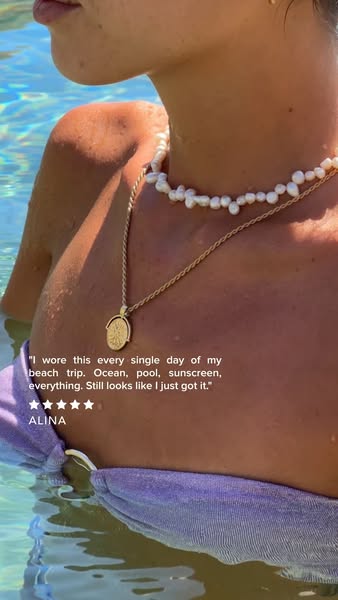
This format pairs a customer review tied to a specific benefit with imagery that reinforces that same benefit visually. Atolea Jewelry executes it well: a close-up beach shot communicates the waterproof, stackable nature of their pieces before the review even registers. The two elements work together to tell one cohesive story.
How to make it work:
A lo-fi image is the right call here. Something that feels native to the feed amplifies the authenticity of a review overlay, adding social proof without it reading like an ad.
The most important thing is alignment between the image and the copy. The review and the visual need to be reinforcing the same angle and the same benefit. Misalignment between the two kills the credibility of the format.
Seasonal Multi-Product
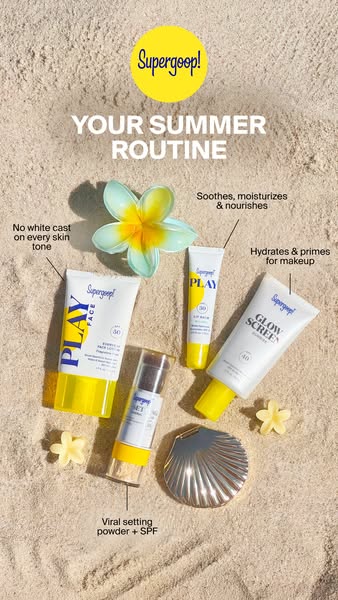
This format works especially well in CPG, where the product story centers on a routine or system across multiple SKUs. Supergoop nails it here with tight, benefit-driven callouts for each product in the lineup. The yellow branding pops against the sandy backdrop, and every element earns its place in the frame.
How to make it work:
This type of ad is built at the production stage, not in post. Brands have gotten better at thinking through paid creative when planning studio shoots, but there is still room to be more intentional.
Before your next shoot, audit your top-performing ad formats and make sure you are capturing imagery with enough negative space to support copy overlays.
Also think about variety at the shoot level. Capturing multiple SKUs together gives you the raw material to build routine-based narratives across products.
Branded Lifestyle Image with Product Render
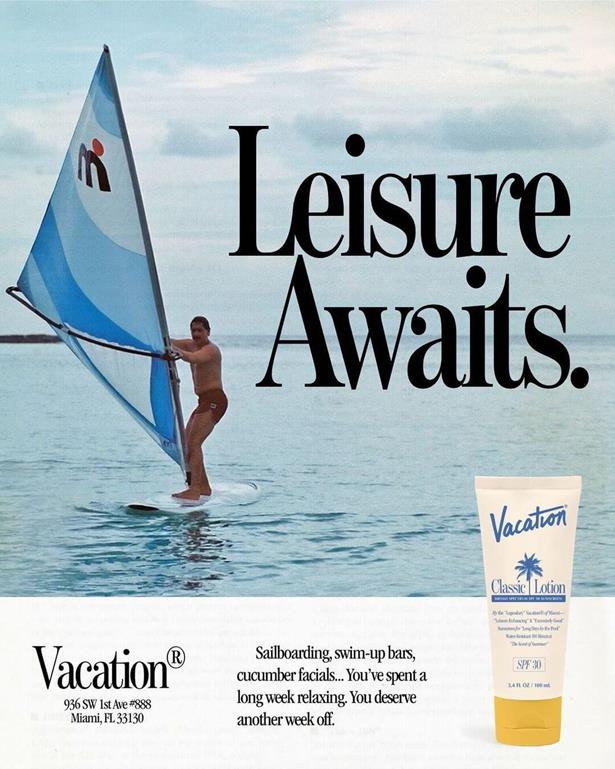
Vacation has built an entire brand world around a retro, sun-soaked aesthetic, and their paid creative is a direct extension of it. The ad feels like a magazine clipping from the 1980s, intentionally trading on nostalgia.
How to make it work:
Commit fully. A highly stylized approach like this only works when the execution is total. Half-measures read as off-brand.
This format requires a genuine, established brand world to pull from. Vacation can do this because the retro aesthetic is baked into every touchpoint of the business, from packaging to copy tone to campaign imagery. Trying to replicate this level of stylization without that foundation tends to hurt paid performance.
Lo-Fi Image with Bold Headline
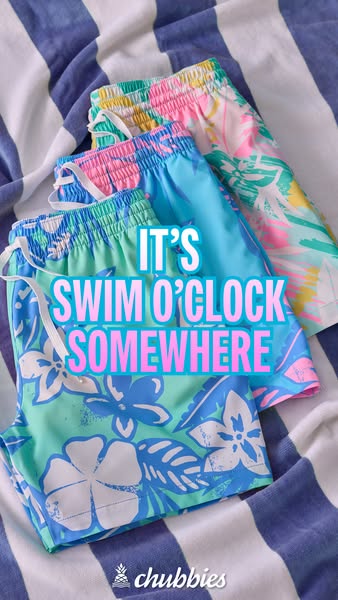
A simple, product-forward format that works especially well in taste-driven verticals. The Chubbies example shows off multiple colorways in a single frame and uses a headline that matches the energy of the product without overthinking it. The text overlay complements the color palette.
How to make it work:
Show range at the top of the funnel. For products where purchase comes down to personal taste, featuring multiple colorway variants in your TOF creative casts a wider net across different customer preferences. A single colorway ad will always leave some of your audience cold.
This format also has additional uses worth testing. If your product is something customers are likely to own in multiple versions, or if you offer AOV-based discounts, a raw asset like this is a worthwhile test to add to your rotation.
Zoe Kahn, interim VP of Marketing for Cove Soda, shares how she’s able to grow an email and SMS list even without having a DTC site.
She breaks down how a retail-first brand can still build a direct, owned channel, why she treats in-person events as the acquisition surface, and how she competes in a soda aisle that already has Olipop and Poppi running Super Bowl ads.
▶️ Watch here | 🎧 Listen on Spotify
Did you find this valuable? Support us by checking out our businesses:
Please note that items in this newsletter marked with * contain sponsored content.
.svg)


.svg)


.svg)


.svg)
.svg)
.svg)