Good morning,
Here’s what you’ll find in today’s DTC:
1️⃣ How Unbound Merino can break into new audiences to accelerate growth
You’re reading this newsletter along with new subscribers from: Lowkey Coffee and Blume Honey Water. 👋

🚶 Unbound Merino's Google Breakdown
Unbound Merino is a Toronto-based apparel brand built around creating minimalist, high-performance clothing for travel and everyday wear.
The brand focuses on premium merino wool essentials designed to be odor-resistant, versatile, and easy to pack, helping customers “pack less and experience more.”
What began as a small crowdfunding project has scaled into a fast-growing DTC business, approaching $100 million in lifetime revenue with projections of around $60 million annually.
The Pilothouse Google team breaks down Unbound Merino's Shopping ads, search presence, and YouTube channel with observations and recommendations for each.
Overview
When looking through Unbound Merino’s live search ad variants, the picture of who they are targeting is unusually clear.
All 46 ad variants target the minimalist traveler: the buyer who packs light, washes less, and carries one shirt for ten days.
The phrases repeat almost verbatim. "Wear for Weeks." "Pack Light, Travel Right." "Less Washing & Packing." "Travel for Weeks Without Washing."
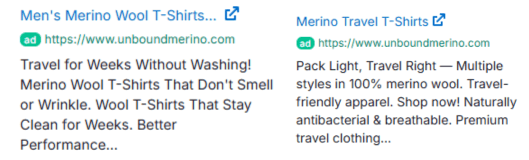
The messaging consistency across 46 ad variants is uncommon at this stage, and the search position data shows it's producing results.
The positioning is specific and earned: premium merino for the traveler who packs one bag and doesn't touch a laundromat.
According to recent Semrush data, Unbound Merino is running 51 paid keywords, spending around $7,000 a month, and pulling in roughly 5,600 paid visitors.
They hold the #1 paid position on "merino wool," "merino," "merino wool t shirt," and most of the obvious adjacent terms. Google's AI Overview names them the "Best Overall Travel" merino brand.


Holding the #1 paid position across core category terms while maintaining full brand ownership of the Shopping carousel is a strong foundation.
Unbound is now pulling traffic from buyers whose search intent doesn't match the current messaging.
The merino category has grown, and the opportunity to extend the brand voice alongside it is real.
Google Shopping
When searching for the brand name “unbound merino”, the brand fully owns the carousel.
All five sponsored slots are Unbound. There are no retailers surfacing or competitors cutting in.
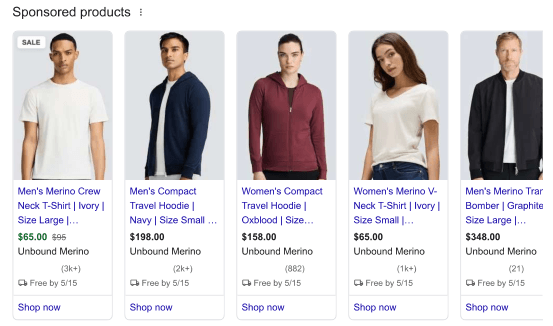
On more specific searches, competitors enter the carousel at lower price points.
Quince leads at $39.90. Wool&Prince at $40. Unbound sits above at $65.

While Unbound's price is justified by the product, the Shopping tile doesn't have room to make that argument. The product page does. The feed has to earn the click first, and right now, on generic terms, the price comparison is taking over before the brand story can even begin.
The Quince shopper sees a tee and a price and clicks. The first customer was probably going to find Unbound anyway.
The shopper in between is the incremental opportunity.
On travel-coded queries like “travel merino,” Unbound takes two of the top placements and competitors fall back.
Where the search itself signals "I'm the customer Unbound writes for," the brand has an advantage.

On generic searches, the brand story hasn't had room to enter the conversation yet.
Pilothouse Tips
✅ Differentiate the feed. Lifestyle imagery, on-body shots, or trust signals layered into the tile pull the eye away from the dollar figure.
✅ Lean on review counts. Several SKUs have thousands of reviews. Strong star ratings are one of the few signals that consistently compete with a lower price.
✅ Test bundle framing. The 3-pack tee is a strong asset. "From $X" framing can shift the perceived entry point without lowering the per-unit price.
Search
The Search account itself is sharp.
Top positions on the obvious category terms, smart capture of brand misspellings ("unbound marino," "outbound merino," "marina wool"), and broad coverage across the catalog. A lot of brands at this stage would be thrilled to be looking at this account.
The structure is solid. The opportunity is in expanding the audience the messaging speaks to.
Only 8 of the 51 paid terms use the word “travel” anywhere in them. The rest are generic merino category searches: “merino wool,” “merino wool t shirt,” “merino wool pants,” “best mens t shirts.” Plus 18 brand variants.
The traffic Unbound is paying for is wider than the current messaging covers, which means there's captured spend that could convert better with a second message.
Across 46 ad variants, the messaging targets a single buyer persona.
"Travel for Weeks Without Washing." "Wear for Weeks." "Less Washing & Packing." "Pack Light, Travel Right."
That copy performs for the core customer. A second message targeting adjacent buyer segments would cover the remaining traffic the current creative isn't converting.
The everyday wearer. The work-from-home buyer. The athleisure customer. The new parent.
There are adjacent buyers in those same results who could be captured with a second messaging layer.
Google's 'People also search for' data shows a high volume of comparison queries on the brand SERP.
"Unbound Merino vs Smartwool." "Unbound Merino vs Icebreaker." "Woolx vs Unbound Merino." "Unbound Merino alternatives." "Unbound Merino discount code."
These are buyers already familiar with the brand who are actively evaluating it against competitors.
That group represents a high-intent segment the current ads haven't been built to capture yet.
Pilothouse Tips
✅ Do customer persona work. Persona work should come before any new ad testing otherwise it’s guessing at the second voice instead of writing for it.
The quickest path is mining what’s already there: review the search terms and bucket based on specific intent, review post-purchase survey responses, Google Search Console queries, etc.
✅ Test non-travel positioning. A second campaign built around everyday wear, work, or "the only shirt you'll need" opens a much larger audience without diluting the travel angle that's working.
✅ Speak to comparison shoppers. A small ad set targeting "vs" and "alternative" queries with copy about durability, longevity, and total cost of ownership intercepts the buyer at the highest consideration moment.
✅ Map keywords to the right page. Generic terms like "merino" should land on a category gateway, not a single SKU.
Video

Beyond Search and Shopping, there’s an untapped channel worth serious attention: YouTube.
Unbound Merino’s YouTube channel features polished videos, mostly targeting the minimalist traveler. However, the channel could be much more active. The most recent upload is seven months old, and there’s no paid YouTube activity.
The existing content performs: "How to Wash Merino Wool While Traveling" has 12,000 views. "Minimalist Packing Tips for Men" has 7,000. The original Indiegogo video for the Compact Travel Hoodie has 40,000.
A third-party review titled “I Wore Unbound Merino For 60 Days” also exists, indicating organic creator interest without paid involvement.

The appetite for this content is clearly there. Scaling the channel is the logical next move.
Water beading on fabric and a shirt unrolling without wrinkles are exactly the kind of visual proof points that perform in YouTube in-stream and Shorts formats.
The creative assets already exist and can be activated through paid distribution without requiring new production.
Pilothouse Tips
✅ Test paid YouTube against existing creative. The clips already live on the channel. Cut the strongest into 15 to 30-second in-stream ads.
✅ Build remarketing audiences from site traffic. Site visitors and cart abandoners who already know the brand are the cheapest, most efficient YouTube spend available.
✅ Test Demand Gen. "Minimalist packing." "How to travel light." Upper-funnel queries Unbound's content already answers.
Conclusion
Unbound has a clearly defined core customer, a converting paid search account, and established brand positioning. The specific opportunities are in Shopping feed differentiation, search messaging expansion, and YouTube activation.
The brand voice is clear, the customer is specific, and the paid search engine they've built converts reliably.
The next layer of growth is a second message running alongside the one that's already working.
The product already solves more than one problem: odor resistance, durability, comfort, longevity. The minimalist traveler cares about some of those.
The work-from-home buyer, everyday wearer, and comparison shopper each respond to a different subset of those attributes.
In Shopping, that means giving the feed enough signal to earn the click on value, not just price.
In Search, it means adding messaging layers that speak to the everyday, comparison, and lifestyle buyer segments already in the results.
In Video, it means activating existing assets through paid distribution and consistent publishing cadence.
The core customer built the brand. The adjacent customer grows it. The infrastructure Unbound has already built is the right foundation for both.

📥 Got a B2B Biz?
Join dozens of B2B companies finding demand-gen success through our niche community of 150k brand leaders and founders this year. Talk to our team to learn more.
Don’t forget to rate the DTC Podcast on Apple (⭐️⭐️⭐️⭐️⭐️)
DTC Newsletter is written by Rebecca Knight and Frances Du. Edited by Eric Dyck.
Please note that items in this newsletter marked with * contain sponsored content.
.svg)


.svg)


.svg)


.svg)
.svg)
.svg)