Goooood morning DTC readers! It’s Rebecca covering the intro again while Eric is out in Austin.
I opened Claude the other morning and found three half-finished projects staring back at me, so I made this because I figured a lot of you could relate…

Anyways, I saw my first official Black Friday countdown yesterday. We’re now only 119 days away, which is slightly alarming to hear on a Friday morning, so… sorry.
Let’s jump in!
💸 Meta beat revenue and lost 4% of its stock anyway
Meta's shares fell 4.2% even though Q2 revenue beat Wall Street's expectations. Profit still fell 14% to $15.85 billion, dragged down by $2.4 billion in legal charges and $1.18 billion in severance tied to the May layoffs. In response, Meta raised its 2026 expense guidance to $165 billion to $169 billion.
Zuck spent the call talking up AI, calling it the engine behind Meta's next wave of products and enterprise plays.
Spend increases like this have a way of finding their way into CPMs down the line, right as Q4 makes them expensive enough already. Keep an eye on where yours land over the next couple of quarters.
🔦 Meta might be changing your ads right now, and you're supposed to catch it yourself
Kody Nordquist (@KodyNordquist) says a Meta rep confirmed the platform is turning on certain Advantage+ creative optimizations inside live ad accounts as part of internal testing for a new product. He asked to be added to a block list to opt out and was told that's not possible.
When he asked how anyone's even supposed to know which of their ads have this turned on, the answer was to use AI to monitor account changes yourself, or check manually. He says Meta's own product manager overseeing the test told him "we have the ability to turn these off," meaning the capability exists, they're just not proactively using it or telling anyone what's changing.
This is Kody's account of a private conversation, not a public Meta statement. If your creative performance has moved around lately without an obvious reason, check your account's creative optimization settings directly instead of assuming nothing's changed.
👀 Your strikethrough pricing might be next
Lululemon got sued last week in LA Superior Court over "phantom discounts."
The lawsuit claims a pair of Wunder Train tights was marked down from $98 to $59. Lululemon hadn't charged $98 for those tights since October.
Nike is fighting a similar lawsuit. The filing says a pair of Air Max 2017 sneakers carried a $190 reference price. Those sneakers had been discounted continuously for six months straight.
Attorney Rob Freund, who tracks these cases, says filings roughly doubled from 2024 to 2025.
California's False Advertising Law requires the reference price to reflect what you actually charged in the last 90 days, and it applies to your DTC site and app specifically. If you run strikethrough pricing and sell into California, check your reference price history against the last 90 days before your next sale event.
🧠 Most of what AI cites about your brand isn't on your site
@kaleighf flagged that most AI answer engines pull their brand citations from sources you don't own like reviews, YouTube, Reddit threads, and customer content.
Your own site and blog only account for a small slice of what ChatGPT or Google's AI Overviews cite when someone asks about your category.
She calls the fix Creator AEO. Get real people (employees, customers, micro-influencers) cited across third-party platforms, on top of your normal site SEO.
For DTC brands, that means the reviews, unboxing videos, and Reddit mentions already floating around your product might carry more weight with AI-driven discovery than your PDP copy does. Search your product name in ChatGPT and see who's getting cited.
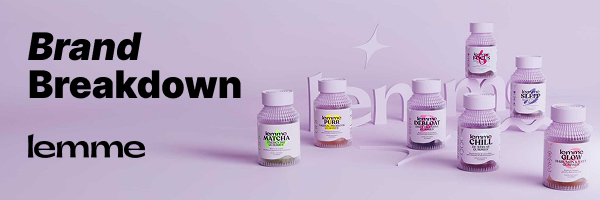
🤖 Lemme’s high-volume static testing, underdeveloped video strategy
Lemme is one of the fastest-growing supplement brands. Founded by Kourtney Kardashian Barker in 2022, the brand started with three products before expanding into gummies, capsules, and soft chews covering bloating, gut health, and weight management.
Lemme was projected to surpass $200 million in sales in 2025. It generated $13M from TikTok Shop in a single month, partnering with 13K creators who produced over 53,000 videos.
I’ve seen Lemme pop up a ton, so I asked the Pilothouse Meta team to look into what’s being run in their Meta account.
They took a look, pulled these examples, and highlighted what’s working and what needs fine-tuning. Check it out.
Match AI-generated visuals to product relevance
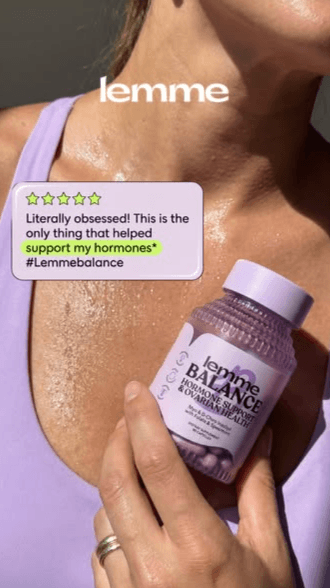
The first ad pairs an AI-generated model image with a customer review, and the instinct to lean on social proof is right, reviews genuinely work at TOF. The execution doesn't hold up though, the review reads as made up, and the AI image itself doesn't feel connected to the actual product.
Pilothouse's read is that this kind of batch-and-blast content mostly works for brands with Kardashian-level star power behind them to cover for the misses, which most brands don't have. A specific, credible review speaking directly to how supporting balanced hormones improves health and wellbeing, paired with an image that actually reads as the product, would be a stronger TOF asset.
Replace vague search bar creative with concrete benefits
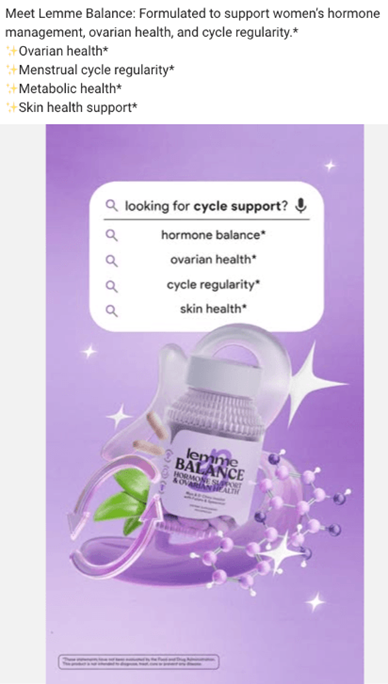
A second ad uses an AI-generated product render with a search bar UI showing related queries. It's easy to produce at scale with AI, but the strategist we tapped mentioned that they haven’t seen this format drive performance across dozens of ad accounts and millions in spend.
The bigger issue, one that shows up across Lemme's ad library generally, is value, the benefits listed don't answer the question a prospect is actually asking, how does this make my life better.
Swapping the search bar for a direct list of benefits that go beyond the existing copy, or leaning into specific ingredients tied to concrete value adds, would close that gap. Differentiation is hard in CPG, and this creative doesn't build a case for why to buy.
Use motion with purpose
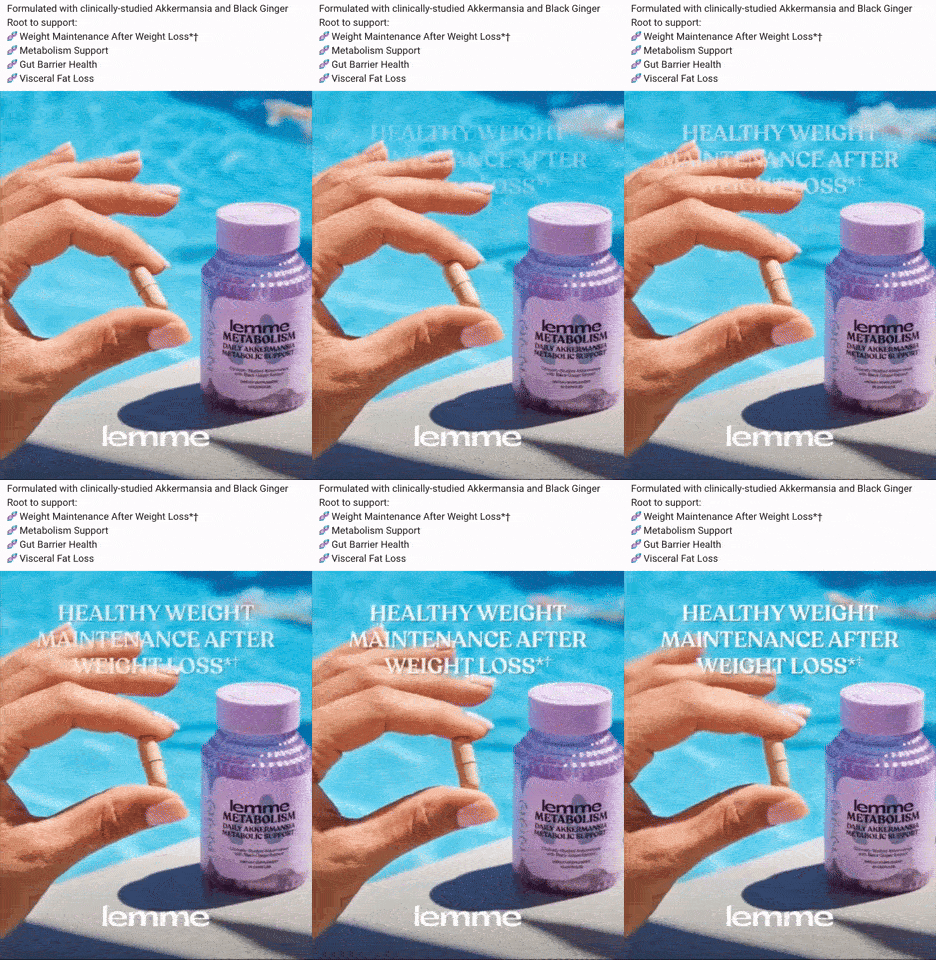
This video ad shows someone by a pool with a hand angling the product into frame, and the visuals don't tie back to the product or the angle, plus the rendering quality is weak for generative AI. Video always costs more to run on Meta than static, so motion needs to be earning its keep.
Pilothouse's fix: make it static, swap in a stronger headline, bring the copy in earlier, and follow it with a subheadline that gets into specific ingredients or cites a consumer study, that version would likely perform at least as well for less.
Add captions to all creator content
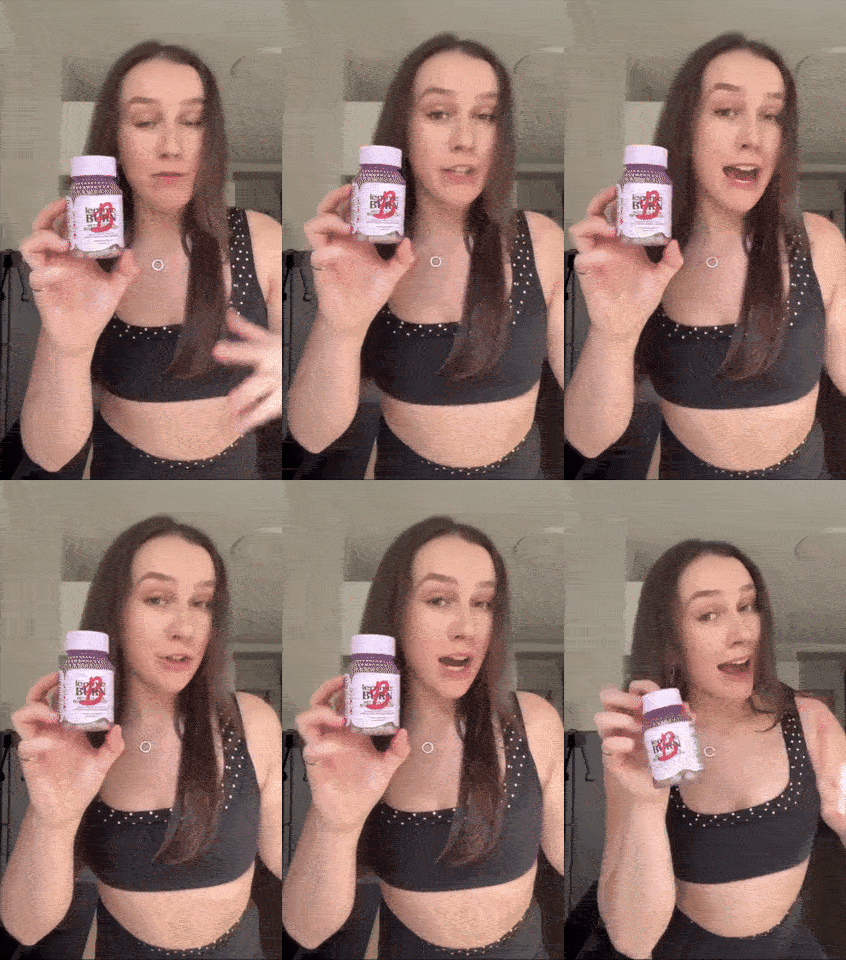
Lemme is testing real creator content, which is the right instinct, but none of it has captions. Most people scroll with sound off and fast, so uncaptioned content is losing reach it shouldn't be losing, and it makes it harder to tell what's actually working in the content itself. Pilothouse shares hooks that work across CPG and wellness broadly:
Adding B-roll of the creator actually using the product would make the asset more dynamic. If that's not available, keeping the voiceover and cutting in shots from other creators is a reasonable substitute.
Conclusion
Lemme's static side is running an aggressive, AI-heavy volume strategy, and in a category like supplements, that can be the right call. Products in this space tend to feel similar, differentiation is hard, and brands rarely win on any single asset, they win by surrounding prospects with enough content that something lands, then iterating on what works. That's an expensive approach, and it leans hard on the kind of brand equity a celebrity-backed launch has that most brands don't.
The video side hasn't caught up to that same logic yet. Building a workflow to process creator content as it comes in, using AI to spin up short-form variations, test visual treatments, and test hooks at scale, would extend the same volume-and-iterate approach that's already working on the static side.
Video is what's driving most TOF performance right now, so that's the higher-leverage place to invest. Static AI content is cheap and easy to produce, but on its own, it can only take you so far.
📊 The right move can improve your CPA, ROAS, and AOV. Clustie's free CPA Playbook shows you exactly how. Have you grabbed your copy yet? Download it here. *
* sponsored
Did you find this valuable? Support us by checking out our businesses:
Please note that items in this newsletter marked with * contain sponsored content.
.svg)


.svg)


.svg)


.svg)
.svg)
.svg)