Goooood morning, DTC readers! Happy August.
No deep Monday morning thoughts from me today. Just this meme to start your day:

Alrighty, let’s get into it.
💰 Amazon got its tariff money back. You have to go get yours.
Amazon recouped roughly $600 million in tariff refunds in Q2, after the Supreme Court struck down a chunk of the Trump-era IEEPA tariffs back in February.
Amazon says its number is smaller than it could've been because it stockpiled inventory ahead of the tariffs and isn't the importer of record on most of what it sells.
For third-party sellers, if you're the importer of record, you or your customs broker need to file through CBP's CAPE tool inside the ACE portal.
Entries CBP hasn't finalized yet, or finalized in the last 80 days, go through CAPE directly. Anything liquidated earlier needs a Form 19 protest, and that deadline is 180 days from the liquidation date with no extensions.
✈️ Your customers: found somewhere unexpected
Most agencies optimize the ad account they're handed with tighter targeting and better creative, but hit the same crowded audience. Pilothouse starts a step earlier than that, with where the actual demand is coming from, not where the category assumes it is.
Take outdoor apparel. Every brand piles into the same expensive markets, Denver, Salt Lake, Jackson, competing for locals who probably already own the gear. Pilothouse pulled winter flight data into Jackson Hole instead and found the people actually flying in were coming from Dallas, Chicago, New York, LA, sitting in a city right now dreaming about the mountains. So that's where they put the spend, geo-targeted YouTube and Meta in those gateway cities, creative built around the life people are actually chasing. Win them in the summer, own them by winter.
That's the kind of thinking I see behind every Pilothouse engagement. Reach out here if you want it on your account.
🔍 Alexa can spot a fake "Made in USA" label. It just won't say anything.
Turns out Amazon's Alexa for Shopping and Walmart's Sparky can both detect when a "Made in USA" badge is fake. The AI tools can spot when sourcing details contradict the claim. Neither of them flags it.
When asked why, the bots gave business reasoning instead of a technical one.
If you're a legitimately domestic brand competing against mislabeled listings on Amazon or Walmart, this is your evidence that the platforms know and aren't acting. Consider a formal complaint if a competitor's listing is misleading.
💡 A creative before and after ad concept to test
@ecomtable is seeing a specific native format perform well.
The two-panel sketch shows how a customer’s bad posture is hurting them with hand-drawn annotations. The other side shows the fix with the product drawn directly into the diagram.

Img source: @EcomTable
The format works because it looks like a doctor's whiteboard explanation, not an ad, and it includes the product into the same frame.
Worth testing on any product where the "before" is a habit, or pain point you can actually draw.
💡 Long-form ad copy takes the lead
Short ad copy feels scannable, but it also starves Meta's algorithm for a crumb of context on who exactly you’re trying to talk to. Do we want to starve the beast that feeds us? Obviously not.
Copy under 100 words gives Meta little to work with. Copy over 100 words gives the algorithm context on what the product is and who it's for, so it can place the ad in front of the right person.
Here’s Pilothouse's structure for long-form copy that scales - feel free to steal it and try it in your account, we don’t mind.
P.S. There’s an example under the list if you want to cross-reference as you go.
1️⃣ Hook first. Lead with a statement or question that calls out the audience directly. The only job of this line is to get the "...See More" click.
2️⃣ Layer in USPs. Break the body into three or four single-paragraph sections, each tackling one specific angle. Space them out so they’re readable for the person and parseable for the algorithm.
3️⃣ Add bullet points and emojis. Format the USP section so it’s scannable. Emojis can also help break up the copy if you feel it looks a bit text-heavy
4️⃣ Include keywords. Work in specific audience descriptors so Meta can pinpoint who you're targeting.
Here’s an example of this long-form copy structure in action:

If you’re wondering why we're talking about ad copy length as a Meta lever right now, this is why: The Pilothouse team ran a recent test with long vs. short copy (for a big brand, supplements, $50M/year) and there was a clear winner:
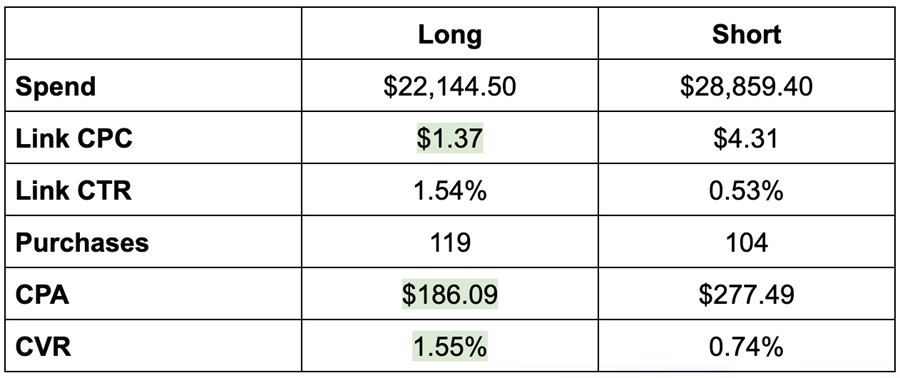
The long-form ad’s link CPC was roughly a third of the cost compared to short copy.
Long-form copy pulled a 33% lower CPA on 23% less spend, while conversion rate doubled.
The long-form ad was cheaper to run, and it reached more people who were actually likely to buy. If you’ve been sticking to ultra-short copy, throw in some longer-form to test. If you see movement from it, report back.

🎧 The marketer’s guide to using socials on purpose
We work in marketing, so scrolling, for the most part, is just part of the job… right? Actually, yes. But scrolling with intention is what sets apart an “oops I just spent an hour down a YouTube rabbit hole that has nothing to do with what I’m working on” and “I just got inspired on new language and angles to use for xyz…”
In this episode of Ad-venturous, Aves breaks down what it really looks like to use social platforms with intention when social is literally part of your job.
From personal posting to structured inspiration gathering to deep persona research, Aves explores how to show up online on purpose, not out of habit.
Go listen.
▶️ Watch here | 🎧 Listen on Spotify
Did you find this valuable? Support us by checking out our businesses:
Please note that items in this newsletter marked with * contain sponsored content.
.svg)


.svg)


.svg)


.svg)
.svg)
.svg)