Good morning DTC readers, happy Friday!
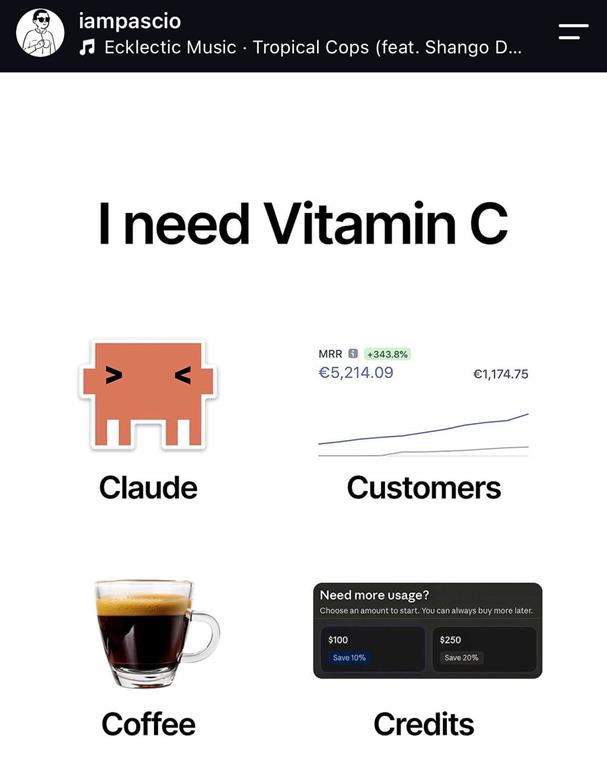
Does anyone here remember learning about the 4 P’s of marketing? I think I saw somewhere that it’s 7 P’s now, but who knows.
Anyways, I saw this and would like to submit to the council: The Four C’s of Marketing, 2026 edition.
Before we get into your DTC reading today, here’s one direct from our team to you (that we’re pretty sure you won’t want to miss…) 👇
👀 How deep should you discount this Q4?
Most DTC brands are guessing. So we're building Beyond the Discount, a benchmark report from two surveys: one to brands on their Q4 discounting plans and another to shoppers on what actually makes them buy and stay.
Take the brand survey (5 minutes, anonymous) and you will get entered in the draw for a $1,000 Amazon gift card. We're expecting a few hundred entries total, so this is probably the best shot at winning $1,000 you'll ever have.
Survey closes Sunday, August 23 and the g-note gets awarded and sent Monday August 24 (Maybe to you??)
Note: Survey results may be used in DTC editorial and advertorial content. Personal info won’t be shared.
* One entrant will be randomly selected to win a $1,000 Amazon Gift Card. No purchase necessary to enter. Survey must be completed by Sunday, August 23rd, 2026 to be eligible. This giveaway is open to legal residents of the United States and Canada (excluding Quebec) who are 18 years or older. Void where prohibited.
🛠️ Your overperforming Google campaigns get reined in on August 17
If a budget-capped campaign has been beating its CPA or ROAS target, enjoy it while it lasts.
Starting August 17, Google Ads will pull budget-limited campaigns into line with whatever target you've set, the same logic unconstrained campaigns already run on.
We reported on this last month and now Google put out a video Q&A on it because the PPC crowd is not calm.
Your target is what actually controls performance now, your budget just decides how much runs through it. Campaigns that have been overdelivering are about to get worse unless you raise the target to match what you've actually been getting.
Pull every budget-limited campaign, check the gap between set target and actual performance, and decide whether to close it or move the target to match your real goals.
💸 DeepSeek is about to stop being the cheap option
DeepSeek just warned of a "significant" API price increase. No number to share yet, but this is a clear departure from the company who started an AI price war by undercutting everyone.
This news came barely a week after DeepSeek launched V4-Flash, which independent testing had just crowned the cheapest capable model around.
If your team or your agency is running anything on DeepSeek's API for creative, copy, or ops, budget for that line item to move.
Meta's Muse Spark and OpenAI's newest model are already closing the price-to-capability gap DeepSeek built its name on, so this is a good time to review options.
💡 How long you stay in ChatGPT's answers depends on how you're tracking it
@neilpatel shares that Writesonic tracked 23 million AI citations over three months and found 44% of sources got cited exactly once, then never again.
The median citation lifespan is 11 to 15 days, so whatever answer engines loved about you two weeks ago is probably already swapped out.
His take is stop checking whether you got mentioned once, start tracking your share of visibility against competitors across ChatGPT, Gemini, and Claude, since the spot reopens as fast as you lose it.
⭐ Bero has the audience. The paid search strategy is still catching up.
BERO is a premium non-alcoholic beer brand co-founded by actor Tom Holland and CPG veteran John Herman, who serves as CEO.
Holland launched it after roughly two years of sobriety, wanting an alcohol-free beer that didn't compromise on taste.
Bero approached nearly $10 million in sales during its first year on shelves and has raised about $43.1 million. Expansion has been rapid. The brand scaled into more than 4,000 locations, including Target, Total Wine, Sprouts, Erewhon, and Soho House.
The Pilothouse Google team reviewed Bero's paid search strategy to identify where paid infrastructure can reinforce celebrity-led awareness for long-term growth.
Overview
There is real buzz around the product, driven by Tom Holland's global celebrity status and openness about his sobriety journey.
The brand has already earned 251K Instagram followers and an audience that was there from the start, with the founding Reel sitting at 8M views.
Search "Is Bero brewing actually good?" and the AI Overview compiles its verdict from reviewers on Reddit, Sporked, and The Non-Alcoholic Aficionado. The consensus reads as "mixed."
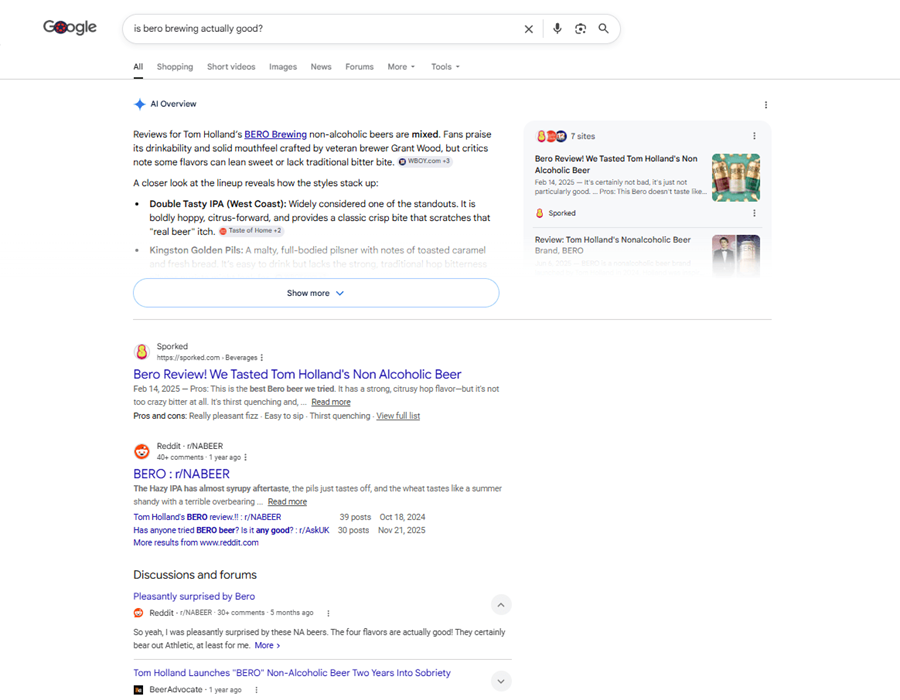
Celebrity-driven brands earn substantial awareness early, and that awareness turns into an ongoing conversation. Bero isn’t actively shaping that conversation through paid media.
According to SEMrush data, Bero is currently running zero paid Google search ads. Zero keywords, zero spend.
The conversation about Bero happens every day on Reddit, YouTube (a third-party review, "Tom Holland's Bero Non Alcoholic Beer Review," has 31,000 views), and in Google's AI Overview, which has settled on a "mixed" verdict. Bero is not an active participant in any of it.
Build a brand-controlled Shopping presence
Search “non alcoholic beer” and Bero is absent from the Shopping results we reviewed. Corona N/A, Michelob Ultra Zero, Athletic Brewing, and Heineken 0.0 all appear, with offers coming from a mix of brand sites and third-party retailers.
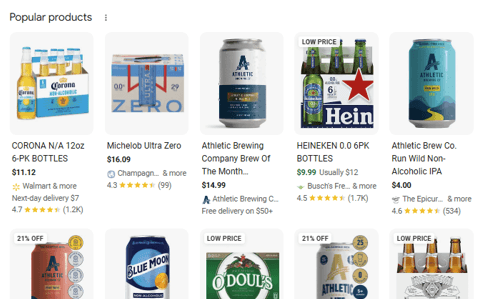
Bero does surface for more specific searches like “non alcoholic west coast IPA,” but the offer shown here comes from a third-party retailer rather than Bero’s own site.
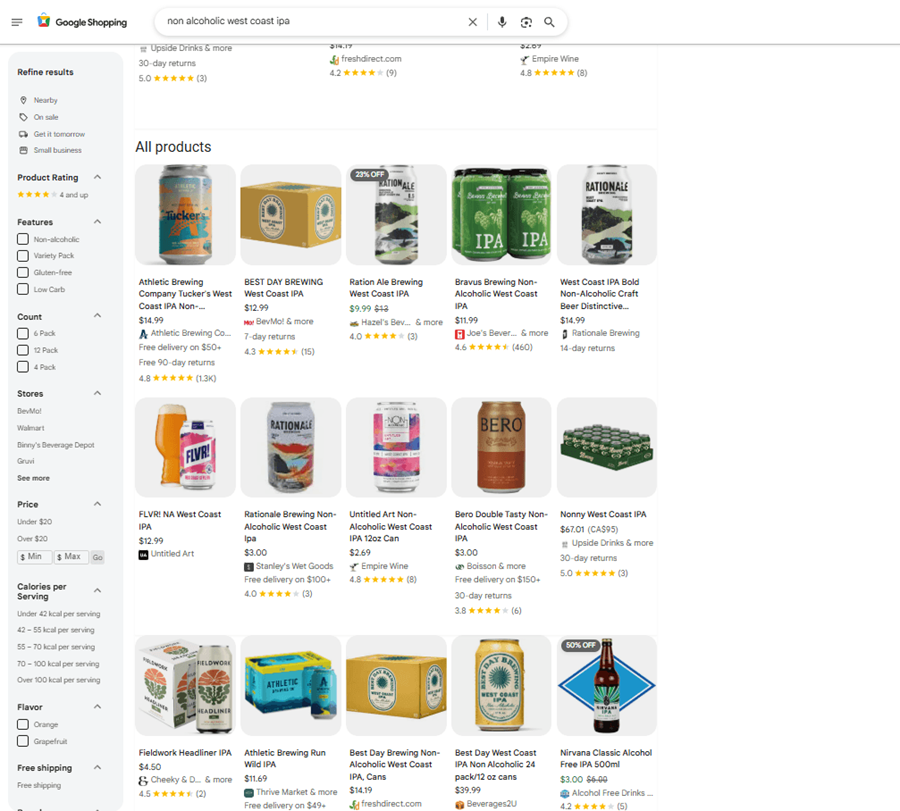
Bero should build out its own Merchant Center presence and run Shopping or PMAX so its DTC offer can compete alongside retailer listings and appear more consistently across relevant category searches.
Pilothouse shares that a Shopping or PMAX campaign with feed-level optimization is the fastest path into the broader “non alcoholic beer” carousel, where Bero is currently absent.
Build review density into the post-purchase flow
In a Shopping tile, where the image is small and prices are similar, review density is one of the few signals that competes with brand recognition.
Bero's tile currently leans on brand recognition alone, with 6 reviews against Athletic Brewing's more than 1,300. A few hundred additional reviews per SKU, driven through the post-purchase flow, would materially narrow that gap and strengthen the visual proof against Athletic.
Run branded paid search to control the consideration phase
Bero's Search presence is almost entirely organic, and it is strong.
Bero ranks first for "bero," "bero beer," "tom holland beer," and most brand and celebrity-coded variations. It also holds strong for "shandy" (12,100 monthly searches) and "na beers" (5,400 searches).
But consideration-phase queries are being answered by others. "Is Bero brewing actually good?" returns the mixed reviews answer by AI Overview.
"Bero brewing vs athletic brewing" returns an AI Overview summary naming Athletic the "industry-pioneering craft non-alcoholic brewery" and Bero "focused on small batch, easy-drinking core styles." "Bero brewing alternatives" surfaces Athletic, IMPOSSIBREW, and GO Brewing. None of those answers come from Bero.
Owning the brand SERP, even at minimal spend, gives Bero direct control over the consideration phase. Reddit and the AI Overview currently shape that phase in Bero's absence.
"Vs" and "is it good" queries are some of the most valuable consideration-stage moments in that cycle, and Bero currently concedes all of them.
Turn the YouTube channel into paid infrastructure
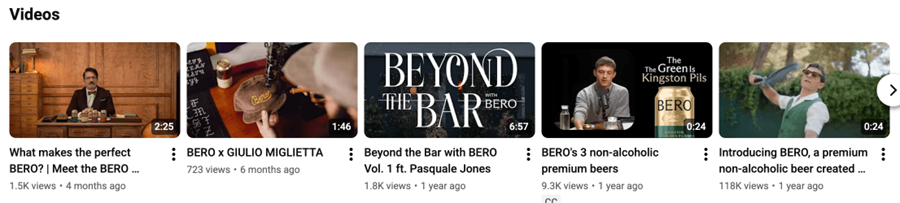
Bero's YouTube channel has 2,400 subscribers and 8 videos. The founding announcement video has 118,000 views, so the audience clearly exists. The channel hasn't kept pace. The last video was posted four months ago.
Third-party content is filling the gap. The Non-Alcoholic Aficionado's Bero review has 31,000 views, and Reddit communities like r/NABEER and r/CraftBeer carry active Bero discussion that links out to other reviewers' takes.
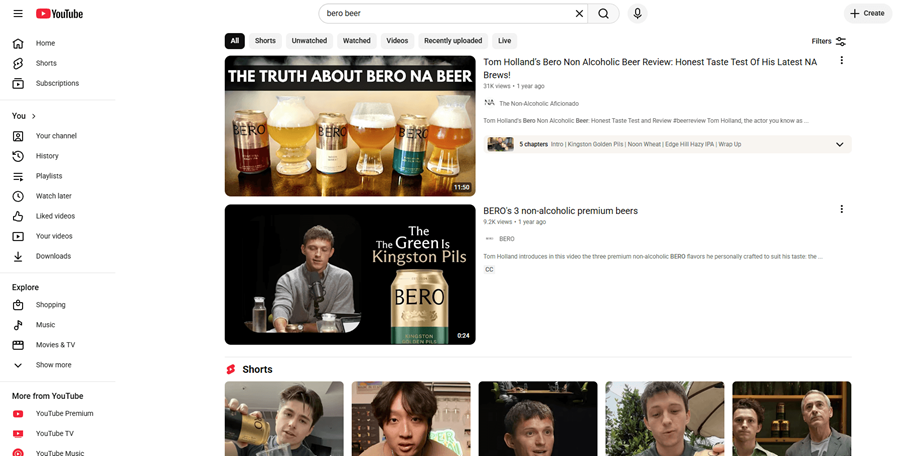
The product lends itself to video. Tom Holland is among the most photogenic founders in DTC, and the brand's most-watched content is him explaining why he made the beer.
The asset is there. The channel hasn't repurposed it as an in-stream ad.
Conclusion
Bero has done the part most brands spend years working toward. The product sits in Target. The founder is a household name. Bero built significant brand recognition remarkably early.
In Shopping, that means appearing in the carousel and building review density that competes with Athletic. In Search, Bero should own its own brand conversation, currently narrated by Reddit and Google's AI Overview in its place. In Video, it means turning a channel with one 118,000-view video into a sustained presence.
Bero needs paid infrastructure to support the conversation already happening around it.
Did you find this valuable? Support us by checking out our businesses:
Please note that items in this newsletter marked with * contain sponsored content.
.svg)


.svg)


.svg)


.svg)
.svg)
.svg)