SPONSORED BY:


Good morning,
Here’s what you’ll find in today’s DTC:
1️⃣ How Feastables Can Turn Creator Hype Into Repeat Purchases
You’re reading this newsletter along with new subscribers from: Sallie Mae, Bleach Temple, and Cameron’s Coffee. 👋
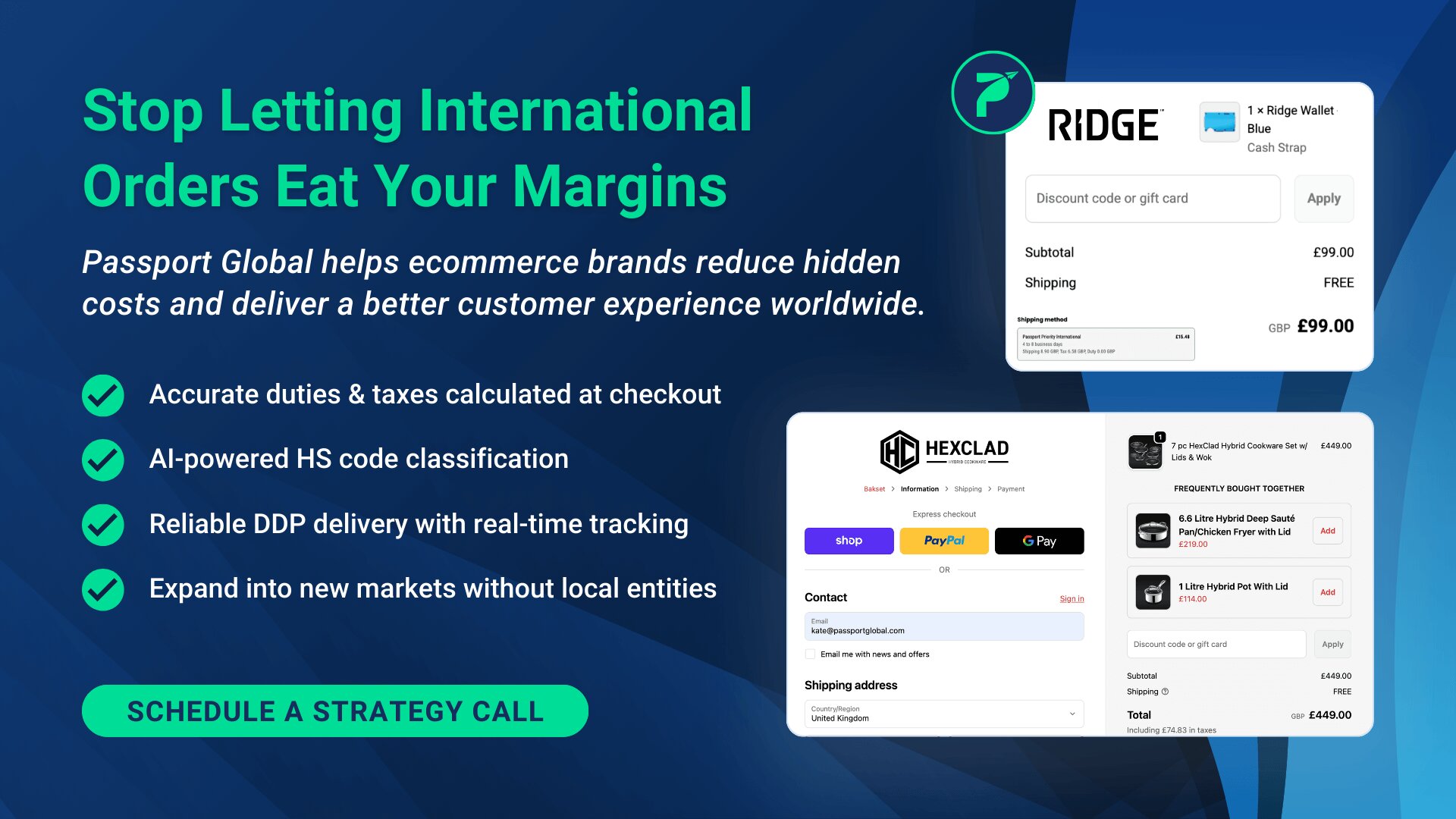
💸 Ridge, HexClad, Comfrt, and Ogee Are Protecting Revenue and Improving Retention. Are You?
You’re paying to acquire global customers…
But between shifting tariff rules, misclassified HS codes, delivery friction, and costly returns, profit disappears fast.
Most brands don’t realize how much margin leaks after checkout.
Passport Global helps DTC teams, like Comfrt, Ridge, HexClad, and Ogee, protect revenue and improve retention by:
International growth shouldn’t mean margin risk.
It should mean predictable, scalable revenue.
👉 Explore how Passport protects and grows your international revenue.
Prefer to start with resources?
📘 Download Passport’s Free IEEPA Tariff Refund Guide and see if you’re leaving money on the table.
* sponsored
💰 Turning Creator Buzz Into Hyper Growth
Feastables is one of the fastest-growing creator brands ever built.
Launched in 2022 by Jimmy Donaldson (MrBeast), the chocolate brand quickly turned viral YouTube distribution into real retail traction.
It generated $10M in early sales and scaled to roughly $250M annually by 2024.
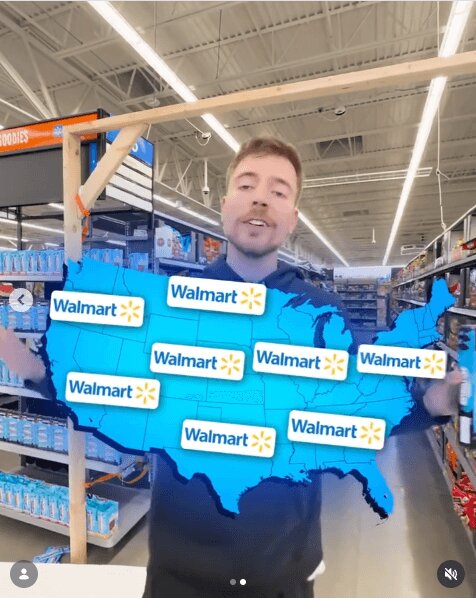
What started as creator merch is now a legitimate CPG contender, sitting on shelves at Walmart, Target, and 7-Eleven.
But as the brand matures, the ecommerce site’s role is changing.
It no longer just needs to handle viral traffic spikes.
It needs to convert that attention into repeat customers and long-term loyalty.
#1 Page Load Speed
👉 Viral traffic only matters if the site loads fast enough to convert it.
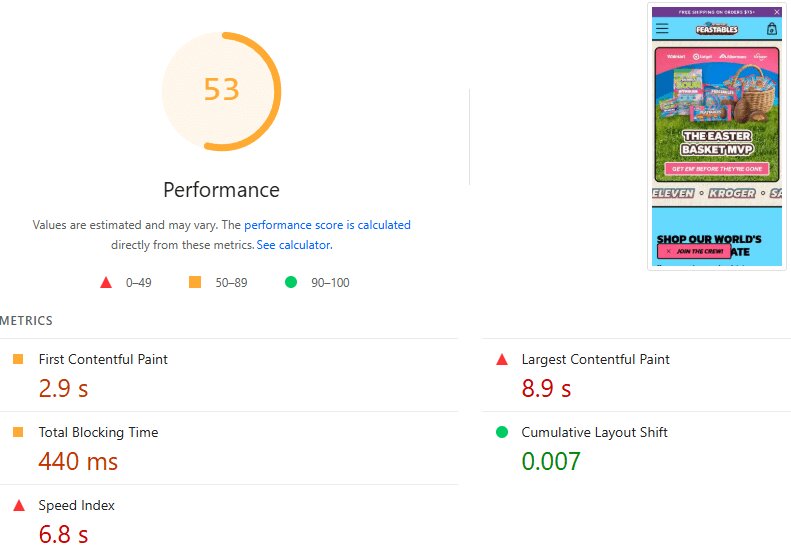
Feastables regularly experiences viral traffic spikes.
The site relies heavily on animations, layered images, and video assets, which can slow performance on mobile, where most traffic occurs.
The main pressure point appears to be Largest Contentful Paint (LCP).
If the main visual takes longer than ~2.5 seconds to load, abandonment rises sharply.
💡 Pilothouse Tips:
✅ Conduct a Technical Audit: Look into the site's JavaScript and third-party apps to improve Core Web Vitals, specifically targeting the Interaction to Next Paint (INP) score.
✅ Edge Delivery & Asset Optimization: Ensure all video hero banners are served via optimized formats (like WebM or AV1) and utilize "Priority Hints" for the main CTA buttons.
✅ Mobile-First Skeleton Screens: During massive giveaways or drops, implementing "skeleton screens" keeps users engaged while the heavy assets load, reducing bounce rates during the critical first 3 seconds.
#2 User Experience
👉 The site still behaves like a “limited drop” store instead of a repeat snack brand.
The Feastables site has a high-energy interface that aligns well with Gen Z aesthetics.
Bold colors, playful typography, and dynamic visuals reflect the brand’s personality and the MrBeast ecosystem.
As the brand matures, the site experience may need to evolve from a “limited drop” mindset to a “daily snack” mindset if the goal is to increase repeat purchases.
One opportunity is shifting the navigation toward bundles and multi-pack purchases.
The site emphasizes individual bars, but bundles and variety packs typically drive higher AOV for CPG brands.
The main navigation could highlight options like:
These formats naturally increase AOV while making the purchase feel more fun and shareable.
Taste is also a central brand promise. The UX could reinforce this further by highlighting flavor profiles and taste experiences, not just product images.
💡 Pilothouse Tips:
✅ Gamify Purchase Experience: Checkout and cart experiences could include progress-based incentives such as: “Unlock a Mystery Flavor”
or “Add one more bar to unlock a Secret Beast Reward.”
Turning the purchase journey into a challenge aligns directly with the playful competitive energy of the MrBeast universe.
#3 Collection Pages
👉 The current site architecture prioritizes speed, but sacrifices discovery.
The site architecture is currently very lean, which makes sense for a brand with a relatively small SKU count.
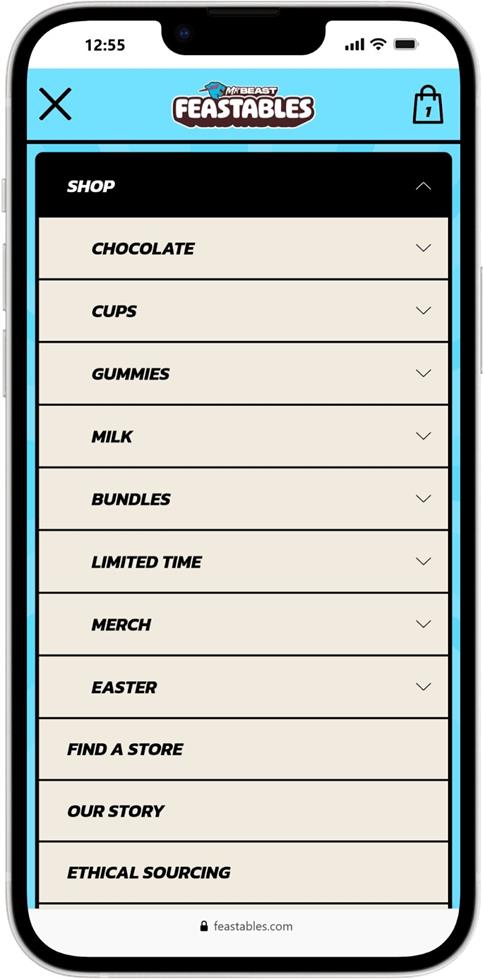
Navigation is organized by product category:
This clarity helps users find products quickly. However, the site moves users almost immediately from the homepage to individual product pages. While this reduces clicks, it also limits opportunities for discovery and browsing.
Introducing more strategic collection pages could improve both navigation and conversion.
For example: Flavor-Based Collections
Instead of a single “Chocolate” page, Feastables could create dedicated collections for top-performing flavors. (e.g. Peanut Butter)
If someone searches specifically for the peanut butter bar, landing on a broader chocolate page that includes unrelated flavors can create friction.
A dedicated collection allows for a more focused experience.
💡 Pilothouse Tips:
✅ Create Flavor-Specific Pages: This allows for stronger storytelling and social proof. Example: “The #1 Rated Peanut Butter Chocolate on the Planet.” These pages can highlight: flavor-specific reviews, creator reactions, etc.
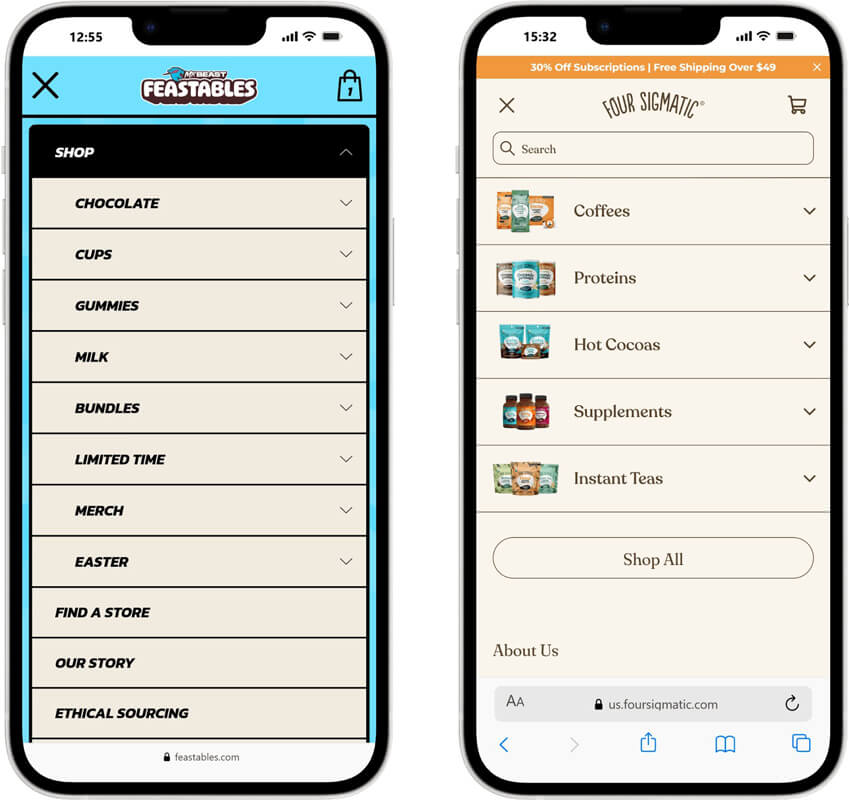
They could do an A/B test by reducing the number of menu links and adding images to each link on mobile.
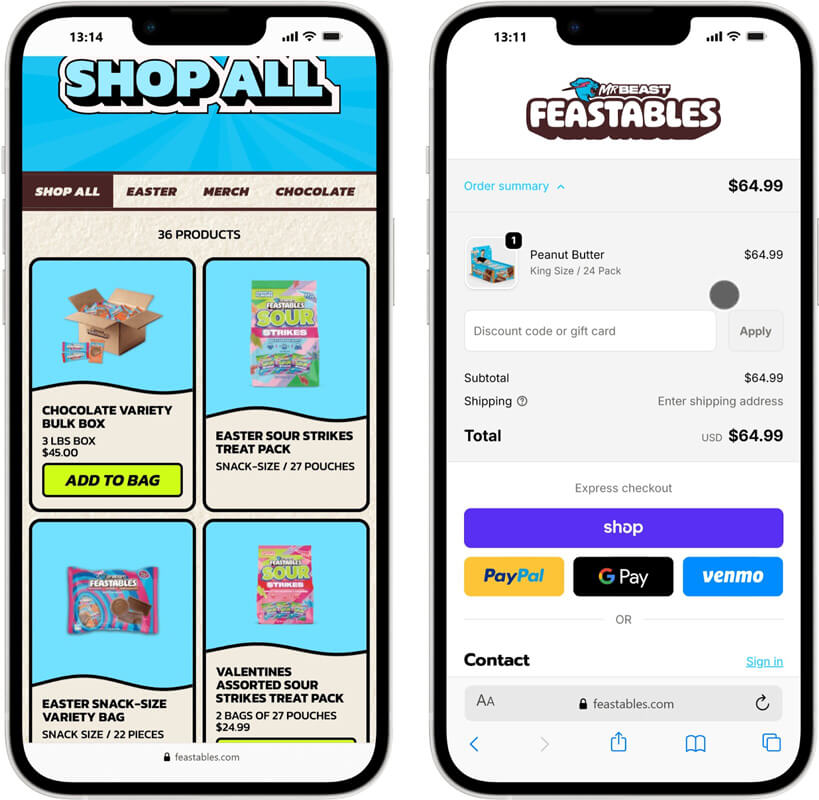
High-converting collection pages also typically include:
• Quick add buttons
• Subscription toggles
• Lifestyle filters (e.g., Plant-Based, Most Viral)
• Visible reviews
• Promotional badges
Feastables built its early momentum through creator distribution.
But turning creator content into consistent revenue is where most brands struggle.
Here’s what the data says.

‼️ 71% Of Consumers Buy Within Days of Seeing Creator Content
Whitelisting, Spark Ads, Partnership Ads—whatever you call them, one thing is certain: they are crushing it for 2026 and minisocial is at the forefront of making them work. 🚀
Creator-led ads, whatever specific flavor you choose, are performing. Meta reported that 71% of consumers say they make a purchase within a couple of days after seeing creator content. 🛍️
Partnering with minisocial they’ll connect you with high-quality creators, manage the process, AND have the usage rights baked-in for whitelisting.
Brands like Instant Hydration, Ayoh!, MadeGood, and Rocksbox already trust minisocial for creator-made content that drives real results. 📈
👉 Ready to see results?
Work with the team that's been doing UGC since 2018.
* sponsored

#4 Subscribe & Save
👉 For CPG brands, the second purchase is the real revenue driver.
For most CPG brands, long-term revenue comes from repeat purchases.
Subscription is a major opportunity in the consumables space.
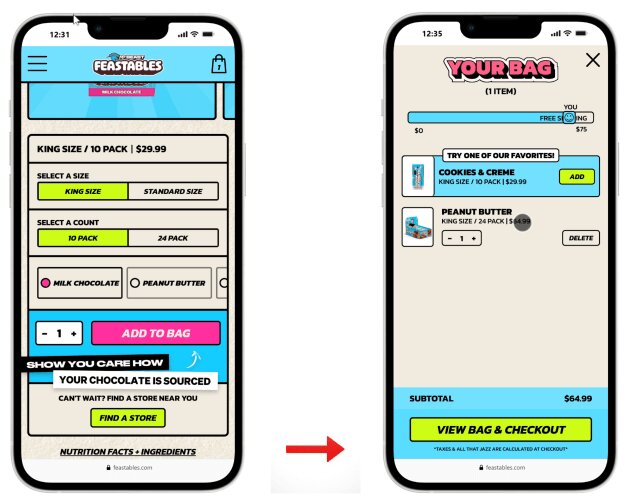
A simple tweak Feastables could make:
The subscription option could be pre-selected with a value-driven message like: “Never run out of chocolate.”
If customers choose not to subscribe on the product page, the option can appear again in the cart.
There is currently unused space between the cart items and the checkout button where this offer could be surfaced again.
💡 Pilothouse Tips:
✅ A/B Test Color: Because the Feastables palette already uses vibrant blues and pinks, the subscription CTA could benefit from a contrasting “action color” such as yellow or teal to visually separate it from one-time purchases.
✅ A/B Test Quantities: Testing larger bundles (12, 24, 48 packs) can anchor value and push customers toward mid-tier options.
#5 Social Proof
👉 Creator credibility is powerful, but food brands still need taste validation.
Having Jimmy Donaldson himself featured on the site and in marketing campaigns is an enormous trust signal.
But for a food brand, new customers still want confirmation from other consumers that the product tastes great.
Strengthening customer-driven proof could further increase conversion rates.
UGC video reviews could reinforce product quality and taste.
💡 Pilothouse Tips:
✅ "As Eaten By" Social Proof: Community-driven signals could reinforce the feeling of being part of the “Beast community.” For example, a “Community Favorite” badge on top flavors.
✅ Real-Time Purchase Notifications: Use subtle "Proof" popups showing "Someone in Chicago just bought a Variety Pack!" This creates a sense of community and drives the "Fear of Missing Out" (FOMO).
#6 Capture "Retail-to-Digital" Intent
👉 Retail discovery should funnel customers back into owned channels.
Many customers first encounter Feastables in retail environments like Walmart or 7-Eleven.
The website can act as a bridge for these shoppers.
For example, if a visitor searches for a flavor that is unavailable online, the site could automatically present a “Find Near Me” store locator.
This creates a seamless omnichannel experience rather than a dead end.
💡 Pilothouse Tips:
✅ QR Code Landing Pages: adding QR codes on packaging could direct customers to dedicated landing pages.
These pages could offer digital-only bundles, secret flavors, and limited online drops
This approach converts offline purchases into long-term digital relationships.
#7 Post-Purchase Flow
👉 The thank-you page is the highest-intent moment most brands waste.
The thank-you page is one of the most underutilized opportunities in ecommerce.
Customers who just completed a purchase are at their highest level of engagement. Feastables could be doing more here to win over customers and raise AOV.
💡 Pilothouse Tips:
✅ Introduce One-Click Upsells: Immediately after checkout, offer a low-friction add-on such as:
These impulse offers often convert well because payment information has already been entered.
✅ Add Retention Loop: The post-purchase experience could also invite customers to join the MrBeast Discord group, subscribe to SMS alerts, or get early email access to upcoming drops.
This turns a single purchase into the start of a longer-term brand relationship.
Conclusion
Feastables has already solved the hardest problem in ecommerce: attention.
MrBeast’s audience can drive massive traffic spikes overnight.
The next stage of growth is turning that attention into repeat purchases and long-term loyalty.
Small improvements to site speed, bundles, subscriptions, and post-purchase flows could significantly increase lifetime value — turning creator hype into a durable CPG business.
📥 Got a B2B Biz?
Join dozens of B2B companies finding demand-gen success through our niche community of 150k brand leaders and founders this year. Talk to our team to learn more.
DTC Newsletter is written by Rebecca Knight and Frances Du. Edited by Eric Dyck.
Please note that items in this newsletter marked with * contain sponsored content.
.svg)


.svg)


.svg)


.svg)
.svg)
.svg)