Good morning,
Here’s what you’ll find in today’s DTC:
1️⃣ Amazon puts an end to review halos. Here’s how sellers can pivot
2️⃣ How to turn one-time buyers into high-LTV subscribers
3️⃣ Learn why Amazon is now a core acquisition and retention channel
You’re reading this newsletter along with new subscribers from: BAIE Wines, Snorkel Lifts, and Schuil Coffee. 👋

⭐ Amazon Eliminates The Review Halo Effect
If your Amazon strategy relies on variation listings to prop up new products or niche SKUs, you need to read this.
Launching a new model, a different material, or a new flavor and letting it piggyback on your hero product's 10,000+ reviews is no longer possible.
Pilothouse shares what's changing and how to pivot.
What's happening:
Amazon is rolling out a site-wide policy update (started February 12, completing May 31, 2026) that ends broad review sharing across product variations.
Previously, sellers grouped child ASINs under a parent ASIN so a new product could instantly inherit the review count of your best-sellers.
That's going away.
Amazon is now decoupling reviews so they reflect only the exact product a shopper is viewing. Reviews will only be shared between variations with purely cosmetic differences like color or pack size.
What's affected? These attributes will now force child ASINs to stand alone with their own reviews:
What this means for your business:
The review halo is gone. New SKUs must earn their own reviews from scratch.
A new flavor launches with zero and looks completely unproven to shoppers.
Weak variants get exposed. Niche SKUs that survived by blending into a parent listing's 4.6-star average will now show their true, isolated ratings. Expect conversion rates to drop.
Launch costs go up. Without the parent listing's reviews as a cushion, new ASINs require more upfront investment to gain traction.
The silver lining? Your competitors lose their review halos too. Those dominant listings crushing your newer products are about to get fractured — instantly leveling the playing field.
What to do now:
1️⃣ Audit your catalog. Identify which listings have already been affected and prioritize those first.
2️⃣ Break up forced variations. Split loosely related child ASINs you bundled together just to pool reviews.
Without shared reviews, separate listings capture more search real estate anyway.
3️⃣ Cut the dead weight. If a low-converting child ASIN was only surviving on the parent listing's review count, remove it.
4️⃣ Offset the zero-review penalty. Your hero ASIN will still drive traffic, but shoppers clicking to newer child ASINs will see bare listings.
Invest in Vine and use aggressive discounts to kick-start the flywheel on new variants.
5️⃣ Hyper-optimize each child ASIN. Variations can no longer coast on shared social proof.
Every child ASIN needs its own tailored images, video, and A+ content, speaking directly to that specific product.
The takeaway?
Amazon's review decoupling is the biggest structural shift to variation strategy in years and it rewards sellers who have already done the work.
Brands with strong fundamentals, optimized individual listings, and a willingness to invest in new launches will come out ahead.
Treat this as an opportunity to clean up your catalog and double down on quality over quantity.

Blind Boxes, Busy Parents, and Building Subscription Brands
Subscription brands sound great on paper.
Recurring revenue, higher LTV, predictable growth…
In reality? You’re asking customers to commit before they fully trust you.
In this episode, Aves breaks down what actually makes subscription brands convert and why most fail when they lean too hard on product and not enough on behavior.
You’ll learn:
🚀 How to Scale Amazon in 2026: 3 Data Plays DTC Brands Are Still Missing
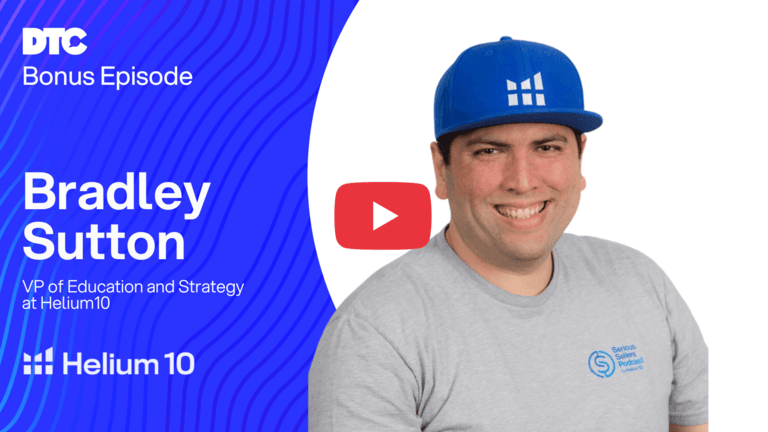
Bradley Sutton, VP of Education and Strategy at Helium10, joins the DTC podcast to share why brands should think about Amazon not as a backup channel but as a core retail growth engine.
We get into where Amazon fits in an omnichannel stack, how PPC has become way more complex, and where sellers can actually use AI for efficiency.
🚨 Amazon doesn't have to eat your margins—Sign up for Helium 10's highest-tier plan for $1 (48 hours only, normally $359/mo). * ⏰
In this episode, we cover:
* sponsored
Are Trump’s tariffs returning? Treasury Secretary Scott Bessent suggests Trump’s tariffs may be restored by July after the Supreme Court setback. Read more →
Nutella’s delicious new offering. The brand debuts Nutella Peanut, its first new flavor in over 60 years. Read more →
Loop raises $95M. The new funding will help the company scale its AI platform across the supply chain. Read more →
📥 Got a B2B Biz?
Join dozens of B2B companies finding demand-gen success through our niche community of 150k brand leaders and founders this year. Talk to our team to learn more.
Don’t forget to rate the DTC Podcast on Apple (⭐️⭐️⭐️⭐️⭐️)
DTC Newsletter is written by Rebecca Knight and Frances Du. Edited by Eric Dyck.
Please note that items in this newsletter marked with * contain sponsored content.
.svg)


.svg)


.svg)


.svg)
.svg)
.svg)