Good morning,
Here’s what you’ll find in today’s DTC:
1️⃣ A quick note about our podcasts
2️⃣ Are you in the tactical spin cycle? Use this to get out
3️⃣ How cult brands like Rhode master the art of selling identity
You’re reading this newsletter along with new subscribers from: GoodBites, Green Ferret Golf, and Cobb Industrial Fabricators. 👋

👂 Are You Listening?
Hey, it’s Rebecca, Content Director here at DTC! 👋😊
In case you don’t already know, I just wanted to take a quick sec to share that we have three (‼️) podcasts you can check out if you’re looking for more content.
1️⃣ If you’re looking for brand stories, real operator insights, and tactical insights and ideas you can apply, check out the DTC Podcast.
2️⃣ If you’ve been searching for foundations, frameworks, and ways to ensure your email and retention program is working as hard as it should be, tune into The World’s Best Email and Retention Podcast.
3️⃣ If creative is your jam, Ad-venturous is the show for you. Hear creative strategies, approaches, and how ads and culture intersect.
Happy listening!
- Rebecca
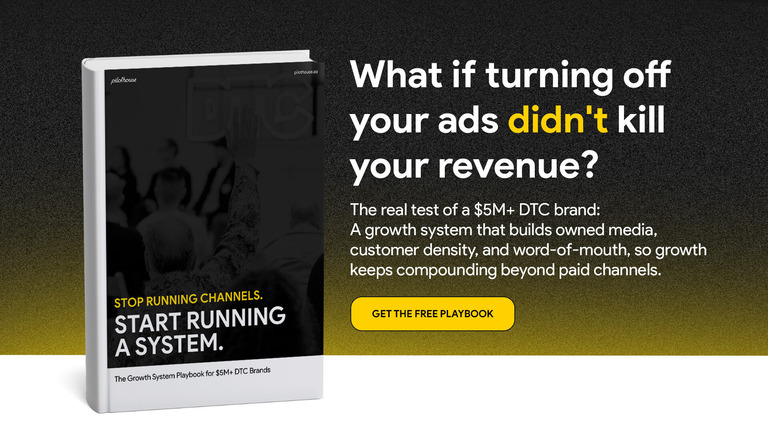
👇 If You Run or Work at a DTC Brand, You Need to Read This
Working harder, testing more, and optimizing everything… while performance stays flat or slowly gets worse.
That’s the tactical spin cycle.
Sound familar?
Most $5M+ brands aren’t stuck because of execution, they’re stuck because they’re solving a strategic problem with tactics.
Pilothouse (DTC’s sister company) pulled together this playbook from working with 200+ ecommerce teams to help you STOP running channels and START running a system.
Inside:
Use it to see what’s actually broken and how to fix it.
📸 How Cult Brands Sell Belonging, Instead of Just Products
Have you ever wondered why some customers stay loyal to certain brands despite the hefty price point?
Because some brands have mastered the art of selling, not just a product, but a sense of belonging.
And here’s how you can too:
1️⃣ Product is just the entry point
The decision to buy goes far beyond specs, ingredients, or features.
Cult brands understand they must position themselves as a customer brand, not a category brand.
The category is what they sell.
The customer brand is who they attract.
People aren't just buying a skincare product, a gym bag, or a pair of sneakers.
They're buying access to a community, an aesthetic, and a clear identity.
The product is the ticket in, but the world the brand has built is what keeps people coming back.
The key to building a cult brand? Start with a niche, earn their trust, and treat your early followers like founding members, not just customers.
Keep the conversation loop open: ask questions, respond to feedback, make them feel seen.
Brands that do this well tend to be highly specific early on. They know exactly who their customer is, what that person values, and what it means to be part of their world.
2️⃣ Showing off is part of the value proposition
Hailey Bieber built a billion-dollar skincare brand in just a few years because she understood what her customers actually wanted.
Take the Rhode phone case, for example. The Rhode lip phone case looks like merch. But it's really a UGC machine.
She recognized her customers didn’t just want to use the lip tint. They wanted to be seen using it.
A phone case designed to display the product during selfies was the perfect solution.
It turned loyal customers into walking billboards, and the organic content it generated was worth far more than any paid campaign.
The same thinking powered their recent collaboration with Justin Bieber on the Spotwear pimple patch launch.
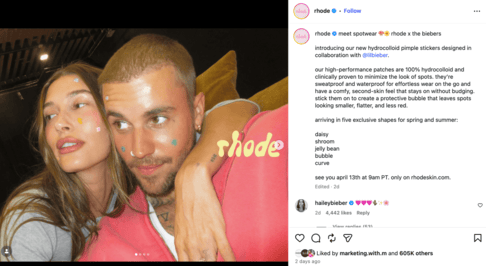
Instead of treating acne as something to hide, Rhode reframed it entirely.
Customers are now drawing attention to their skin with colorful patches, wearing them proudly, and often with their partner.
What could've been a niche skincare product became a statement about self-expression and shared self-care.
This kind of innovative thinking is what separates cult brands from the rest of the pack.
When you buy Rhode, you're not just using a product. You're participating in a cultural moment.
3️⃣ Word of mouth follows identity more than quality
People recommend things that make them look good.
When your brand has a clear identity signal, recommending it carries a personal upside for the person sharing it. It says something about their taste, their values, their world.
If your brand has no distinct identity, you're essentially asking customers to do free marketing for you with zero personal return.
That's a hard sell.
But when recommending a brand is a form of self-expression? When saying "I love this brand" is the same as saying "this is who I am,” word of mouth becomes effortless and organic.
4️⃣ Belonging drives repurchase
First-time buyers are product-motivated.
But repeat customers? They're almost always identity-motivated. They've decided this brand is part of who they are.
When a customer sees a brand as an extension of themselves, price stops being the primary decision driver.
That shift is huge for retention and lifetime value.
Loyalty programs and discounts can keep customers around. But identity is what makes them stay without incentives.
The takeaway?
People don't just buy products. They buy a piece of their identity.
Cult brands understand that and create meaning by tapping into emotions and cultural demand. To do that too, you need to make customers feel something that goes far beyond the transaction.
Meet Meta’s Muse Spark. The new multimodal AI model boasts ‘competitive performance’ on various tasks, Meta stock jumps 6.5% after its release. Read more →
Abercrombie x Sperry. The two brands revived a partnership from the 1930s, releasing limited edition apparel and boat shoes. Read more →
Grüns Acquisition. Unilever purchases the fast-growing supplement brand for an undisclosed amount. Read more →
📥 Got a B2B Biz?
Join dozens of B2B companies finding demand-gen success through our niche community of 150k brand leaders and founders this year. Talk to our team to learn more.
Don’t forget to rate the DTC Podcast on Apple (⭐️⭐️⭐️⭐️⭐️)
DTC Newsletter is written by Rebecca Knight and Frances Du. Edited by Eric Dyck.
Please note that items in this newsletter marked with * contain sponsored content.
.svg)


.svg)


.svg)


.svg)
.svg)
.svg)