SPONSORED BY:


Good morning to everyone except the brand that sent a creator a one-sentence brief and then wondered why the video failed to perform,
Your CGC briefs are the reason your creator content isn't converting.
Most brands treat creator briefs like a formality. The ones scaling past seven figures treat them like a performance document. Today, we're sharing the system and the 3 specific brief elements separating winning content from expensive mistakes.
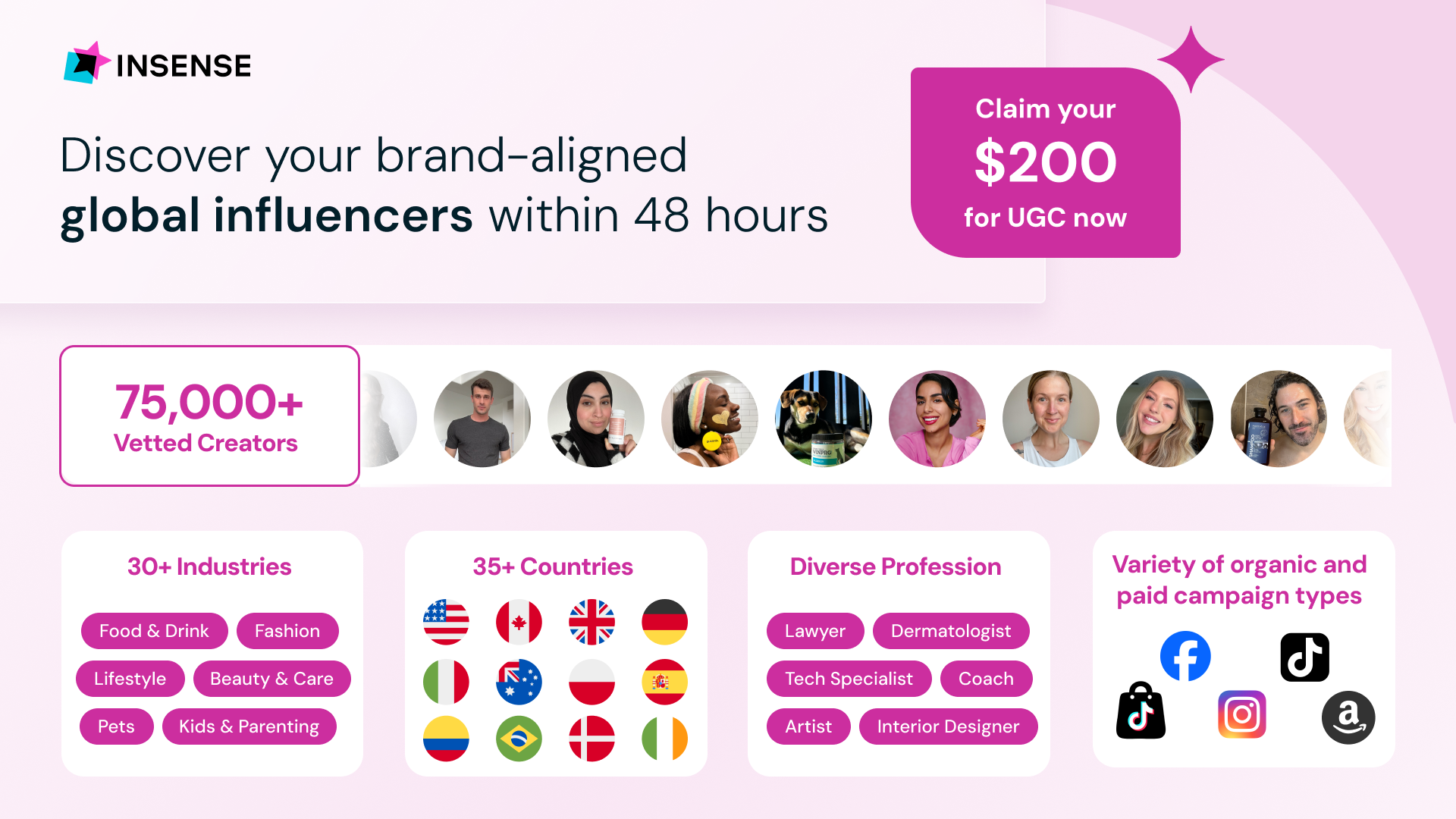
⚡ Save 40+ Hours On UGC Sourcing And Influencer Campaign Management
Are you tired of wasting time contacting influencers who don’t respond to your DMs?
💡 Listen up: There’s a simple way to grow your brand awareness with influencers while sourcing high-quality UGC content, for organic & paid social, within 14 days from responsive creators.
👉 Join major DTC marketing teams like Obvi, DRMTLGY, and JLO Beauty using Insense.
Plus, book a free strategy call by March 13 and get $200 for your first UGC campaign.
* sponsored
📸 The Brief Is the Strategy: How to Write CGC Briefs That Actually Drive Performance
Back in 2020, you could shoot a video on your iPhone (no storyboard, no strategy, barely a concept) and it would perform.
Not because the content was exceptional. Because the platform was forgiving. Meta's algorithm rewarded volume over precision, and almost anything with a creator’s face and a product could crack a CPM.
That era is gone. Today, the single thing holding back your creator content is your brief. The document you hand to an external creator before a single frame is shot.
Get it wrong and you've wasted budget, time, and a creator relationship. Get it right and you have a repeatable system for performance creative that scales.
People think CGC is easy to generate at scale. It’s actually one of the hardest things to get right. And the brief is where most brands blow it before the creator ever picks up a phone.
So what makes a brief actually work?
Here are the three steps that most brands skip entirely.
THE BRIEF IS A PERFORMANCE DOCUMENT
Step 1: Set your intention. If you don't know your audience segment, your funnel stage, and the specific angle you're testing…you have no business briefing a creator yet.
Know your persona, know what product you're selling them, and know what has already worked at the hook level.
If it's a coffee mug at the top of funnel, you're doing something eye-grabbing. Mid-to-bottom-of-funnel should lean on USPs, functionality, and social proof. At the bottom of the funnel you're showing the lid screwing on leak-proof. Different briefs. Same product.
And don’t fall into this trap: using creator content to test net-new concepts when you don't know if the angle works.
Save CGC for concepts you have reason to believe in.
Step 2: Over-contextualize. Assume your creator knows nothing and cares even less. This is the mindset shift that separates functional briefs from great ones.
You have months or years of brand context in your head. Your creator has only whatever you put in the document.
So your brief should include: the exact visual hook and how to execute it, the product's top 2–3 benefits in natural conversational language (not spec-sheet language), and the words and phrases your brand uses versus the ones you'd never say.
Don't just send a top-performing ad and say "do this." Call out specifically what's working and why the creator should replicate that element. "There's a really fine line between over scripting and being too prescriptive, but for the first three to five seconds, be exceptionally clear."
After the hook, give them the freedom to speak in their own voice within the guardrails you've set.
Step 3: Brief visual hooks, not audio hooks. This is the tactical update that's changed how Aves approaches creator briefs over the past six to eight months. Historically, you'd brief three versions of the same shot with different voiceovers. For example: "I love this mug" vs. "I got this as a gift." Meta used to reward that kind of variation. It no longer does.
Meta's Andromeda system now rewards visually distinct creative in the first three to five seconds. So instead of three audio variants on the same setup, brief three completely different visual scenarios: holding the mug, pouring coffee into it, and packing it into a work bag. Same product. Same copy. Three distinct visual worlds.
"Three visually different ads give me more results than three audio hooks. And most people on Meta don't even have sound on."
Visual variation doesn't just improve deliverability. It surfaces meaningful angles.
The "holding the mug" creative speaks to identity.
The "pouring coffee" creative speaks to morning ritual.
The "packing the bag" creative speaks to the busy professional.
You're not just testing hooks. You're testing positioning.
✂️ The 5-Part CGC Brief Framework (Use This Before You Brief Any Creator)
1️⃣ Set the intention first. Define: persona → product → funnel stage → angle that's already proven. If any of these are blank, don't brief yet.
2️⃣ Specify the visual hook exactly. Call out what works and why. This visual performs best for us in the first 3 seconds.
3️⃣ Give language in natural form, not spec form. Give them the feeling, not the feature.
4️⃣ Brief 3 visual hooks, not 3 audio hooks. Each should represent a visually distinct scenario: different setting, different action, different context. This is how you get real learning from Andromeda.
5️⃣ After the hook, give them freedom within guardrails. Script the first 3–5 seconds tightly. Then: "After the hook, please touch on [point A] and [point B], in your own voice." This preserves authenticity without sacrificing performance.
TikTok Shop is growing fast globally. A recent report reveals TikTok Shop could be a top global retailer by 2030. Read more →
The AI wars heat up. Anthropic accuses DeepSeek of creating 24K fake Claude accounts to train their own models. Read more →
Update’s rebrand. Kim Karadshian joins the functional energy drink company as a co-founder. Read more →
How BrainGain Scaled Heavy Home Gym Equipment to 30 Countries
Kareem Raslan, co-founder of BrainGain, shares how he went from selling dumbbells in his garage during COVID to accumulating over 100K customers.
He shares the 3PL strategies that cut their fulfillment costs, and why they’re saying no to TikTok influencers and going all in on YouTube, plus more.
▶️ Watch on YouTube | 🎧 Listen on Spotify
Don’t forget to rate the DTC Podcast on Apple (⭐️⭐️⭐️⭐️⭐️)
📥 Got a B2B Biz?
Join dozens of B2B companies finding demand-gen success through our niche community of 150k brand leaders and founders this year. Talk to our team to learn more.
You’re reading this newsletter along with new subscribers from: Lumingle, Eternal Skin Care, and Mainland Whisky. 👋
DTC Newsletter is written by Rebecca Knight and Frances Du. Edited by Eric Dyck.
Please note that items in this newsletter marked with * contain sponsored content.
.svg)


.svg)


.svg)


.svg)
.svg)
.svg)