Good morning to everyone except sound-on video ads that assume everyone's watching with headphones in,
What a $125M snack brand's Michelin chef collab can teach you about authority-based creative.
IQBar landed one of food's most prestigious partnerships. We break down their four Meta ads to show exactly how to turn authority into conversion — and where most brands leave that equity on the table.
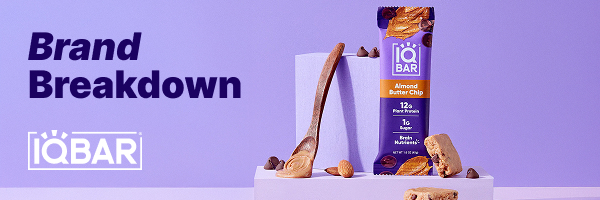
How to Turn Culinary Credibility Into Conversion: Lessons From IQBar's Thomas Keller Campaign
IQBar sells snack bars built for your brain, not just your body — clean ingredients, low sugar, no mid-afternoon crash. The brand has grown fast, and their latest partnership signals they're playing a bigger game: they've teamed up with Thomas Keller, the three-Michelin-star chef behind The French Laundry, to co-create new flavors.
Landing a Keller collab is a major get. A partnership like this gives a challenger brand something most can't buy outright: immediate authority in a category full of noise.
So how do you make the most of it in paid media? That's the question worth asking — and IQBar's four current Meta ads give us a lot to learn from. Two execute the authority transfer brilliantly. Two show where the opportunity is still wide open.
The Four Ads, Broken Down
1️⃣ "Use Your Brain, Babe"
Awareness-builder with strong personality — conversion work still ahead
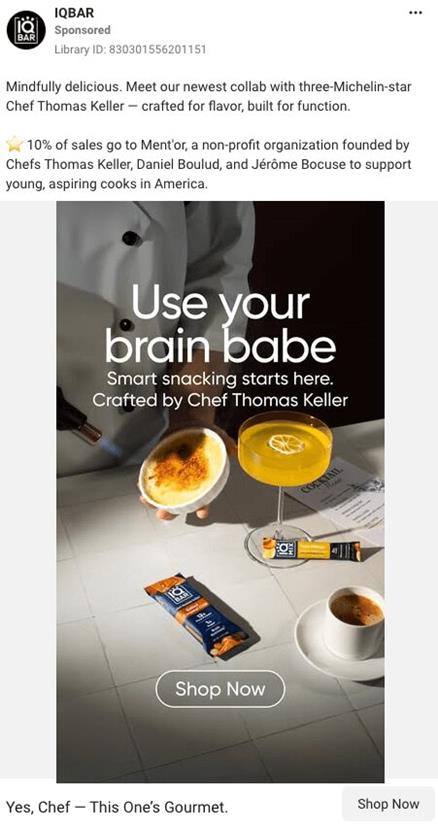
The headline has real personality — playful, confident, culturally fluent. The “Yes, Chef” cue transfers authority instantly. The visuals are premium.
This is a strong brand-building asset. It earns attention and signals quality. For a first-time viewer, it plants the flag: IQBar is a brand with a point of view.
The opportunity: pair this awareness energy with specificity. A first-time buyer has real questions — Does it taste good? Why does a Michelin-starred chef care about a protein bar? Answering even one of these in the creative moves it from awareness asset to acquisition asset.
✅ What Works
Strong brand personality. Premium visual signal. Instant authority cue through familiar kitchen language.
💡 The Opportunity
Add one functional claim or taste cue to bridge awareness to consideration. Don't make the landing page do all the conversion work.
2️⃣ "Yes, Chef!"
Strong stopping power — Keller's authority needs a "why" to close
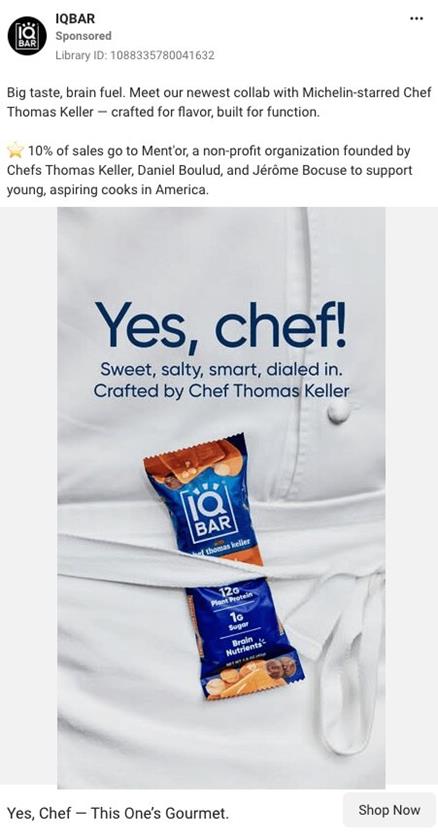
“Yes, Chef!” communicates authority in two words. The uniform locks in the premium signal. Scroll stopped.
What this creative does right: it borrows Keller's cultural weight and applies it to the brand. That's the first half of authority-based creative.
The second half — answering "Okay, but why did he actually choose this product?" — is where there's room to grow. Adding text overlays with even a single formulation detail or outcome claim turns consideration-building into acquisition-friendly creative.
✅ What Works
Excellent stopping power. Keller's authority lands immediately. Chef uniform context signals premium.
💡 The Opportunity
Give Keller a reason on screen. "Thomas Keller chose IQBar because..." is a sentence that converts skeptics.
3️⃣ The Keller Introduction (Video)
The partnership earns its keep — one execution tweak away from elite

This is where the creative starts to really work. Within three seconds, viewers get the full authority signal: Michelin plaque, white uniforms, professional kitchen. It feels like a different category from generic functional nutrition ads entirely.
This is also the first asset to name specific products — the Salted Caramel Chip Bar and the Yuzu Mango Hydration IQMix — and Keller explicitly frames IQBar as brain-and-body nutrition designed for long shifts. The prestige-to-product connection lands.
One refinement that would lift performance significantly: build for sound-off. The majority of Meta content is consumed on mute. Larger text overlays carrying the key claims would make this an all-conditions asset instead of a headphones-required one.
✅ What Works
Instant authority signal. Named products. Keller connects prestige to real-world use case (long shifts, brain performance). Feels premium and differentiated.
💡 The Opportunity
Increase text overlay size for sound-off viewers. Key claims need to land without audio — assume 60%+ of your audience is watching on mute.
⭐️ Taelor Rankin, Private Chef (Video)
The strongest asset in the rotation — and it doesn't feature Keller at all
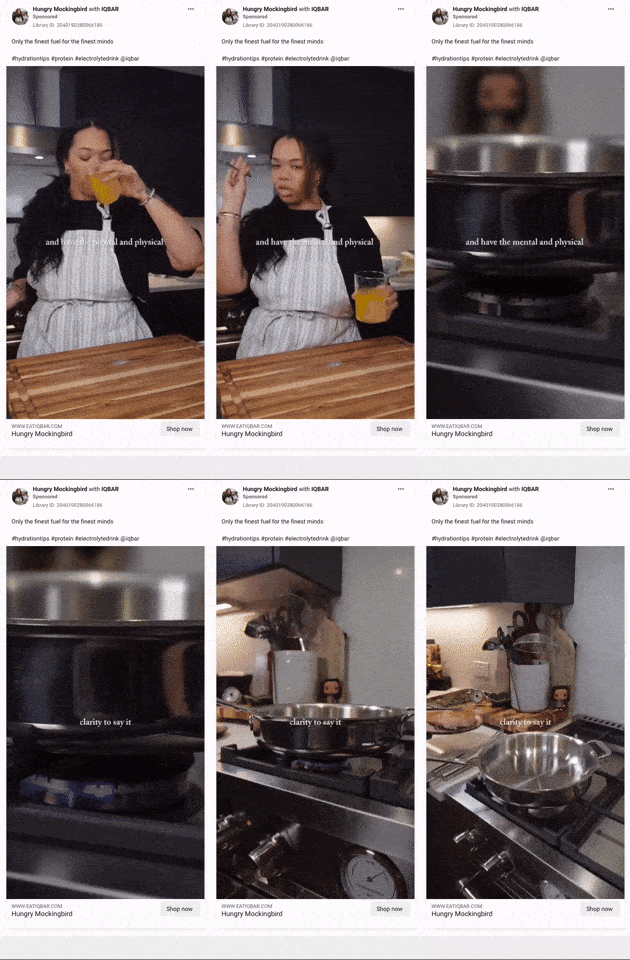
Private chef and internet personality Taelor Rankin talks about the physical and mental toll of cooking — and how IQBar helps her get through 12-hour days. The editing is fast and TikTok-native. The environment is real. The problem-solution loop is tight.
What makes this the standout: identity-level positioning. Rankin isn't just a testimonial. She's a proof point for a category IQBar could own entirely: hospitality workers as performance athletes.
The "Athletes of Hospitality" frame that surfaces briefly here is the single most powerful strategic concept in the current creative library. It's the kind of positioning that builds a community, not just a customer base.
✅ What Works
Real environment. Real tension. Fast, platform-native editing. Identity-level frame ("Athletes of Hospitality") that gives buyers a story to tell about themselves. This is what performance-first creative looks like.
Hospitality workers as performance athletes. That's not just an ad angle — it's a brand position IQBar could own for years.
The lesson across all four ads: authority without specificity is awareness, not acquisition. The Keller partnership delivers exactly what a high-profile collab should at the top of the funnel — credibility and cultural differentiation. The ads that convert are the ones that take that credibility and connect it directly to a buyer's real problem.
First-time buyers in the better-for-you snack category have predictable objections: taste skepticism, ingredient confusion, benefit vagueness. The strongest ads address all three by showing a real user in a real high-pressure environment getting a real outcome.
The winning brief practically writes itself: put Keller's craft in contact with real-world user pressure. Show the dinner rush. Show the focus that doesn't fade. Let the product be the bridge between prestige and performance.
The Prestige-to-Performance Creative Framework
Use this any time you're building ads around a high-authority partnership, collab, or endorsement.
1️⃣ Answer "Why them?" — Don't just feature the authority figure. Show the specific reason they chose your product: formulation, values, outcomes. Unstated authority is just a photo.
2️⃣ Build the functional bridge — Connect every prestige signal to a tangible benefit. "Michelin-starred chef" → "engineered for precision and endurance." The bridge is what converts.
3️⃣ Lead with the problem, not the person — Show the user's tension (fatigue, long hours, mental fog) before introducing the solution. Empathy before authority.
4️⃣ Build for sound-off — Key claims need to land without audio. Assume 60%+ of viewers are on mute. Large, legible overlays aren't optional.
5️⃣ Make the CTA specific — "Chef's Choice Kit" outperforms "Shop Now." Specificity signals value and continues the story the ad just told.
6️⃣ Frame around identity — Who is your buyer when they're at their best? Speak to that version of them. "Athletes of Hospitality" is a community, not just a demographic.
7️⃣ Check your visual hierarchy — The product is the hero, always. If the talent upstages it, reframe the shot.
Here's what the IQBar breakdown really reveals: most brands treat a high-profile partnership like a finished creative strategy. It's not.
A collab with Thomas Keller is an incredible differentiator — but it doesn't do the conversion work for you. You still have to answer the buyer's actual questions. You still have to connect the prestige to the problem.
What I keep coming back to is the Rankin video. It wins because it respects the buyer's reality. She's tired. She needs something that actually works. That's not a brand story — that's a performance brief.
The brands who figure out how to run both — the authority-building Keller content at the top, the identity-driven Rankin content at the bottom — are the ones who are going to own this category in two years. The raw material is already there.
What's the most underutilized authority asset in your current creative library? Hit reply — I'm genuinely curious.
You’re reading this newsletter along with new subscribers from: Love Logs, Dutchman’s Gold, and Bondi Sands. 👋
DTC Newsletter is written by Rebecca Knight and Frances Du. Edited by Eric Dyck.
* = sponsored. We only partner with tools we'd actually use. Items marked with * contain sponsored content.
.svg)


.svg)


.svg)


.svg)
.svg)
.svg)