.svg)


Back

Content


Content

.svg)
Welcome to the DTC family!
Oops! Something went wrong while submitting the form.
Back

SPONSORED BY:



Good morning.

Hi, we’re one of the emails. 👋
Have a great day!
Here’s what you’ll find in today’s newsie:
But first… 👇
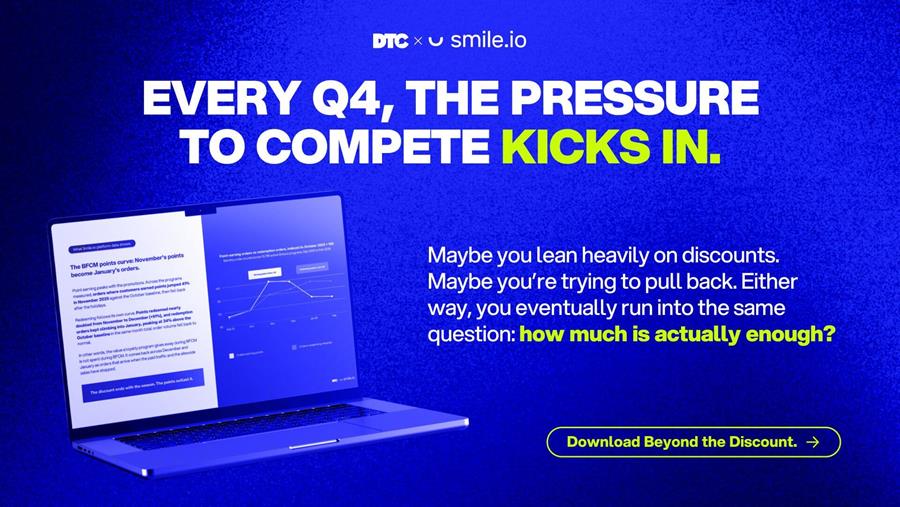
Beyond the Discount compares how 575+ DTC operators are approaching Q4 with what 700+ shoppers say earns their purchase.
Brands and shoppers have different numbers in mind. Shoppers most commonly say it takes 20 to 25% off to try an unfamiliar brand. The most common acquisition discount from brands is 11 to 20%.
The report follows that initial offer into retention. Across 10,766 active loyalty programs, Smile.io found that customers who redeem rewards have 3.1x the value and purchase 154% more frequently than those who never redeem.
Before you finalize your Q4 offers, check your discount depth, incentives, and retention plan against the findings. Download the free report.
*In partnership with Smile.io
Google Ads expanded its Data Strength guide this week, with more detailed steps for connecting customer data.
Three parts are worth a look before BFCM budgets go up:
@herrmanndigital shared six tests they’re running ahead of BFCM, spanning the storefront, offers, and campaign setup.
1. Rework the buy box. Test multiple buy-box layouts that feature a free gift with purchase. If the offer is part of your BFCM plan, figure out how prominently it needs to show up before traffic spikes.
2. Revisit incremental attribution. For accounts already using incremental attribution, compare different settings and see whether the setup is giving you the read you expect.
3. Loosen lifecycle exclusions. If an account is struggling, test removing lifecycle exclusions and compare the result against your current setup.
4. Give listicle headlines another run. Take listicle-style creative that has worked before and test new headline variations rather than rebuilding the whole concept.
5. Look at what upper-funnel activity does downstream. If you’re running awareness campaigns, check whether that activity is showing up later in the funnel. Don’t judge it only on the first click.
6. Test the offer before the sale. Run bundle and promotional-offer tests now so BFCM isn’t the first time shoppers see them.
You don’t need to run all six. Pick the test tied to an actual weakness in your account or storefront, choose the metric you’ll use to judge it, and leave enough time to use what you learn before BFCM.
Half of daily Snapchatters typically finalize their holiday wish lists before Halloween, according to 2026 Ipsos research in Snapchat’s new holiday guide. 48% start buying seasonal items before November.
Halloween is 17 days away.
The guide also says friends and private conversations play a big role in gift decisions. So put your giftable products out now, and make it obvious who each one is for. Give shoppers a line they can drop straight into the group chat.
You’re about to spend heavily to bring in a wave of new customers. The next job is getting them to come back after the promotion ends.
GetResponse brings email, SMS, and push into one lifecycle automation platform, so you can build the follow-up before Black Friday hits.
Set up post-purchase journeys based on what customers bought, cross-sell relevant products, and re-engage shoppers who haven’t returned. The follow-up runs automatically while your team handles the rest of Q4.
Give every Black Friday customer a reason to place order number two.
*Sponsored
A polished product shot can look great and still leave shoppers wondering how much of what they’re seeing is real. Generative AI is making that question more common.
Vida Glow handles that tension with a simple high-low rule: match the polish of the image to the type of proof on top of it.
Here are two Vida Glow ads, one for each half.
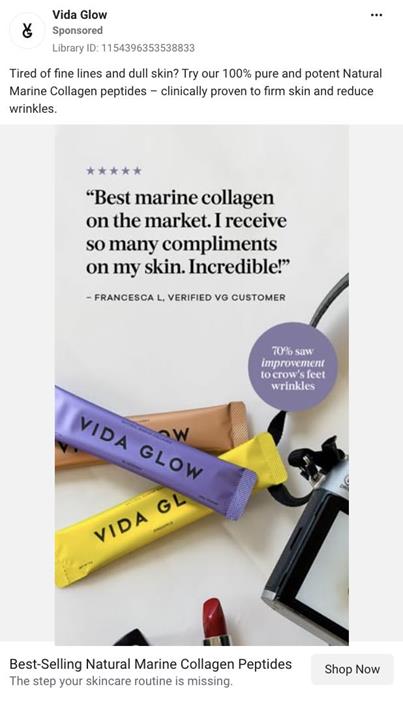
Collagen sticks sit beside a red lipstick and a compact camera. It reads like the inside of a handbag, which sells collagen on the go without a line of copy.
Over the photo sits a five-star review from a verified customer. The image is styled; the quote sounds like a person. A clinical badge closes it out: 70% saw improvement in crow’s feet wrinkles.
Where it fits: middle and bottom of funnel, for shoppers who know the brand and want evidence the claims hold up.
To make it work:
Low polish, editorial voice
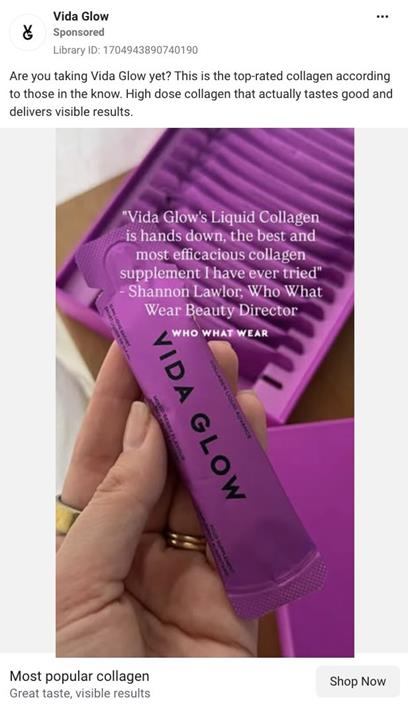
A hand holds one stick over the open box, shot on a phone. Over it, Who What Wear’s beauty director calls it the best collagen supplement she’s tried.
The handheld shot makes the product feel more everyday. The quote brings the authority.
Where it fits: top of funnel, where cold audiences need third-party credibility before they’ll listen to the brand. It’s also one of the fastest formats to produce.
To make it work:
Run the rule on your own account
Pull your current social proof ads and sort them into two piles by image polish. Then check the proof on each.
If your polished ads lean on press quotes, or your lo-fi ads lean on customer reviews, swap the overlay on one and test the new version against the original.
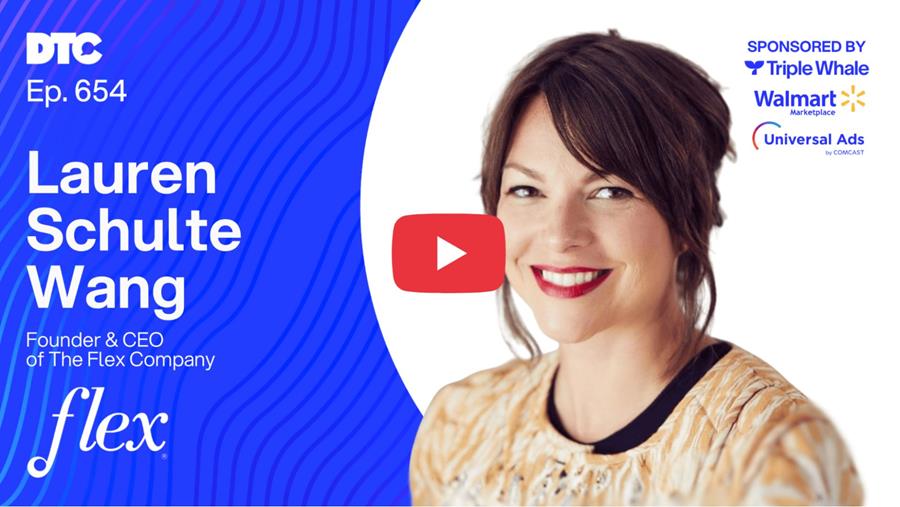
Flex was growing quickly as a DTC subscription business when customers kept telling founder Lauren Wang: “I wish I could buy this in retail.”
Customers needed replacements immediately when they ran out. Flex tested subscription quantities, delivery frequencies, and fulfillment options, but requests for retail availability kept coming.
Some investors questioned the move. Lauren followed a lesson from Y Combinator: stay close to your customer.
Lauren says retail now represents more than 60% of Flex’s revenue and is its fastest-growing channel.
▶️ Watch here | 🎧 Listen on Spotify
.svg)

.svg)


.svg)
.svg)