SPONSORED BY:



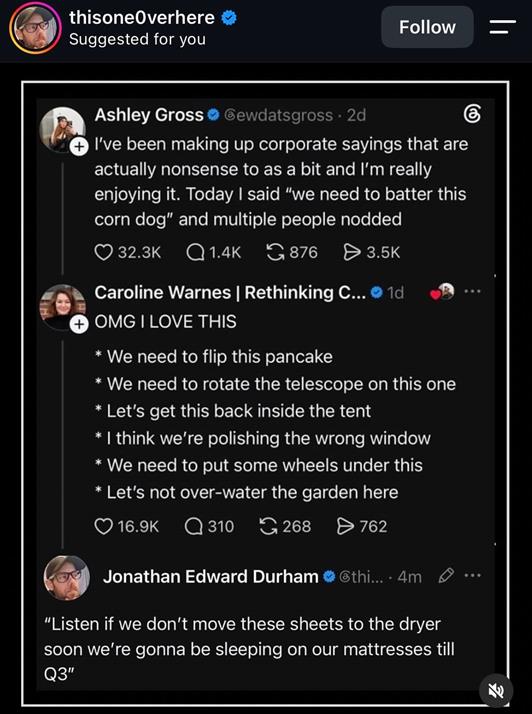
Good morning, happy Friday. Remember when let’s get this bread was a thing?
Anyways, here’s what's on the Friday menu:
🛒 ChatGPT adds bulk campaign tools
OpenAI is expanding ChatGPT Ads, with faster product campaign creation and deeper conversion reporting.
OpenAI’s latest API update also lets advertisers select click and view attribution windows. Reported conversion totals can change with those settings, even when impressions, clicks, and spend stay the same.
For brands testing the channel, easier setup could make a broader assortment more manageable. The reporting change deserves attention too: check your attribution settings before comparing performance across periods or platforms, so a change in how conversions are counted doesn’t look like a sudden improvement in results.
😅 Meta wants more creative. Again.
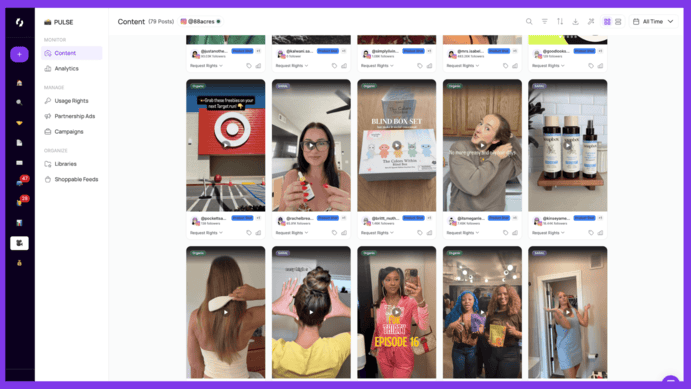
Your Meta account needs a steady supply of fresh ads. So “free creator UGC, only pay when you run it” sounds pretty good.
Then submissions pile up, the quality varies, and your team has to start looking for creators all over again.
SARAL helps you build a community of creators who keep making content for your brand.
Creators try your products, post to their own audiences, and earn commissions on the sales they generate. That gives them a reason to keep posting before you put paid spend behind their content.
Those posts can generate affiliate revenue on their own. You can also run the strongest ones as partnership ads on Meta or TikTok.
Grüns, Obvi, Proactiv, and 200+ brands use SARAL to manage their influencer programs.
DTC readers can claim an exclusive 14-day free trial by booking a demo below.
* sponsored
📹 Put paid reach behind a creator’s IG livestream
Instagram Live Video Ads let brands amplify a creator’s live content as a Partnership Ad, expanding a format already available on Facebook.
For brands planning BFCM demos, launches, or creator events, this offers a way to bring more people into the broadcast beyond the creator’s existing audience.
Start with a creator who can explain the product and answer questions naturally. Set a clear offer and destination, then measure purchases and acquisition cost alongside live engagement to see whether the extra distribution earns its budget.
📊 Shopify lets you explain the weird spike in your dashboard
Shopify merchants can now add annotations directly to supported Analytics reports, including titles, descriptions, dates, and custom categories.
Mark campaign launches, creator posts, promotions, stockouts, and site changes as they happen, so the next reporting review doesn’t start with everyone trying to remember what happened three Tuesdays ago.
❗ FTC investigates AI safety risks
The FTC is investigating OpenAI, Anthropic, and other AI companies over potential risks their technology poses to consumers.
The agency confirmed the investigation as AI developers face scrutiny over agents acting beyond their instructions, including incidents involving external websites.
Reuters reports that the FTC plans to demand information and executive testimony. The investigation has not established wrongdoing.
For operators connecting AI agents to storefronts, customer records, or payment tools, review what each agent can access and which actions require approval before expanding its role.
🎁 Your holiday buyer may be someone new
As @natelagos points out, gifting season changes who your creative needs to convince. The person buying may be a partner, parent, or friend shopping for your usual customer.
That buyer needs help choosing something the recipient will love, plus reassurance that they’re making a thoughtful choice.
For BFCM and Christmas, Nate recommends:
Review your creative and product pages: do they help someone buy for another person?
🫒 Six ways Graza can squeeze more from every visit
Graza was founded in 2021 and launched Drizzle and Sizzle in January 2022. Its chef-inspired squeeze bottles gave the products a recognizable format, while the playful branding brought a more casual personality to the olive oil aisle.
Today, Graza has several strong conversion levers: a clear product system built around Drizzle, Sizzle, and Frizzle, more than 4,500 onsite reviews, and refill products designed for repeat purchases.
Some of those strengths get limited space at key points in the shopping journey. The Pilothouse CRO team identified six tests heading into Q4, focused on offer structure, product education, and where important information appears.
1. Give the Duo a bundle-exclusive incentive

The Duo costs $37, the same as buying the $21 Drizzle and $16 Sizzle separately. Right now, the one-time purchase doesn’t include a price advantage for buying the bundle.
Pilothouse recommends testing one bundle-exclusive incentive, such as a margin-approved price reduction or a useful add-on that isn’t available with either bottle alone.
If Graza tests a discount, show the individual total, bundle price, and exact savings beside the purchase controls so the value is easy to understand.
Pilothouse test: Compare the current $37 Duo with:
Measure Duo conversion rate, bundle take rate, gross profit per visitor, and AOV.
The $69 Starter Kit page explains the difference between Drizzle and Sizzle, then ends with a “Shop this Classic Kitchen Duo – $37” button.
That final CTA points shoppers toward a product that costs $32 less. If someone is already evaluating the larger kit, sending them to the Duo could pull attention away from the higher-value offer.
Pilothouse recommends testing a Starter Kit value stack that shows what’s included, the combined individual price, the kit price, and the estimated usage period for a defined household or cooking frequency.
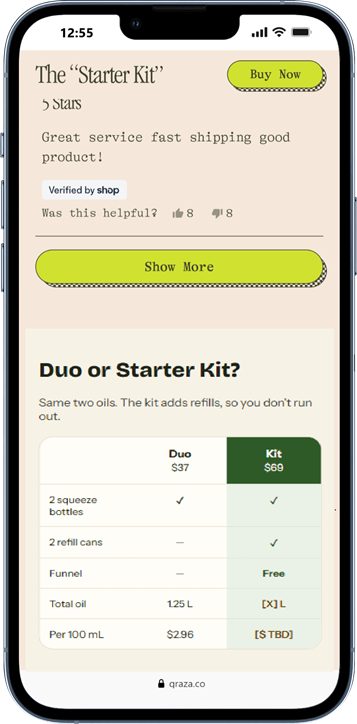
Replace the closing Duo button with a Starter Kit CTA, then introduce the refill subscription as the next step beneath the value stack.
Pilothouse test: Compare the current Starter Kit page with a version that:
Measure Starter Kit conversion rate, revenue per visitor, and clicks from the Starter Kit page to the Duo.
3. Bring the refill savings onto the homepage
Graza’s homepage introduces Drizzle, Sizzle, and Frizzle as individual bottles, but the main shopping journey doesn’t explain the refill or subscription options.
In the FAQ, Graza says subscribers can save up to 19%, receive free goodies beginning with their third order, and pause or cancel at any time.
Pilothouse recommends testing a homepage module built around “Squeeze. Refill. Save.” The module could explain the refill process in three steps, compare the refill price with a replacement bottle, and include the pause or cancel anytime terms.
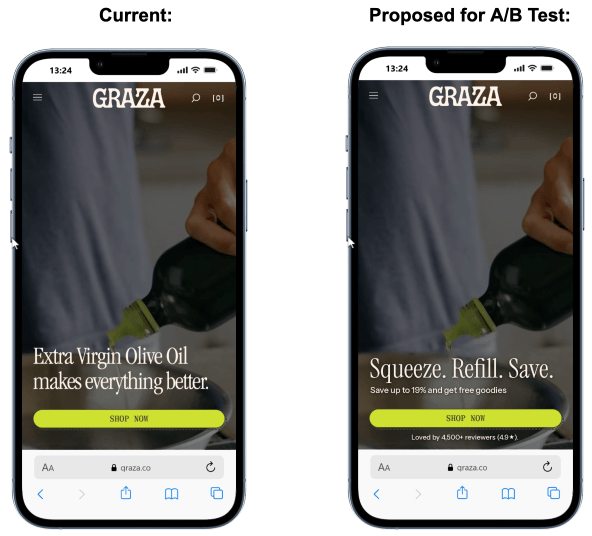
Pilothouse test: Compare the current homepage with a version that introduces the refill process, savings, and subscription flexibility after the main product lineup.
Measure subscription attach rate, refill-product clicks, and revenue per homepage visitor.
4. Show each product’s reviews first
Drizzle, the Duo, and the Starter Kit currently share the same pool of roughly 4,550 reviews.
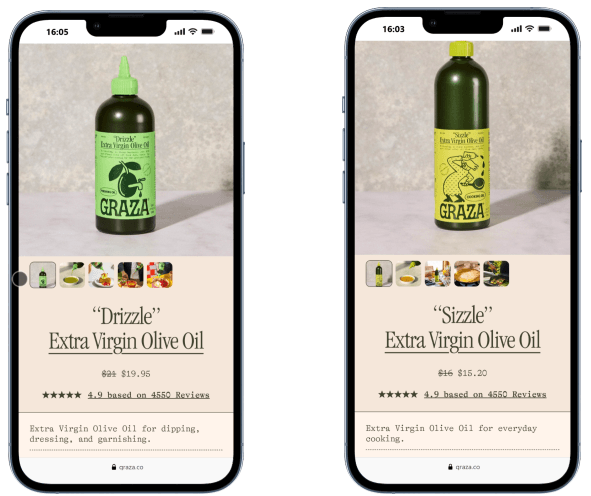
With “Most Recent” selected by default, a shopper on the Drizzle page may see reviews for other Graza products near the top of the feed.
Pilothouse recommends testing a product-first review experience, with reviews for the current product shown first and an “All Graza reviews” tab available for broader brand proof.
Graza could also test “Most Helpful” as the default sort, feature a few verified reviews that answer common product questions, and add filters by use case, such as salads and bread for Drizzle or frying for Frizzle.
Place one relevant photo review near the purchase module, then keep the full review collection farther down the page.
Pilothouse test: Compare the current shared review feed with a product-first version that defaults to “Most Helpful” and includes one relevant photo review near the purchase module.
Measure add-to-cart rate, review interaction, and PDP conversion rate.
5. Show delivery timing and Graza’s promise near the CTA
Graza’s FAQ asks customers to allow three to five days for processing, plus another three to six business days for shipping.
Those details aren’t currently visible near the product-page purchase controls.
Pilothouse recommends testing a dynamic delivery estimate below the add-to-cart button, based on the shopper’s location and Graza’s current processing capacity.
Graza could pair that estimate with its existing customer-care promise:
“The Graza Promise: If anything’s off, we’ll work to make it right. Email hello@graza.co.”
Separately, Graza could review whether the current processing window can be shortened before promoting a faster promise onsite.
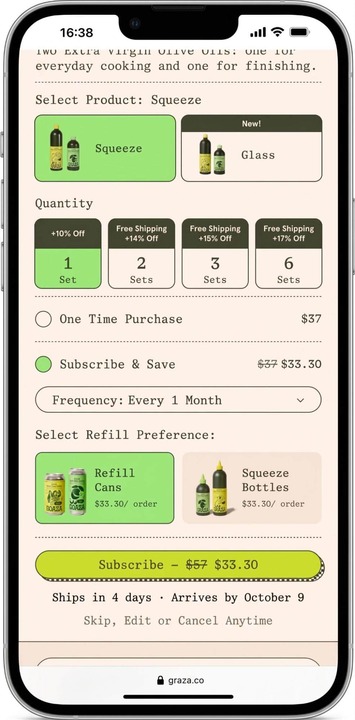
Pilothouse test: Compare the current PDP with a version that places the delivery estimate and Graza Promise below the add-to-cart button.
Measure add-to-cart rate, checkout completion rate, customer-service contacts about shipping, and PDP conversion rate.
6. Add relevant one-click products in the cart drawer
Graza’s cart already keeps checkout prominent and clearly shows what’s in the order.
Pilothouse recommends testing a small one-click add-on module beneath the cart contents, without interrupting the path to checkout.
The module could show progress toward any verified shipping threshold, applicable bundle savings, and one or two complementary add-ons such as mayo or chips. Larger gift sets can be reserved for carts where the price and occasion make sense.
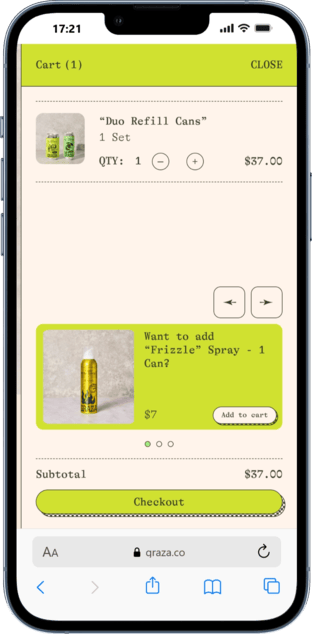
Pilothouse test: Compare the current cart with a version that shows one relevant one-click add-on beneath the cart contents.
Measure add-on rate, checkout initiation, checkout completion, AOV, and revenue per cart.
Bonus: Improve Graza’s AI visibility
Graza already publishes product pages, FAQs, recipes, and educational content that can support discovery through search and AI-assisted research.
Google says the same SEO fundamentals used for traditional search also apply to AI Overviews and AI Mode. Graza could focus on three things:
Graza also publishes an agents.md file. If it continues using it, the file could point to canonical product, subscription, FAQ, and policy pages, while the website and standard sitemap remain the primary sources of truth.
Conclusion
Graza already has a memorable product system, thousands of reviews, and refill options built for repeat purchases.
The opportunity is to make those strengths easier to see at the moments shoppers are deciding what to buy, whether to subscribe, and whether to complete checkout.
Did you find this valuable? Support us by checking out our businesses:
Please note that items in this newsletter marked with * contain sponsored content.
.svg)


.svg)


.svg)


.svg)
.svg)
.svg)