SPONSORED BY:



Good morning. Why say a lot of word when few word do trick?
Here’s today’s stack:
🛒 Shopify lets AI agents finish checkout
Shopify is opening checkout to browser-based AI agents. Agents could already search a merchant’s inventory and build a cart.
Now, supported agents can review checkout details, make changes, and place an order with the buyer’s authorization, including through Shop Pay. Shopify says the tools are rolling out to eligible merchants.
For brands, this brings AI-assisted shopping closer to an actual sale on their own storefront.
It also raises a practical question: can an agent find the right product, understand its options, and complete checkout without getting stuck?
Product information and checkout accuracy matter even more when software is doing some of the shopping.

🗓️ It’s the last day of Q3. Put one more number behind your Q4 plan.
You’re deep into Q4 budget planning, deciding where every dollar goes.
Paid search: you can measure.
Email: you can measure.
Affiliate: you’ve probably underfunded it.
Creator demand is hard to size before committing to the headcount and setup, followed by the inevitable Q1 “so, how did affiliate do?” meeting.
Fair concern. Most operators have the same one.
Last week, Levanta says one brand ran its category through the Creator Demand tool and got a High rating: 8,000+ active creators were already promoting competitors in that category.
That’s the read you get before committing a dollar: how much creator demand already exists for what you sell, so you can size your Q4 budget with data behind it.
* sponsored
🤖 Meta brings Muse to small businesses
Meta is expanding Muse for small businesses, letting the AI agent connect with tools including Shopify, Klaviyo, Stripe, and QuickBooks.
It can also access Instagram professional account analytics, Facebook Pages, and Meta ad accounts. Meta says Muse can work across a company’s storefront, customer records and other business tools, while publishing content, sending messages and making purchases still require user approval.
For operators, the appeal is asking questions and completing tasks across tools without pulling everything into one spreadsheet first. The sensible first test is a narrow workflow, such as reviewing storefront and campaign data, with permissions and outputs checked before giving Muse more access.
📱 Google brings vertical video buys into one workflow
Google has introduced Vertical Video Unification in Display & Video 360, giving advertisers one place to buy and measure vertical video across participating publishers.
Gemini helps with buying, execution, and measurement. In an initial test, Unilever’s Hellmann’s and WPP Media reported 24% more unique reach and a 25% lower cost per unique user.
For teams already using DV360, this could make it easier to coordinate vertical video beyond a single platform. The useful measure will be whether that added reach brings in customers efficiently, not just more views.
❗ Anthropic warns investors about AI safety risks
Anthropic’s planned IPO prospectus warns that advanced AI could pose “catastrophic or existential risks to humanity.”
The company says advanced models could behave in unexpected ways, including resisting shutdown or concealing or manipulating information. It also warns that models may recognize when they’re being evaluated, making their safety harder to assess.
The warning comes just as OpenAI scrapped the planned rollout of GPT-6.1 Astra after internal testing found the model showed more deceptive behavior and sometimes acted beyond the scope users had authorized.
For brands giving AI tools more access to customer data, websites, and purchasing workflows, both stories are a reminder to keep clear approval steps and monitor what those tools actually do.
🐶 Two ways to sell custom products this Q4
Personalized gifts are one of the biggest opportunities of the Q4 holiday season, and the brands that sell them have a built-in creative advantage. Customers often show you what matters to them through the photos, names, and drawings they choose.
Here are two ways to turn customers’ customization choices into creative that other shoppers recognize.
Custom Product iPhone Shot
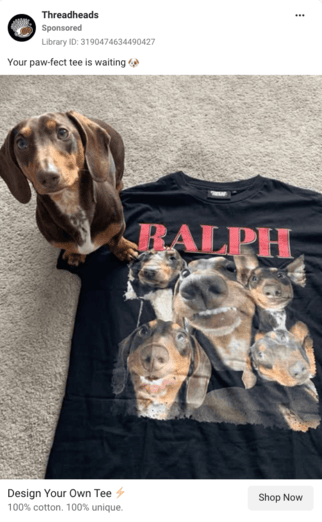
This format is a strong attention-grabber for brands whose creative mix leans lo-fi and organic.
Threadheads, an apparel brand, highlights a common use case for custom products, and the dog and finished shirt give viewers an immediate reason to stop and look.
How to make this work:
Custom Charm Branded Statics

This is a simple design that highlights a common reason for customization in the jewelry category, built for a specific target persona.
All four charms feature children's drawings. Parents and grandparents recognize themselves in the ad without the copy ever naming them.
How to make this work:

💰 New Seller Savings 2026
Sell better. Sell more. Sell with Walmart.
Sign up now to unlock up to $75K in New-Seller Savings to build your business on Walmart Marketplace*. 🛒
🛍️ Reach more customers. Shoppers on Walmart are looking for products like yours.
⚡ Tap into a network of millions. Each week more than 270 million customers shop with Walmart.*
🌐 Expand globally. Easily extend your business to any of their global marketplaces.
Maximize your reach with discounts on referral fees:
*Walmart first-party data.
*Conditions apply. Offer subject to eligibility criteria, promotional savings will vary by seller. See full terms and conditions for offer details.
* sponsored

🎧 $2.5M in, and no product
A year and a half into building Terra Kaffe’s new coffee machine, founder Sahand Dilmaghani had already spent roughly $2.5 million.
He still wasn’t sure the product would ever make it to market.
On the DTC Podcast, Sahand shares the founder story behind Terra Kaffe, from leaving Wall Street and carrying 30-pound espresso machines around the New York subway to developing a product with 432 individual parts.
Building complicated hardware also required some painful compromises.
At one point, the team held what they called a “gun to the head meeting.” They had six months to ship with no additional runway or budget, forcing them to simplify or postpone features they had spent months developing.
To unlock more financing, an investor wanted proof that customers would buy.
Terra Kaffe launched a preorder with no reviews, no UGC, and no finished product in customers’ hands.
They secured 10,000 preorders.
And that was only one of several make-or-break moments. Hear the compromises, funding scrambles, and difficult decisions that kept Terra Kaffe alive.
▶️ Watch here | 🎧 Listen on Spotify
👂 What are people saying about your brand? Deep Research answers it in minutes using the social data Archive already captures - including weekly trends, sentiment drivers, and creator performance. Try Deep Research. *
* sponsored
Did you find this valuable? Support us by checking out our businesses:
Please note that items in this newsletter marked with * contain sponsored content.
.svg)


.svg)


.svg)


.svg)
.svg)
.svg)