Good morning!
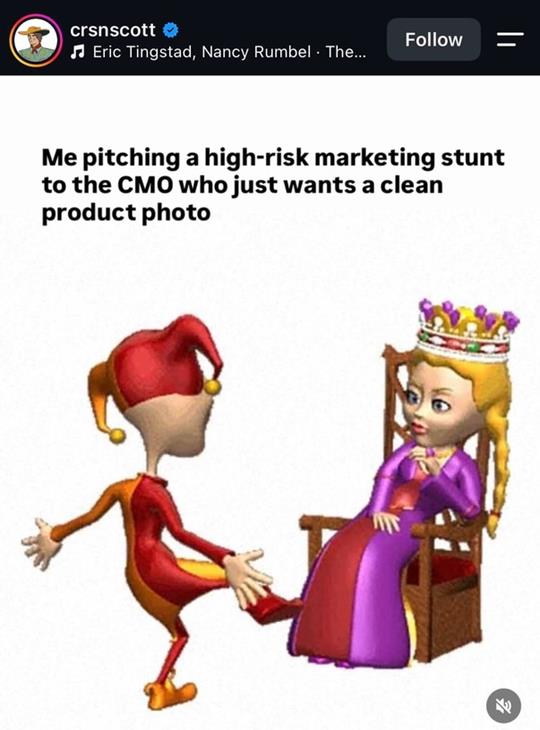
If the pitch starts with, “hear me out,” you know it’s going to be a fun one.
Here’s your pre-weekend briefing:
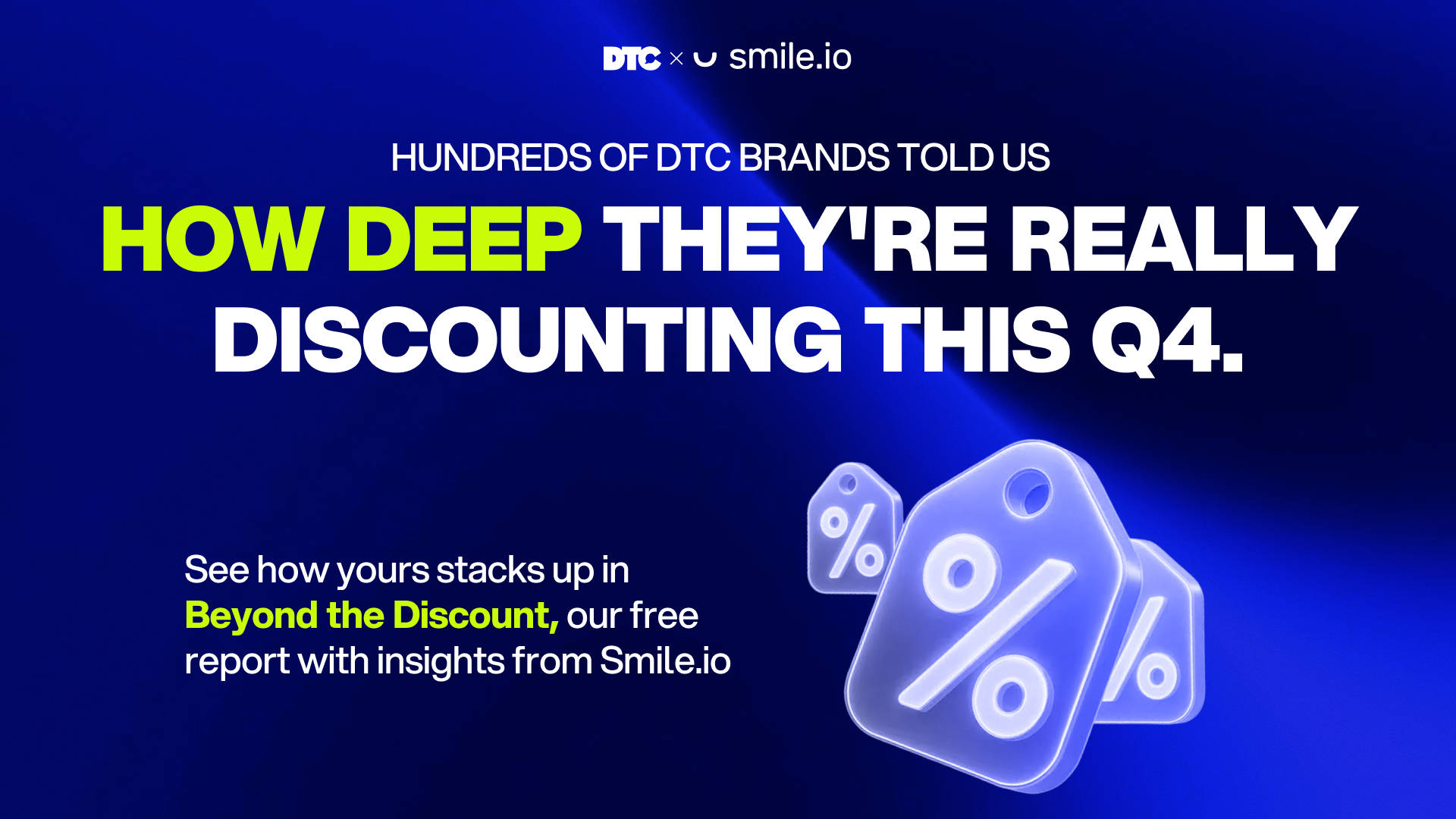
⁉️ How deep should you discount this Q4?
We surveyed 575+ DTC operators on how deeply they’re discounting this Q4, then asked 700+ shoppers what actually gets them to try a new brand.
The results are in Beyond the Discount, a free benchmark report exploring the gap between what brands assume and what shoppers say, with additional insights from Smile.io on loyalty and repeat purchase.
One finding: shoppers most commonly say it takes 20 to 25% off to try an unfamiliar brand. The most common acquisition discount from brands? Just 11 to 20%.
See how your plan compares before you finalize your Q4 strategy.
* sponsored
📦 U.S.-China trade truce covers Q4
The U.S. and China agreed to extend their trade truce from November 10 to January 10, according to Treasury Secretary Scott Bessent. The extension reduces the immediate risk of a tariff escalation during the holiday shopping season while trade talks continue.
For brands importing from China, confirm supplier timelines and current landed costs. Model a second scenario for inventory arriving after January 10.
🚚 Amazon brings Prime delivery to brand websites
Amazon is letting U.S. merchants using Multichannel Fulfillment add the Prime badge and fast, free delivery to their websites without paying beyond standard MCF fees.
Prime membership is verified after checkout, so shoppers do not need to log in through Amazon. Merchants can also keep their existing payment processing, customer service, returns, and store policies. Shopify brands can enable the option through Amazon’s MCF and Buy with Prime app.
Separately, eligible FBA sellers can save 15% to 25% on multichannel fulfillment fees for their first six months through Amazon’s new Preferred Pricing Program. Compare the discounted rates with your current 3PL costs before switching fulfillment volume.
🛍️ Meta gives Muse more places to shop
At Meta Connect, the company announced new shopping connections for Muse, including Walmart, Best Buy, Gap, Sephora, Ulta, and Wayfair. It’s adding Shop Pay and PayPal for payments, Instacart for groceries, and Expedia for travel planning.
Meta also previewed Muse Charm, a pocket-sized device for talking to the assistant. The company says it will share more details later this year.
If you sell through any of these retailers, audit the product information Muse may be pulling from. Check that pricing, availability, titles, and key product details match across each connected channel.
💯 Meta starts grading creative diversity
Peter Quadrel spotted a new Creative Health panel that gives each Meta ad set a diversity rating of High, Medium, Low, or Unknown.
The score looks at variation across three areas: format, message and visual style. The panel also flags creative fatigue and shows top-performing imagery from similar brands, giving teams a snapshot of what customers are already seeing in their feeds.
Open your largest campaign and count how many ad sets receive a Low rating. Use those scores to decide where next week’s creative batch needs more variety.
▶️ YouTube lets viewers build their prompt-driven feeds
YouTube is introducing Custom Feeds, allowing U.S. viewers to describe what they want to watch and save the resulting feed as a homepage tab. Its shopping guide will also answer product questions and organize review videos into comparison tables.
Creators are getting AI editing tools, feedback on draft videos, and an A/B test that compares up to three different cuts to see which hook holds attention best.
For your next upload, pick one discovery question your customer might ask and make sure the title and first lines of the description answer it clearly. If the three-cut A/B test is available to you, use it to compare opening hooks before committing to a final version.
💪 Five email tests for OUAI
Founded by celebrity hairstylist Jen Atkin, OUAI first became known for haircare before expanding into body care and fragrance. Its bestsellers include Detox Shampoo, Leave In Conditioner, and Wave Spray.
OUAI’s packaging, photography, and recognizable logo give the brand a consistent look across those categories. The Pilothouse email team reviewed three welcome emails and two abandoned-cart emails and identified five tests worth exploring.
👋 Welcome email #1: Bring the 15% offer and code together
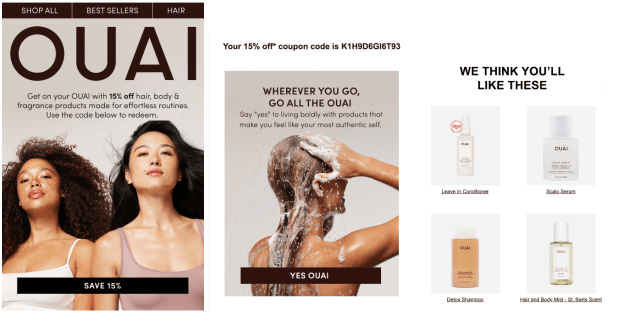
OUAI’s first welcome email makes an immediate visual impression. The oversized logo, model photography, and restrained color palette carry the brand’s style into the inbox. The subject line also mentions the 15% offer, giving subscribers a clear reason to open.
Inside, the “Save 15%” button sits at the bottom of the hero image, while the unique code appears in smaller text above the next section. OUAI could test placing the offer, code, and button closer together so mobile subscribers can see how to use the discount without scrolling through the full hero. Slightly reducing the logo’s height could make room while preserving the branded opening.
Farther down, the email introduces OUAI’s hair and body categories and features a product grid. An Allure Beauty Award badge beside the Leave In Conditioner gives shoppers another reason to consider it.
📰 Welcome email #2: Move the ELLE endorsement closer to the hero
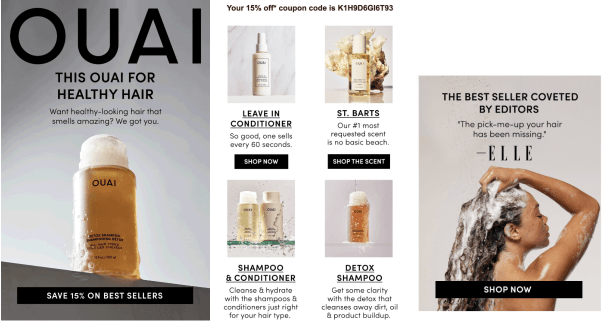
The second welcome email opens with “This OUAI for healthy hair,” a playful use of the brand’s name. The Detox Shampoo image gives the hero a clear focal point, and the “Save 15% on bestsellers” button offers a specific shopping direction.
The unique code appears above the product grid, visually separated from the 15% message. OUAI could test placing it directly below the offer or applying the discount through the button, making the next step clearer for shoppers.
Larger product names and dark buttons make this grid easy to scan.
Later, an ELLE endorsement describes the featured product as “the bestseller coveted by editors.” Testing that endorsement directly below the hero would let subscribers see the editorial proof before they reach the broader product selection.
🔍 Welcome email #3: Give the final message a distinct focus
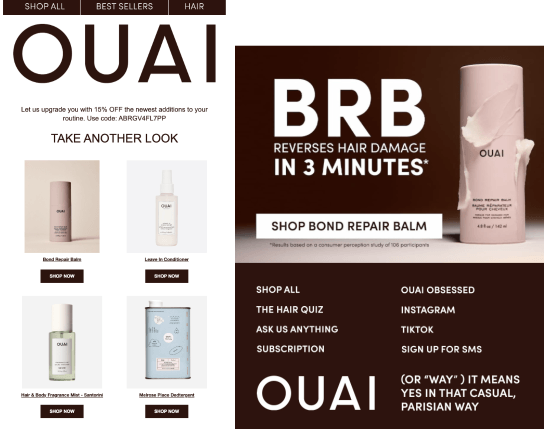
The third welcome email is shorter and places the product grid higher up, helping subscribers reach the recommendations quickly. “Take another look” fits OUAI’s understated tone.
Farther down, the Bond Repair Balm section introduces the claim “reverses hair damage in three minutes.” OUAI could test bringing that product and claim into the opening to give this message a more specific focus than the earlier product grids.
If the discount expires, stating the deadline near the top is another test worth considering.
🛒 Abandoned-cart email #1: Add a detail about the product left behind
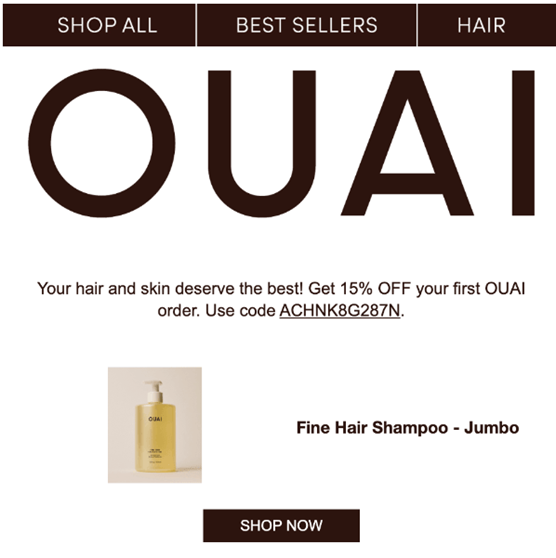
OUAI’s first abandoned-cart email arrives one hour after abandonment. It shows the Fine Hair Shampoo Jumbo, repeats the 15% code, and provides a clear button back to shop.
The email could test adding information specific to the product and size shown. If the jumbo bottle offers a verified per-ounce saving compared with the standard size, displaying that comparison would give shoppers a concrete detail to consider before completing their purchase.
The Pilothouse email team would also test the current one-hour delay against an earlier reminder. Recovered-cart revenue, conversion rate, unsubscribe rate, and purchases that may have occurred without a reminder would help assess the effect of the timing change.
💬 Abandoned-cart email #2: Give the follow-up new information
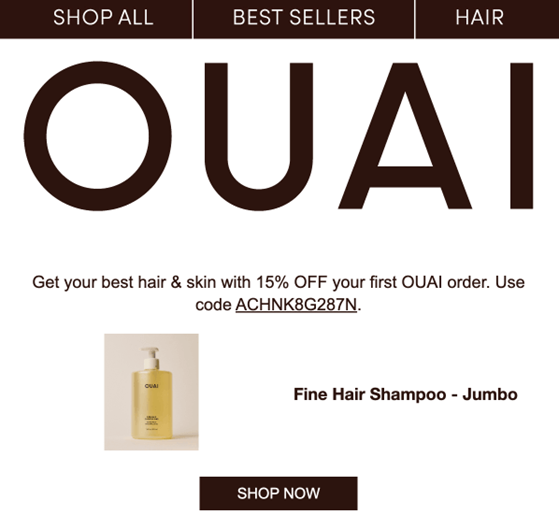
The second abandoned-cart email arrives a day later and repeats the large logo, discount code, abandoned product, and primary CTA. Shoppers can quickly recognize the item and the incentive.
The test here is to add information for someone still considering the Fine Hair Shampoo Jumbo. The follow-up might explain what makes the formula suitable for fine hair, feature a relevant customer review, or answer a common product question.
A conditioner or treatment selected for fine hair could appear below the main recovery button. Limiting the suggestions to one or two products would keep the abandoned shampoo in focus.
🧪 What to test first
OUAI carries a consistent visual identity through both flows and keeps the welcome incentive recognizable across the journey. These five tests from Pilothouse explore how the emails present the incentive, introduce editorial proof, give subscribers a reason to revisit a product, and answer questions that may arise before purchase.
The immediate fix is the Leave In Conditioner destination, which opened a 404 page across the welcome flow during our review. Since the product appears in multiple emails, check its linked images, product names, and buttons across desktop and mobile. A reused product module or feed would be one place to investigate, and automated link monitoring could help catch URLs affected by future product or merchandising changes.
That’s all for today’s Brand Breakdown! Want us to add a brand to the list? Reply to this email and let us know.
Have a great weekend; see you Monday! 👋
Did you find this valuable? Support us by checking out our businesses:
Please note that items in this newsletter marked with * contain sponsored content.
.svg)


.svg)


.svg)


.svg)
.svg)
.svg)