Good morning.

Corporate final boss. 🦇
Here’s what we’ve got for you in today’s newsletter:
Let’s gooooo.
🛍️ Instagram gives Amazon links a better spot
“Link in bio” has some competition. Instagram now lets eligible US creators connect their Amazon affiliate accounts and tag products right in Reels and feed posts. They can tag up to 30 products per Reel or 20 per post, and Amazon pays the commission.
If you sell on Amazon, ask your creators if they’ve got access yet. Gift guides, demos, and “things I’m loving” roundups just got a lot easier to shop.
📧 Help reduce buyer’s remorse after BFCM checkout
@MaxwellCopy shared a post-purchase checklist to run through before the holiday orders start piling up:
His team sees 1.8–2.7% placed-order rates on plain-text founder thank-yous, compared to 0.3% on branded ones. That’s from his own accounts, so test it against yours.
🔎 Google’s shaking up rankings right before Black Friday
If your organic traffic’s been bouncing around, this could be why. Google’s November core update started rolling out November 10, it’s global, and it can take up to two weeks to finish. Google hasn’t called it done yet.
Keep an eye on which pages and searches are gaining or losing traffic, and how that lines up with sales. And write down any site changes you make, so you’re not left guessing what caused what.
⚖️ Temu could be facing another EU fine
EU regulators say Temu still isn’t doing enough to stop illegal products from being sold on its platform. They’re pointing to weak product checks, moderation, and seller penalties.
It’s not final yet, and Temu says it disagrees and will respond. But if the findings stick, the fine could be up to 6% of its global annual revenue.
If you’re competing with bargain marketplaces, it doesn’t hurt to make your quality, specs, and customer support really easy to see.
🏷️ Two Black Friday ads we shared in the group chat
These came from our own scrolling this week. They’re very different ads, and both are good inspiration if you’re still working on sale creative.
1️⃣ Ridge: “This is Dad”
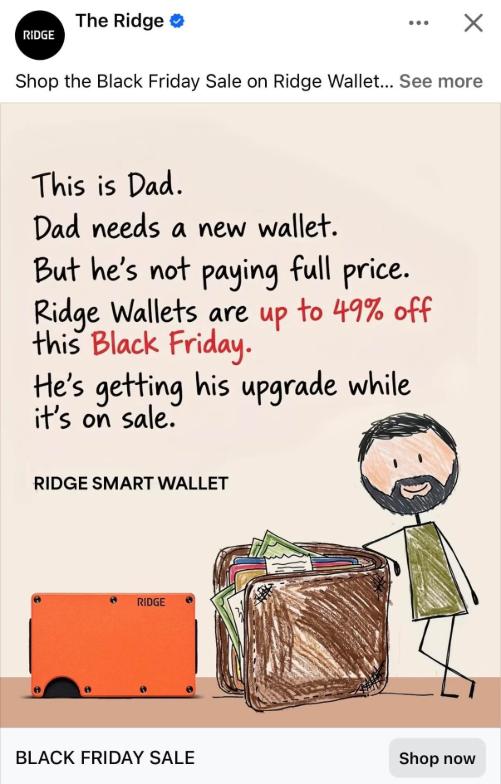
The first thing that pulled us in was the mix of styles. Dad and his old wallet have a scribbled, coloured-pencil look, and the Ridge is a sharp, polished product shot sitting right next to them.
That pairing also does the comparison for you. Dad’s brown wallet is bulging with cards, cash, and receipts, and the Ridge is slim and clean. You can see the reason to upgrade before reading the copy.
Then there’s Dad. The copy can land two ways. A dad reads it and thinks, yeah, I do need a new wallet. Or (and we’d guess this is who Ridge is really after) a partner or kid reads it and pictures the beat-up wallet sitting on their kitchen counter.
“He’s not paying full price” gives him a familiar personality, too. Most people know a dad who waits for a sale.
2️⃣ Brick: the gift tag
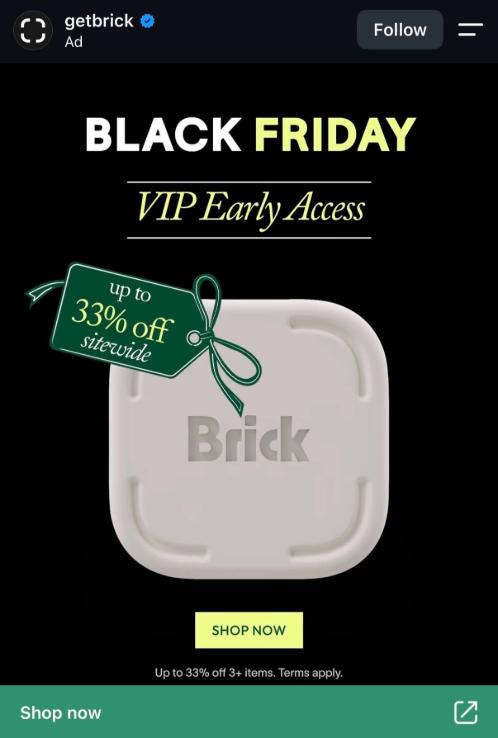
This one is stripped way down. A headline, a Shop Now button, one product shot, and a gift tag with the sale on it.
It also never explains what a Brick is. The ad depends on the viewer already recognizing the device, so it reads like a retargeting ad for people who’ve visited the site or seen Brick before. Cold audiences would probably need more context.
The offer is the part we’d look at more closely. The tag says “up to 33% off sitewide,” with the three-item condition under the button. The landing page explains the tiers: 15% off one item, 25% off two, and 33% off three or more. Someone focused on the biggest number could still expect 33% off a single Brick.
Those tiers could also give Brick a more specific gifting angle. Someone buying for themselves, a partner, and a teenager could have a reason to buy three. Testing “Buying for the family?” above the existing offer would make that use case explicit.
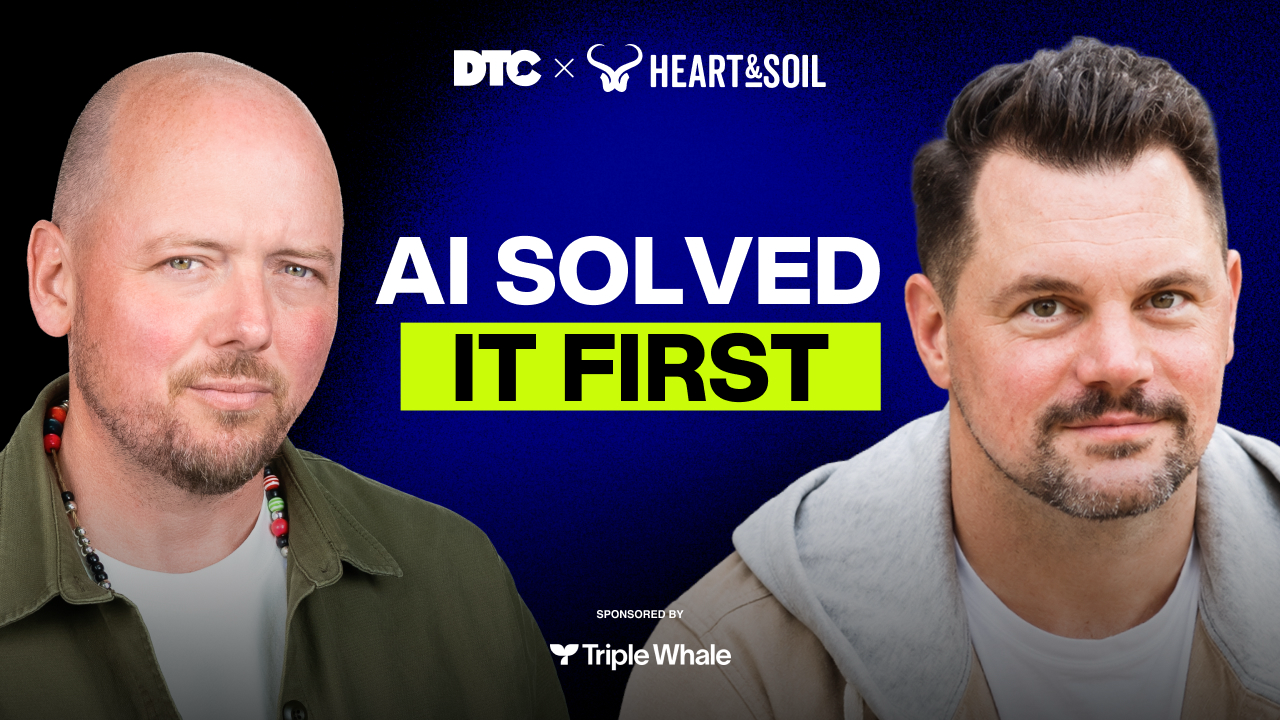
🎧 How organic growth took Heart & Soil toward $50M
Heart & Soil grew primarily through organic channels in its early years. CEO Dean Brennan estimates the brand was approaching $50 million in revenue around year three, after roughly two years without paid ads.
A major driver of that early growth was founder Dr. Paul Saladino’s audience, built over years of educational content.
But as Heart & Soil approached $40–50 million in revenue, the team realized it needed a stronger paid acquisition strategy.
On the DTC Podcast, Dean explains how the team built its paid acquisition capabilities.
He also shares how the supplement brand is using AI to analyze internal communications and uncover leadership blind spots.
▶️ Watch here | 🎧 Listen on Spotify