SPONSORED BY:



Good morning.
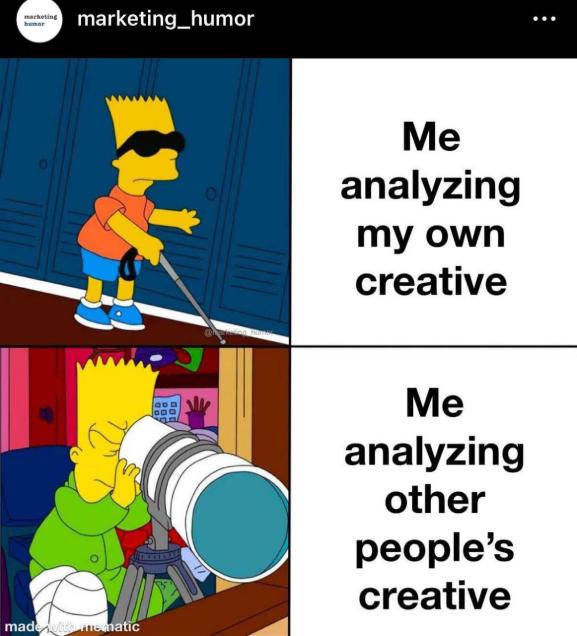
“Looks good, ship it.” (Also me, with 14 notes on a competitor’s ad.)
Here’s what’s in today’s newsletter:
Let’s dive in.

👀 What did the first 188 shops learn about ChatGPT Ads?
Triple Whale analyzed the first 45 days of ChatGPT Ads across 188 shops. In early results, the channel beat Microsoft, TikTok, and Pinterest on click-through rate.
Buying activity is climbing too. AI-attributed orders across Triple Whale brands have more than doubled since BFCM 2025, with ChatGPT driving roughly 3 of every 4 of those orders.
Many brands still bring search habits to the channel, and keyword lists and exact-match thinking don’t fit how shoppers research inside a conversation.
Triple Whale’s free ChatGPT Ads Guide covers:
Get the benchmarks and setup guidance before you commit BFCM budget to the channel.
* sponsored
📊 You can finally see how often ChatGPT mentions your brand
Remember those “claim your business” screenshots floating around last week? It’s official now. OpenAI launched Businesses in ChatGPT in beta on November 10.
Once you verify your business, you can update your details and product feed. Then, once you hit OpenAI’s reporting thresholds, you’ll be able to see how often ChatGPT mentions you in its regular answers, how many people click through to your site, and what topics people find you through. If you’re on Shopify, connecting your store makes verification easier.
Eligible US ecommerce and online service businesses can also set up a Business Agent that answers product questions. You can even use it as the destination for your ChatGPT ads.
So claim your profile and start watching the dashboard. Just check your own store analytics too, so you know whether those clicks are turning into orders.
🛍️ TikTok Shop is testing its own version of Prime
TikTok Shop Plus is a paid pilot that’s being offered to more than 1 million of TikTok Shop’s most loyal US shoppers. After a 30-day free trial, it’s $9.99 a month for free shipping on eligible items, member-only discounts, and faster refunds (as store credit) on qualifying returns.
Members are also getting extra deals during TikTok Shop’s BFCM event, which runs November 11 to 30. So if you sell on TikTok Shop, check which of your products have a Plus badge or member offer before you brief creators. That way they know what shoppers will see at checkout.
📱 Test the hook before you shoot the video
@iamshackelford has a shortcut for finding fresh Meta creative: take one product photo and write a few headlines that give shoppers different reasons to buy.
Keep the image and offer fixed. Use clicks to shortlist which angles are worth turning into video, then see which ones drive purchases.
For BFCM, his advice is to design for the phone and send shoppers to a page built around the offer they clicked. As for budget, his starting point is 70% behind what he trusts and 30% for tests, with less going to experiments when performance is shaky.
🔎 Google’s gift guide shows what shoppers are searching for
Google’s Holiday 100 is a curated list based on this year’s search trends. A few standouts: searches for adjustable roller skates rose 180%, searches for lymphatic sculpting face brushes rose 400%, and perfume was the most-searched type of gift set.
If a trend fits something you already sell, use the wording as a starting point for a gift email or product page. Search interest tells you what people are curious about. Your own sales data can tell you whether that interest is turning into orders.
🎁 Two ways to make your product feel like the gift
Holiday shoppers are in a weird spot. For most of the year, they’re buying for themselves. They know their size, their taste, and what they’ll use. In November and December, a big chunk of them are shopping with someone else in mind, like their dad, their sister-in-law, or the coworker they drew in the gift exchange.
That changes what your ad has to do. It’s not enough for the shopper to like your product. They have to picture the other person opening it and loving it. So the ads that work best this time of year show what the gift says about the giver, and why it’s a better pick than whatever they’d grab last minute.
Here are two brands doing that really well, in very different ways.
1️⃣ Aura Frames: Make it personal before it’s opened
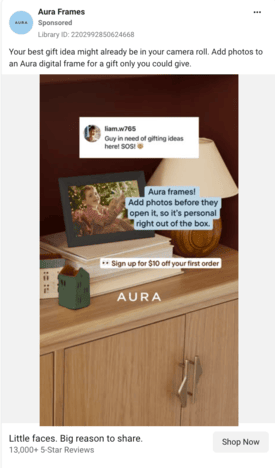
Aura’s ad looks like a comment thread. Someone asks for gift ideas, and the answer is the product. It feels like a recommendation from a friend instead of an ad, and it speaks directly to the person stuck on what to buy.
The best part is the hook: add photos before they open it. That turns a digital frame into a gift only you could give, which the primary text spells out too (“Your best gift idea might already be in your camera roll”). And 13,000+ five-star reviews in the headline hbelps with the “will they actually like it?” worry.
Try it for BFCM: If your product can be personalized, lead with that. Show the gift-giver what they add to make it special, whether that’s an engraving, a note, a photo, or a custom bundle.
2️⃣ Storyworth: Beat the boring gift
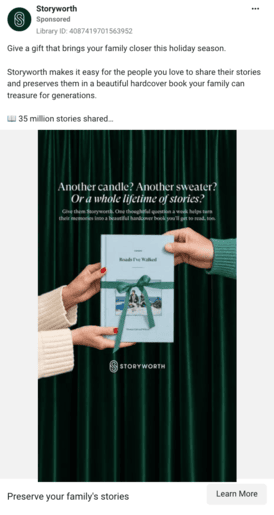
Storyworth goes straight at the gift-giver’s biggest fear, which is giving something forgettable. “Another candle? Another sweater? Or a whole lifetime of stories?” sets up the usual gifts as the competition, then positions itself as the meaningful option.
The visual backs it up. Two hands passing a ribbon-tied hardcover book reads as a gift right away, even before you see the logo. And “35 million stories shared” in the copy adds proof without breaking the mood.
Try it for BFCM: Name what your shopper would buy otherwise, and show why yours is the better choice. This works especially well for higher-priced or sentimental products that need a little justification.
🎄 Your gifting checklist
Not every brand has a personalized product or a sentimental story. But almost any brand can make gift shoppers’ lives easier. A few things to check before the holiday rush:
Pick one or two of these and make them obvious on your ads and product pages before the shipping deadlines hit.

🎧 Cadense pre-sold two-thirds of its first container
What if you could test demand for a new product before shipping a single unit?
That's exactly how footwear brand Cadense got its start.
On the latest DTC Podcast, co-founder Johannes Sauer explains how the brand launched a specialized sneaker designed to help people with walking difficulties move more confidently.
Rather than launching through Kickstarter, Cadense opened pre-orders directly on its Shopify store in September 2023.
By the time the company started shipping the following March, it had already pre-sold two-thirds of its first container of inventory.
Pre-order revenue helped Cadense fund new colors and sizes over its first 18 months. It also showed the team what customers actually cared about, which ads worked, and what got people to buy.
Johannes says Cadense passed $10 million in sales within 28 months of opening pre-orders.
He also shares how a physical therapist's product review became a powerful acquisition tool, why more than 750 clinicians now recommend Cadense, and how the brand is expanding beyond DTC.
▶️ Watch here | 🎧 Listen on Spotify
🙀 Your biggest competitor might be a copycat of your brand. Podqi’s trusted-reporter status gets fakes off Amazon, Etsy, and hundreds more platforms for 150+ brands. Scan your brand for free. *
🔮 Give your brand a sixth sense. Nectar spots trends and competitor moves, then helps you land creators, reply in your voice, and turn comments into sales. Trusted by e.l.f., OLIPOP, Liquid Death, and many more. See Nectar in action. *
* sponsored