Good morning.
Quick change of plans today. 👉 Shopify dropped its Fall Edition yesterday, and there’s enough in there that matters for BFCM that we swapped out our usual news stack to cover it.
And if you’re not the one who’s in your Shopify admin every day, forward this to whoever is. A lot of these updates take a few minutes to check, and it’s way better to find them now than the week of Black Friday (or after…).
Here’s what you’ll be reading from DTC today:
🛍️ Shopify’s Fall Edition is here (all 150+ updates of it)
Shopify dropped its Fall ‘26 Edition yesterday afternoon, so we went through the new updates for you.
A big chunk of it is about AI, both how shoppers find your stuff through AI assistants and how you can run your store from one. We know you’re tight on time these days, so here’s the ones we think you should at least be aware of before Black Friday/Cyber Monday (BFCM).
Stuff to set up before Black Friday 👇
OK, so that’s the BFCM to-do list. Everything else in the Edition is kind of the bigger picture, and it’s mostly AI. Some of it’s for you (running your store from a chat window), and some of it’s for your shoppers (buying stuff without hitting your site). Let’s start with you. 🫵
1️⃣ Running your store from your AI assistant
If you’ve already got ChatGPT or Claude open all day anyway, you might not need the admin as much. You can connect Shopify to nine supported AI assistants, including ChatGPT, Claude, Gemini, Copilot, Grok, and Meta’s Muse. Harley Finkelstein gave a few examples, like checking yesterday’s sales, changing a product price, or planning a holiday promo.
And if you’d rather just stay in the admin, Sidekick got smarter too. It can do math, write code, search the web, remember stuff you’ve told it, and line up a bunch of changes for you to approve all at once. Canvas, now in early access, lets you see and edit your whole storefront in one view, with Sidekick helping out on redesigns.
2️⃣ Shoppers buying through AI agents
Now the shopper side, and honestly this is the part that’s easy to miss. More of your customers might check out without ever actually landing on your store.
Shop Pay checkout now works in Muse, Claude Duet, Grok Bot, and Instinct. Checkout in Google Search, including AI Mode, and the Gemini app is rolling out to eligible stores and shoppers, and orders show up in your admin like normal.
So what those agents know about you kinda matters now. The Knowledge base lets you control the store facts they get. You review and approve the policies and FAQs they pull from. (We covered this one earlier this week, but it’s officially part of the Edition now.)
3️⃣ Shop Campaigns is going global
OK, one that’s not about AI. If you sell internationally, Shopify’s pay-only-when-it-sells ad program is expanding to 35+ new markets, including the UK, Australia, and the EU. One campaign can run across all of them, and you still only pay when an ad drives a sale.
And a few quick ones
P.S. A lot of this is “rolling out” or “coming soon,” so before you build your holiday plan around any of it, pop into your admin and see what’s actually live for you.
P.P.S. Forward this to whoever on your team is in charge of your Shopify setup. Trust us, they’ll want to see it before BFCM.

📊 Your next customer might be asking AI who to buy from
So yeah, Shopify’s betting big on shoppers finding and buying stuff through AI. We wanted to know if that’s actually happening yet. Our research shows it’s already influencing purchases.
We surveyed 556 online shoppers and 146 DTC operators for The Invisible Shelf, our AI Discovery Report. And 53% of AI-assisted shoppers told us they’d bought from a brand they’d never heard of because AI recommended it.
That’s a lot of people meeting brands for the first time inside a chat window. The report gets into which assistants they’re using to research products, what makes them trust a recommendation, and where brands are putting money into AI visibility right now. Plus four actions to improve your AI visibility and measurement.
If the Edition got you thinking about how your products show up in AI, this is a good next read. 👇
💡 4 weeks left to Black Friday: Rewrite your CTA
Over the next few weeks, we’re sharing one CRO test operators can launch before Black Friday.
Each test is designed to be relatively quick to implement, giving your team time to collect data and apply what works before Q4 traffic peaks.
“Add to Cart” explains the action, but it does little to shape how customers think about the purchase.
Pilothouse recommends testing generic CTA copy against language that reflects the product’s larger use case.
For the grooming brand Every Man Jack, that means testing “Add to Cart” against “Start My Routine.”
Here’s what that looks like:
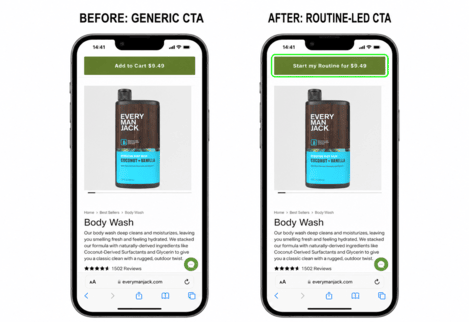
The new CTA frames the product as the beginning of a grooming routine rather than an isolated purchase.
Pilothouse says this language could encourage more customers to explore complementary products.
Test whether that framing changes add-to-cart rate, conversion rate, or order size.
This is a relatively simple test because the product, price, page layout, and offer remain unchanged. Only the button copy changes, making the results easier to interpret.
How to run this CRO test:
A skincare brand could test “Build My Routine,” while a coffee brand might try “Stock My Morning.”
Does your CTA language match how customers genuinely use the product? Hit reply to the newsletter and let us know!
🎧 Your BFCM emails might be too creative
Planning 10 completely different emails for Black Friday? You might be making more work for yourself.
On the latest TWBERP, Jordan Gordon shares research into how customers actually engage with email during Black Friday.
His biggest finding? The most common buyer opens one email and then places an order.
The next most common path is two opens before purchasing, followed by three. Once you get to customers opening five or six emails before buying, you’re dealing with a much smaller group.
That changes how you should think about your BFCM campaign.
By email six, it can feel like you need a fresh angle because subscribers must be getting bored. The person opening email six may not have opened the previous five.
Jordan’s recommendation is to treat every BFCM email like it’s the only one that a customer will open.
That means your campaign might end up looking surprisingly repetitive. Keep putting your strongest offer and message in front of customers instead of saving them for one specific point in the sequence.
▶️ Watch here | 🎧 Listen on Spotify