SPONSORED BY:


Good morning,
Here’s what you’ll find in today’s DTC:
1️⃣ Is your PDP built to convert? Here are 5 red flags to look out for in your next audit.
2️⃣ How to create a scalable brand growth system built around the customer journey.
You’re reading this newsletter along with new subscribers from: Laboratory Perfumes, Pact Coffee, and fyb jewelry. 👋
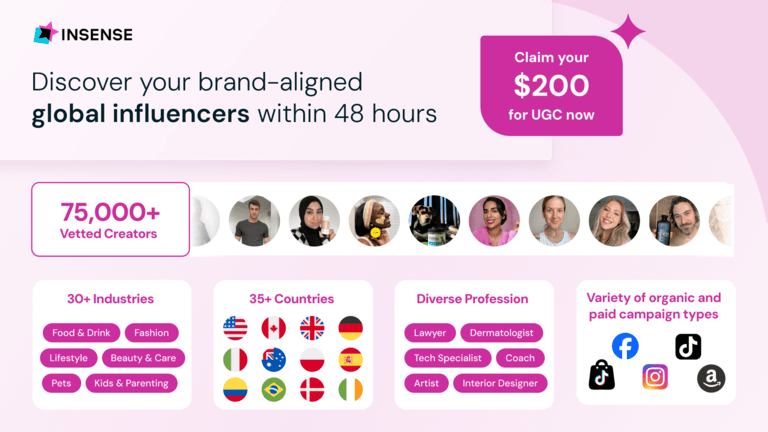
⚡ Save 40+ Hours On UGC Sourcing And Influencer Campaign Management
Are you tired of wasting time contacting influencers who don’t respond to your DMs?
💡 Listen up: There’s a simple way to grow your brand awareness with influencers while sourcing high-quality UGC content, for organic & paid social, within 14 days from responsive creators.
👉 Join major DTC marketing teams like Obvi, DRMTLGY, and JLO Beauty using Insense.
Plus, book a free strategy call by April 10 and get $200 for your first UGC campaign.

⛳ 5 Red Flags That Are Killing Your Amazon ROAS
A healthy ROAS isn't just about how well you bid on keywords. It’s about whether your creative actually converts once the shopper lands on the page.
Traffic is only half the battle. If shoppers are clicking but not buying, your PDP is usually the bottleneck.
Your brand needs to show up consistently across every touchpoint.
Your narrative needs to create urgency and images need to communicate clearly.
Below are the five most common creative red flags Pilothouse sees in Amazon audits and exactly what to do about each one.
Fix these, and you’ll stop leaving money on the table.
1. The Squint Test Failure (Mobile-First Legibility)
A significant majority of Amazon shoppers browse on mobile. In some categories, that number reaches 70%.
If your infographics require a pinch-and-zoom to read, you’ve already lost the sale.
❌ Red Flag: Small serif fonts and light-colored text on busy backgrounds become illegible on a 6-inch screen.
✅ The Fix: Use high-contrast, bold sans-serif fonts. Ensure your “Hero” benefits are readable even when the thumbnail is shrunk down in search results.

2. Infographic Overload
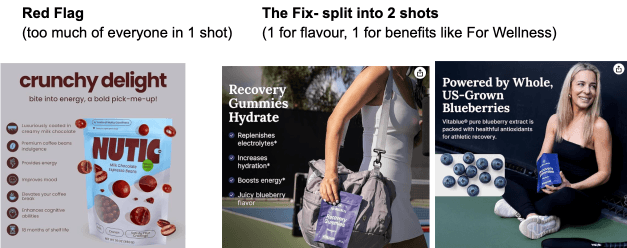
When a brand tries to say everything at once, the customer hears nothing.
Cluttered tiles overwhelm the brain and lead to decision fatigue and a shopper who can’t make a decision simply leaves.
❌ Red Flag: A single image attempting to list 10+ ingredients, 5 certifications, and a “How to Use” guide all at once.
✅ The Fix: Follow the One Goal Per Tile rule. Each tile should focus exclusively on a single idea — whether that’s the product’s function, a star ingredient, a key benefit, or a notable achievement. When in doubt, split it into two tiles. Use your space wisely.
3. Missing Problem/Solution Narrative (A Rufus Must-Have)
Amazon is a destination for problem-solvers.
Shoppers arrive with a need and if your image gallery only shows the product without addressing the pain point it solves, you’re not creating urgency. You’re just decorating.
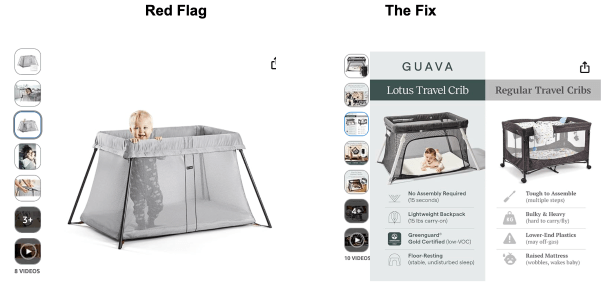
❌ Red Flag: A gallery full of glamour shots. Product on a white background or lifestyle images without any context or copy.
✅ The Fix: Clearly shows the “Why.”
Depict the problem (e.g. boredom, health needs, comfort issues) alongside the solution (your product). Pair the solution image with bold, eye-catching copy that communicates your best USP. Tell the shopper exactly what they’ll gain.
4. Platform Disconnect
A creative audit should always check for platform consistency.
If your Amazon Storefront looks like a flea market while your DTC website looks like a premium boutique, you’re eroding brand authority and shopper trust.
❌ Red Flag: Outdated logos, mismatched color palettes, or low-resolution lifestyle photography that clashes with the current website experience.
✅ The Fix: Treat your Amazon Storefront as an extension of your main website, not a separate entity.
Sync your A+ Content headers with your website’s hero banners to build immediate consumer trust.
5. Static Snooze (Lack of Video/Motion)
Static images tell, video sells.
In 2026, a PDP without video is essentially invisible to a large and growing segment of shoppers who expect motion, energy, and proof.
❌ Red Flag: No Main Image Block video or a video that’s simply a slideshow of existing static photos.
✅ The Fix: Deploy a motion strategy built around high-energy hooks and social proof. Depending on your brand’s goals, implement one (or more) of these three formats:
The takeaway?
Creative optimization isn’t a one-time project. It’s an ongoing discipline.
Walk through every PDP with these five questions or screenshot for later:
1️⃣ Can a shopper read your key benefits on a mobile screen without zooming in?
2️⃣ Does each image tile communicate exactly one idea, clearly and boldly?
3️⃣ Does your gallery show the problem your product solves, not just the product itself?
4️⃣ Does your Amazon presence look and feel consistent with your brand’s DTC website?
5️⃣ Do you have a video strategy that includes authentic, motion-driven content?
If you answered “no” to any of these, you’ve found your leak.
The good news? Every one of these red flags is fixable and fixing them has a direct, measurable impact on your ROAS.
Stop letting great traffic go to waste on creative that doesn’t convert.
Audit your PDPs, apply these fixes, and let your creative do the work your ad spend deserves.

💰 New Seller Savings 2026
Sell better. Sell more. Sell with Walmart.
Sign up now to unlock up to $75K in New-Seller Savings to build your business on Walmart Marketplace*
🛍️ Reach more customers. Shoppers on Walmart are looking for products like yours.
⚡ Tap into a network of millions. Each week more than 270 million customers shop with Walmart.*
🌐 Expand globally. Easily extend your business to any of their global marketplaces.
Maximize your reach with discounts on referral fees:
*Walmart first-party data.
*Conditions apply. Offer subject to eligibility criteria, promotional savings will vary by seller. See full terms and conditions for offer details.
* sponsored
Where Will Your Growth Come From This Year? The 5-Message Creative System for Scaling DTC Strategically
Duncan Ferguson, Strategy Lead at Pilothouse, breaks down why so many DTC brands are stuck in the tactical spin cycle, always testing, tweaking, and “optimizing” without a clear answer for where growth will actually come from.
This episode gets into the difference between platform-centric marketing and a real growth system built around the customer journey, message sequencing, and repeatable creative.
In this episode, we get into:
Instagram’s AI Transition feature. Users can now transform static photo carousels in Stories into seamless, animated video transitions. Read more →
YouTube tests preview feature. The platform is experimenting with short clips to combat misleading thumbnails. Read more →
818 Tequila moves into the beauty category. Kendall Jenner’s alcohol brand partners with Salt & Stone on a limited edition bodycare line called Amber & Agave. Read more →
📥 Got a B2B Biz?
Join dozens of B2B companies finding demand-gen success through our niche community of 150k brand leaders and founders this year. Talk to our team to learn more.
Don’t forget to rate the DTC Podcast on Apple (⭐️⭐️⭐️⭐️⭐️)
DTC Newsletter is written by Rebecca Knight and Frances Du. Edited by Eric Dyck.
Please note that items in this newsletter marked with * contain sponsored content.
.svg)


.svg)


.svg)


.svg)
.svg)
.svg)