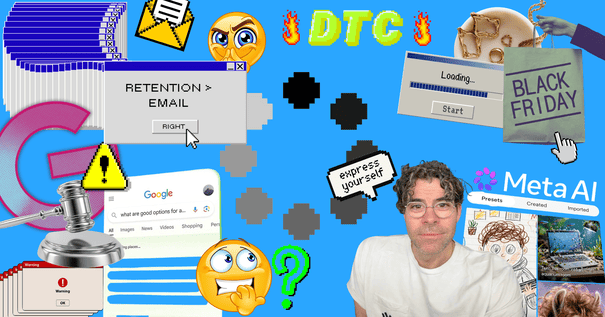
Good morning. Today’s insane header image is brought to you by our gen Z social media manager. I don’t really know what’s going on here, and it’s making me feel old, so on with the DTC news and insights you need to hear today!

🛠️ Kurt Elster open-sourced his agency's Shopify catalog playbook
Probably gonna want to bookmark this one. Friend of the pod, Kurt Elster shared nine Claude agent skills on LinkedIn that cover the exact order his agency runs a new client's catalog cleanup: audit the mess, bulk edit safely with Matrixify, backfill SEO metadata and structured data, map old URLs after a migration.
Shopify's own AI toolkit gives an agent the API access, but Elster's skills give it the judgment. Which fields not to guess on, when to trust the API readback over what the storefront shows, how not to let Matrixify quietly wipe something important. That's the gap that gets people in trouble the first time they let an agent touch a live catalog.
Install it in Claude Code and the skills fire off after receiving simple prompts like "audit my catalog" or "fix my 404s."
It's free and it removes most of the friction from something most stores are probably putting off. Grab it here.
⚖️ A court just made Google liable for what its AI Overviews say about your brand
Remember a while ago when AI answers rolled out and it was telling people to eat rocks and stuff?
A Munich court just ruled Google can be held responsible for false claims generated by AI Overviews, after two publishers said the feature linked them to scams and disreputable practices.
The court treated the AI-generated summary as Google's own statement, not a simple link to a third-party source, which is the legal distinction that matters here. Google is appealing.
If an AI Overview misrepresents your brand or your product, that's no longer just an SEO problem. Go search your brand name in AI Overviews right now and see what it says.
🎨 Meta's new AI image model is headed straight into your ad account
Meta rolled out Muse Image, its first image generation model from Meta Superintelligence Labs, live now in Meta AI across Instagram and WhatsApp.
It handles multi-image blending, in-image text rendering, and edits sketched directly onto a photo.
Meta confirmed that advertisers and agencies will get Muse Image inside Advantage+ creative in the coming weeks.
The timing of this is kinda funny considering the amount of posts I’ve seen lately of people saying Meta isn’t even displaying their already-built ad images correctly.
Anyways, watch for it in Advantage+ over the next few weeks.
📱 In the age of AI-generated everything, ugly is a strategy
Is this news? No. But I do think it deserves a spot up here today.
Ugly ads are good ads. With everything leaning AI these days, Rok Hladnik posted this simple but true line yesterday: “In this era of AI-everything, Ugly ads are more important than ever”
Lean into lo-fi, make something that’s not perfectly polished, take a picture on your phone and throw a quick Canva overlay on it.
One of the biggest advocates of ugly ads I know, Barry Hott (who you probably saw posting those sticky note ads), echoed Rok’s post with the very understated, “UGLY ADS ARE MORE IMPORTANT THAN EVER.”
Long live ugly ads.
💰 A jewelry brand's April sale outperformed BFCM by 222%
The Pilothouse team shared this one with me and I had to do a double take on the numbers.
A 7-figure jewelry brand ran a locked site sale in April. It was password only, and you only got the password by being on their email list.
It was their first promotion since Black Friday, three days locked down before they opened it up to Meta ads for eight more.
The numbers against their own BFCM: net sales up 222%, conversion rate up 218%, ad spend down 35%, $50k in email revenue on day one, and email CTR hit 8.37% against a 2.4% average.
The reason it worked is that they hadn't promoted anything since November, so by April there were months of pent-up demand sitting there waiting (plus, who doesn’t want to be in on the exclusivity? I’d unlock just to see what they were up to).
When the sale dropped it didn't feel like the generic spray-and-pray 10% off discount email, it felt like getting let in somewhere. Bestsellers at 35% off, old inventory at 60% to clear it out, restocks and prototypes in small batches.
If you're a premium brand scared of what a deep discount does to your perception, trying out a site lock could be an interesting opportunity for you to test the waters.
Are you team planning big sales moments through the year or riding the wave and discounting when the moment feels right?
🎧 The First 30 Days That Determine Customer Lifetime Value
Thomas Lalas, founder of Art of Ecomm and author of Retention Economics, joins Jordan on the TWBERP podcast to break down why the first month after a customer's purchase has an outsized impact on lifetime value, profitability, and long-term growth.
They discuss why retention is much bigger than email, how top subscription brands reduce early churn, and the systems they use to turn first-time buyers into loyal customers.
▶️ Watch here | 🎧 Listen on Spotify
📈 Simply making new creatives won't fix your rising CPAs. Find the real causes of rising acquisition costs and how to move CPA, ROAS, and AOV at the same time. Grab Clustie's free CPA Playbook here. *
* sponsored
Did you find this valuable? Support us by checking out our businesses:
Please note that items in this newsletter marked with * contain sponsored content.
.svg)


.svg)


.svg)


.svg)
.svg)
.svg)