SPONSORED BY:



Here’s what you’ll find in today’s DTC:
You’re reading this newsletter along with new subscribers from: StoreHero, Ailments Fabbrica, and Deckers. 👋
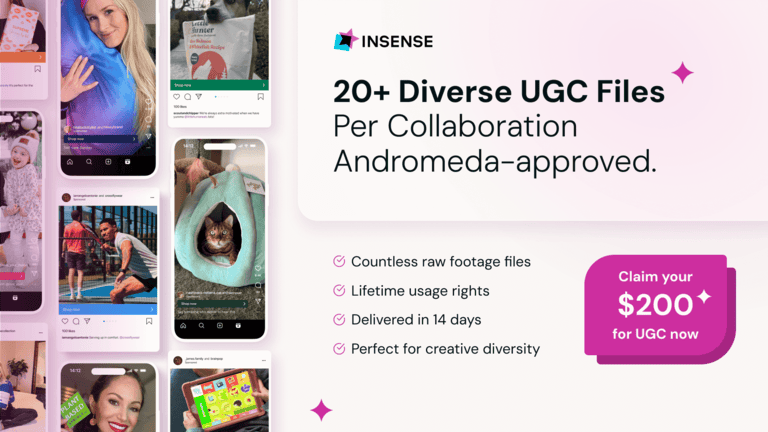
🤔 Ready For Winning Marketing Math? 1 UGC Creator = 20+ Ad Variations = Andromeda-Approved Creative Diversity
Wonder how major DTC brands, including Beauty Pie, Bones Coffee, Flo Health, and Aceable, scale UGC without killing team bandwidth?
They use Insense to make insanely cost-effective UGC ads. 💸
From just one collab, get numerous raw footage clips to mix and match into multiple scroll-stopping creatives for your paid social ads.
What you get:
Ready to turn one collab into 20+ testable ads?
Book a free strategy call by January 23rd and get $200 for your first campaign.
* sponsored

🤖 Five Hidden Tradeoffs of Using AI in Paid Media
Last week we talked about the advantages of using AI in paid media to unlock speed, scale, and efficiency.
But those advantages can quickly turn into liabilities without the right strategy behind them.
AI-driven campaigns can quickly hit plateaus without clear goals and oversight.
Below are five common downsides of leaning too heavily on AI in paid media and what to watch for to stay in control.
1. Limited or Incomplete Data
AI is only as good as the data it receives. When tracking or attribution breaks down, optimization suffers.
What to look out for:
2. Unclear or Misaligned Objectives
AI will optimize exactly toward what you tell it to, whether or not that aligns with revenue. You may end up optimizing for vanity metrics instead of business goals.
What to look out for:
For example, TikTok campaigns optimized for Video Views can generate engagement without driving purchases.
Performance Max campaigns optimized for traffic instead of revenue often chase low-quality clicks that hurt ROAS.
3. Over-Reliance on Automation
Automation should support strategy, not replace it. AI lacks brand context, market nuance, and creative intuition.
What to look out for:
4. Poor or Incomplete Attribution
Without clear visibility into where conversions originate, AI struggles to scale what’s actually working.
What to look out for:
5. Loss of Control and Transparency
As automation increases, visibility often decreases.
Without transparency, it’s difficult to refine strategy or apply learnings across channels.
What to look out for:
The takeaway?
The most effective paid media programs use AI to execute faster and more efficiently within a human-designed framework.
That means: clear objectives tied to revenue, reliable data, and human oversight to spot blind spots and guide optimization.
If AI is running your account, double-check these five areas this week.

📦 Ship With Walmart: Ship Smarter. Spend Less. Scale Faster.
➡️ Are you a Walmart Marketplace seller looking for a shipping edge?
⚡ Consider Ship with Walmart your secret weapon for cutting costs, boosting performance, and scaling on one of the U.S.'s fastest-growing eCommerce platforms.
(1) Walmart first-party data, 6/20/2025.
(2) Walmart first-party data, 2/1/2025–5/30/2025.
* sponsored

🎧 The Old Spice Rebrand That Actually Worked
Old Spice didn’t just change a logo.
They rebuilt relevance.
In this episode, Aves breaks down one of the most successful rebrands of the last 20 years and why Old Spice’s 2010 reset worked when so many modern rebrands fall flat.
From shifting targeting to focus on women to launching online instead of the Super Bowl, this was a masterclass in cultural timing and segmentation.
What we cover:
▶️ Watch the full episode on YouTube.
🎧 Or listen here on Spotify.
Cart Abandonment Idea 💡
Instead of sending the same abandonment email to everyone, Andreas Janesch recommends this conditional split based on free-shipping eligibility.
Already qualified? Emphasize free shipping.
Not qualified? Offer a cart discount.
A simple flow that protects margin whenever possible.
📥 Got a B2B Biz?
Join dozens of B2B companies finding demand-gen success through our niche community of 150k brand leaders and founders this year. Talk to our team to learn more.
DTC Newsletter is written by Rebecca Knight and Frances Du. Edited by Eric Dyck.
Please note that items in this newsletter marked with * contain sponsored content.
.svg)


.svg)


.svg)


.svg)
.svg)
.svg)