Good morning. Happy Friday!
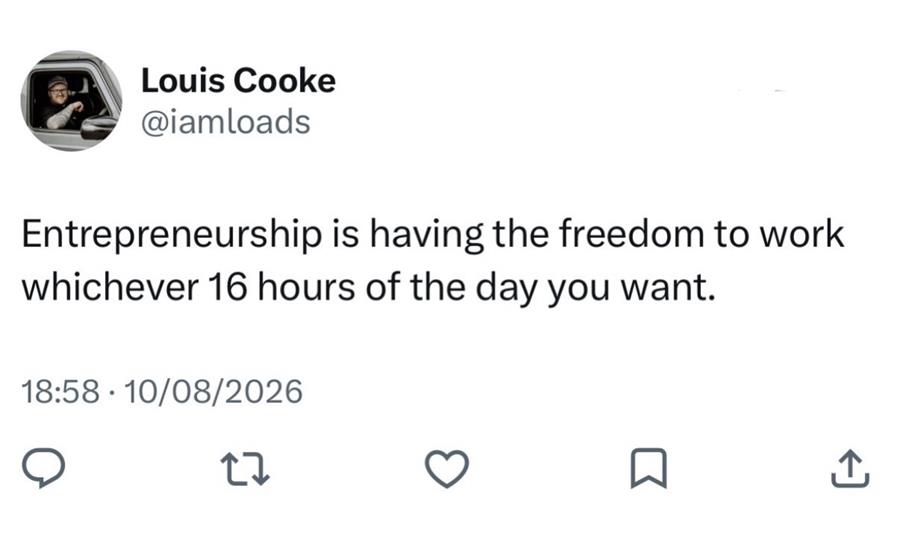
“Be your own boss” really buried the lede on the whole “your boss now lives inside your head and has no respect for business hours” thing.
Figure something out this week? Work on or solve something cool? Reply to this email and tell me what. Humble brag a little, it’s Friday.
Here’s what’s in the stack today:
💸 Amazon would like to hold your money for another week
Another group of Amazon UK sellers moves to delivery-date-based reserves today, which means Amazon can hold funds until seven days after confirmed delivery. Slow carrier confirmation can stretch that out even longer.
Amazon says sellers may see less cash available for seven to 20 days during the transition. Fun.
Eligible sellers who haven't migrated may be able to defer until January 19, 2027, but once you move over there's no going back. Check your reserve status before the next three weeks of bills depend on money Amazon has decided it needs to hold onto a little longer.
⏰ The Q4 planning gap nobody talks about (5 minutes, anonymous, and a shot at $1,000)
Right now, every DTC brand is setting their Q4 discount strategy in a vacuum. You don't know if 20% off is aggressive or standard. You don't know if free shipping beats a % discount for retention. You're guessing, and so is everyone else.
We're fixing that with Beyond the Discount, a two-sided benchmark pulling data from DTC brands on their Q4 plans, and from shoppers on what actually drives purchase and loyalty.
Add your answers and you'll get the full report first, covering:
Takes about 5 minutes, fully anonymous. We only grab an email at the end for the $1,000 gift card draw* and to send you the report.
Note: Survey results may be used in DTC editorial and advertorial content. Personal info won’t be shared.
* One entrant will be randomly selected to win a $1,000 Amazon Gift Card. No purchase necessary to enter. Survey must be completed by Sunday, August 23rd, 2026 to be eligible. This giveaway is open to legal residents of the United States and Canada (excluding Quebec) who are 18 years or older. Void where prohibited.
🤖 Your beautiful product page may be useless to an AI shopper
Stanley (the water bottle company) figured this one out the hard way. Its imagery-heavy occasion campaigns weren't giving AI shopping tools enough text to understand when or why someone should buy its products. So they’ve started adding FAQs, care instructions, structured data, and natural-language guides built around specific use cases like gifting, travel, fitness, and hosting.
Open your top five PDPs and read them without looking at the photos. If the copy can't explain who the product is for and where it fits into their life, ChatGPT probably can't either. And ChatGPT is becoming one of the things deciding whether your product gets recommended.
📊 TikTok would also like credit for the sale on your Shopify store
TikTok Shop launched an Off-site Performance Analysis tool that connects purchases on external stores like Shopify with exposure to TikTok Shop content. You can now compare who bought through your DTC site against who came through livestreams, videos, and product cards.
TikTok doesn’t get full credit though. Amazon, Walmart, and offline sales are still outside the reporting. TikTok also changed its attribution logic without restating historical data, which means your existing reports may stop making sense unless you export them now.
🚚 One less shipping app to pay for
Shopify merchants in the UK, Germany, France, Italy, and Spain can now buy DHL Express labels directly inside Shopify admin. Domestic and international labels, customs documents, DHL On Demand Delivery, works on every plan, no separate DHL account, no app, no monthly fee. You pay per label.
For anyone whose shipping stack currently has more subscriptions than their streaming account, this is a nice little win.
📌 Pinterest wants a piece of your Amazon affiliate sales
Pinterest creators can now connect an Amazon Storefront directly to their Pinterest account, giving product-led Pins a shorter path to checkout. Amazon creators get more distribution, Pinterest gets more shoppable content, and brands get another affiliate channel to monitor because apparently there was room for one more.
Check which Amazon creators already make Pinterest-friendly content. Their existing product photos, lists, and gift guides may be enough to get a test running without producing anything new.
🗣️ Rewrite your landing page headline in first person
@KanishDigital says one of his biggest landing page wins has come from turning brand promises into customer first person language.
“Lower your cholesterol in 8 weeks” becomes “I finally got my cholesterol down without giving up everything I love.”
The second version reads like a customer outcome instead of ad copy. Pull the strongest line from your reviews, rewrite it in first person, and test it against your current headline.
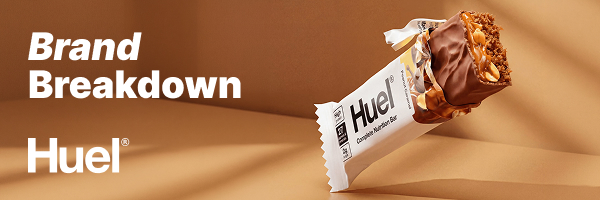
💡 Huel has plenty of reasons to buy. Some of its best ones are easy to miss.
Huel has built its brand around making complete nutrition convenient, with products spanning powdered meals, ready-to-drink shakes, hot meals, bars, and more.
Convenience sits at the center of the positioning. Huel promises complete meals in seconds for people who want to spend less time cooking or meal prepping.
The Pilothouse CRO team analyzed Huel's US DTC site and shared what they found.
Here are the biggest opportunities they found: 👇
The Product Detail Page (PDP)
Huel's PDP for Black Edition establishes clarity fast. The headline at the time of review, "High-protein, high in fiber," defines the product on sight, and the above-the-fold layout pairs a clear product image with a high-visibility Add to Bag button.
The page also carries substantial proof throughout:
The biggest opportunities are surfacing value that already exists earlier in the journey and tightening cart and checkout mechanics. There are also opportunities to make Huel's science and comparison content easier for shoppers and search systems to discover and parse.
Add a sticky mobile CTA.
Huel gives shoppers a lot of detail as they scroll, from ingredients and health benefits to product comparisons. On mobile the Add to Bag button scrolls out of view as soon as a visitor reaches the ingredient profiles.
Pilothouse recommends a sticky, minimalist CTA bar pinned to the top or bottom of the mobile screen, so purchase intent can be captured at any scroll depth.
Move the free gift offer above the fold.
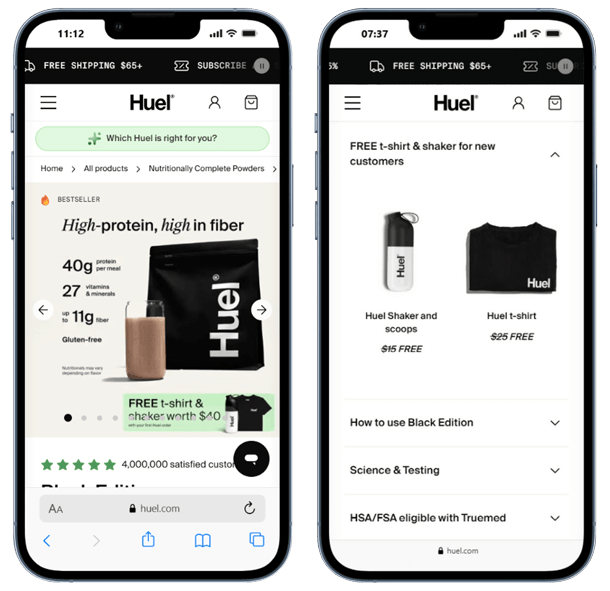
The free t-shirt and shaker offer, worth $40, sits buried below the carousel dots and takes up excessive space in the first accordion. Subscription is $45, so this offer nearly covers the cost of a first shipment.
Moving the image and text higher in the gallery and trimming the padding on the dropdown box will put this incentive in front of visitors immediately.
Make the scale of Huel's social proof more tangible.
To build immediate credibility, Huel features its Trustpilot rating and star reviews prominently on its PDPs.
The social proof can be made even more persuasive by showcasing visual user-generated content (UGC) higher up.
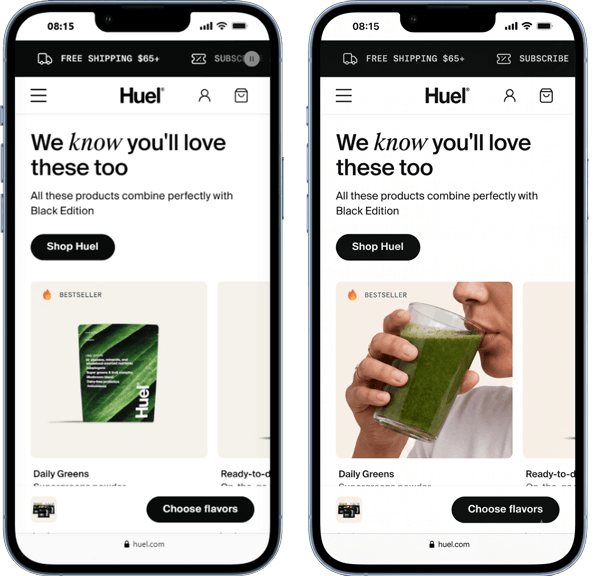
The hover state on the product image currently shows a smoothie being poured. Replacing it with a photo of a real person drinking the smoothie, alongside a dedicated community section of customers using the product in everyday scenarios, gives the page a human anchor.
The Paid Traffic Landing Experience
Build dedicated landing pages for each ad angle.
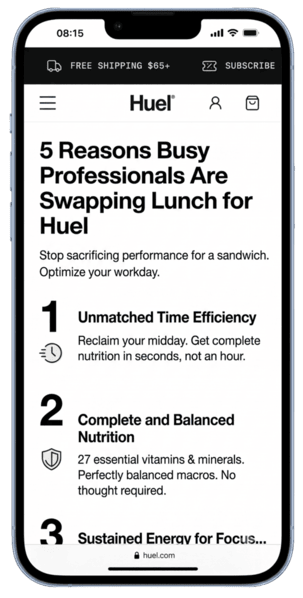
When an ad is built around a specific audience, objection, or promise, sending that traffic to a generic homepage or collection page can make the visitor reconnect the argument themselves. Dedicated landing experiences are worth testing for Huel's biggest paid angles.
Answer three big cold-traffic objections earlier.
For a shopper arriving cold from a short-form ad, three questions are worth answering quickly: What exactly is this? Why is it worth $2.65 per meal? What happens if I subscribe and want to cancel?
The PDP gives motivated shoppers plenty of depth once they start researching. For colder traffic, some of Huel's strongest risk-reversal and subscription messages could be surfaced closer to the first purchase decision.
Here are some possible solutions.
1️⃣ Test a simpler starting choice. Black Edition currently presents 11 individual flavors alongside a Variety Box and Bestseller Trio. That's a large first decision for someone who has never tasted Huel. Test the current equal-weight selection against a version with one clearly recommended starter option pre-selected. Measure the impact on add-to-cart rate and conversion rate.
2️⃣ Surface the taste guarantee prominently. Huel already promises “Love it or your money back,” but the guarantee appears much farther down the Black Edition PDP. Test repeating that risk-reversal message beside the purchase controls and again near the final checkout decision.
The Cart and Checkout Experience
Fix the Learn More link in the cart drawer.
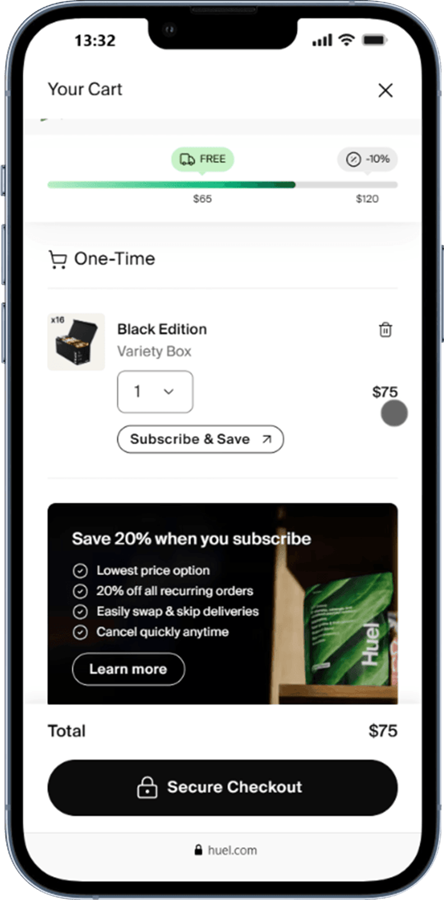
In Pilothouse's test, clicking Learn More opened content behind the active cart drawer, leaving the destination hidden until the drawer was closed. That's an avoidable interruption during the subscription decision.
There's also an inconsistency in the subscription controls. In Pilothouse's test, Subscribe Now opened a separate page while Subscribe & Save changed the cart item directly. Testing one consistent interaction for both actions would remove an extra decision and keep shoppers inside the cart.
That’s all for today’s brand breakdown! Have a brand you want us to take a look at? Reply back to this email with the name and URL.
Have a great weekend!
Did you find this valuable? Support us by checking out our businesses:
Please note that items in this newsletter marked with * contain sponsored content.
.svg)


.svg)


.svg)


.svg)
.svg)
.svg)