Good morning!

Business on top, comfort on the bottom.
Here’s what's in the stack today:
Shopify launched Shop MCP, a connection that lets compatible AI agents search products, build carts, and complete purchases.
It works with more than a billion products in the Shopify Catalog.
Signed-in shoppers can use saved preferences, addresses, and Shop Pay details, confirming the total and payment method before the agent completes checkout.
The opportunity is a shorter path from an AI recommendation to a purchase. For operators, this is a good reason to review product titles, descriptions, pricing, and availability so agents receive accurate information when helping shoppers choose.
@IstvanicMarin shared how changing markets improved one client’s creative testing results.
The client was evaluating new creative in the US, its largest market, with a 15% hit rate. The UK, meanwhile, had a 30% higher conversion rate.
After moving creative testing to the UK, the hit rate rose to 28%. He then moved winning ads into the US using their post IDs to retain social proof.
A cheaper, stronger-performing market could give new creative more room to prove itself.
Check your market-level costs and conversion rates before choosing where to evaluate creative. Then validate winners in the destination market, since performance won’t always transfer.
Google Ads is testing a setup flow that asks advertisers to describe what they want a campaign to achieve, then uses AI to suggest goals and assets.
Google hasn’t announced a broad rollout.
If it appears in your account, try a specific brief covering the product, customer, and desired outcome. Review the suggested goals and assets before publishing, particularly whether the goals match the results you actually want.
Maybe Meta is doing too much of the heavy lifting. Maybe you’ve been meaning to get serious about Amazon, retention, or CRO. Maybe the creative pipeline already feels tight.
That’s the kind of stuff Pilothouse can help with.
The teams work across media, creative, email, CRO, Amazon, and data, so they can look at the full plan and see where your next round of growth could come from.
With BFCM coming up, this is a good time to get another experienced set of eyes on what you’re working with.
Already feeling 100% confident in the plan? Great. The Pilothouse team is still happy to give it a second set of eyes. Book a call with the Pilothouse partnerships team.
Vitruvi’s Air Cordless Diffuser page has a graphic that explains setup in three steps. It’s the fourth image in the gallery, which means plenty of first-time visitors may never reach it.
This week’s pre-BFCM CRO test fixes that with zero new design work.
Pilothouse recommends moving the setup graphic from fourth to second, keeping every other asset unchanged.
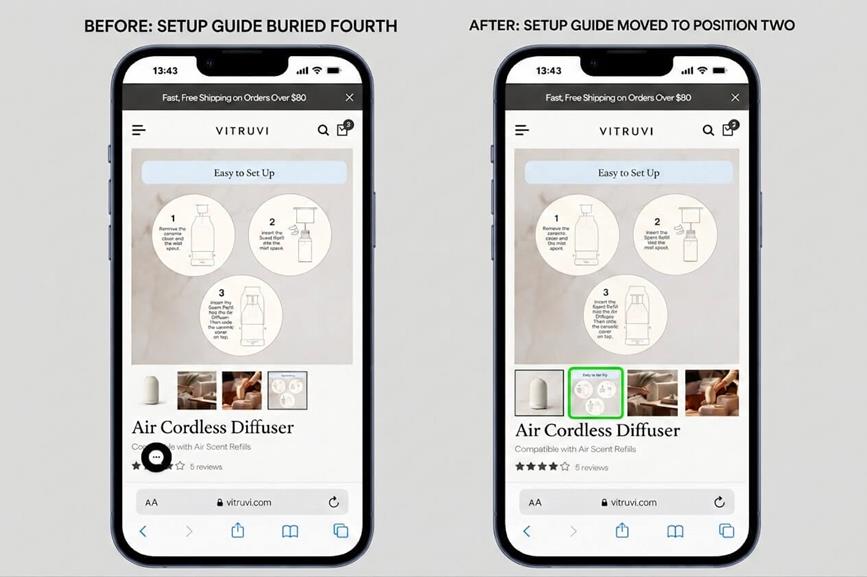
How to run this CRO test:
Mobile is where this matters most. Shoppers swipe through galleries one image at a time, and phones drove 52% of online spending during Prime Big Deal Days.
This approach can also work for apparel sizing guides, product comparison graphics, ingredient callouts, assembly instructions, or “what’s included” images.
Which image in your current gallery answers the biggest customer question, and how far do shoppers have to swipe to find it? Hit reply and let us know!
Customer journeys look nice when we draw them on a slide.
Pilothouse’s Head of Email and Retention, Jordan Gordon, took a much messier route into Formula One.
It started when his five-year-old son mentioned that a friend had a McLaren Hot Wheels car. Later, Jordan spotted the same car at Walmart and bought it. Then YouTube started connecting more dots.
Jordan already watched Red Bull content, which led him to videos featuring F1 driver Max Verstappen. That sent him further down the rabbit hole until he was watching race highlights and googling F1 teams.
Eventually, he landed on the F1 website, entered his email to vote for Overtake of the Month, and downloaded the app.
That journey included word of mouth, retail, licensed products, YouTube, search, onsite content, email capture, and an app download. Jordan calls it an “unstructured touchpoint map.”
His point: each relevant touchpoint can make someone more receptive to the next interaction.
Some of those interactions will never appear in your attribution platform, but they can still be doing important conversion work.
Add a “How did you first hear about us?” question to your post-purchase page, then compare the answers with what your attribution platform credited for the same orders.
▶️ Watch here | 🎧 Listen on Spotify
🤔 What are you using to set your Q4 discounts? We asked hundreds of shoppers what discount pushes their first purchase and what makes them come back. Grab your free copy of Beyond the Discount. *
.svg)


.svg)


.svg)


.svg)
.svg)
.svg)