Good morning,
Here’s what you’ll find in today’s DTC:
1️⃣ Optimizing your site for the subconscious brain, aka the Gator
2️⃣ April Fools' pranks that had us second-guessing ourselves
3️⃣ Why chasing ‘easy conversions’ can damage your LTV
You’re reading this newsletter along with new subscribers from: BioSkin, Made With Intent AI, and BLUNT umbrellas. 👋
🧠 Four Ways To Create A Gator-Friendly Website
Your website is losing sales. Not because of your ads, your offer, or pricing.
But because it isn’t gator-friendly.
Dylan Ander, founder of heatmap.com, shares a behavioural economics framework from Zoe Chance’s book Influence is Your Superpower that reframes how you should think about every element on your site.
It starts with your brain. Specifically, two parts of it.
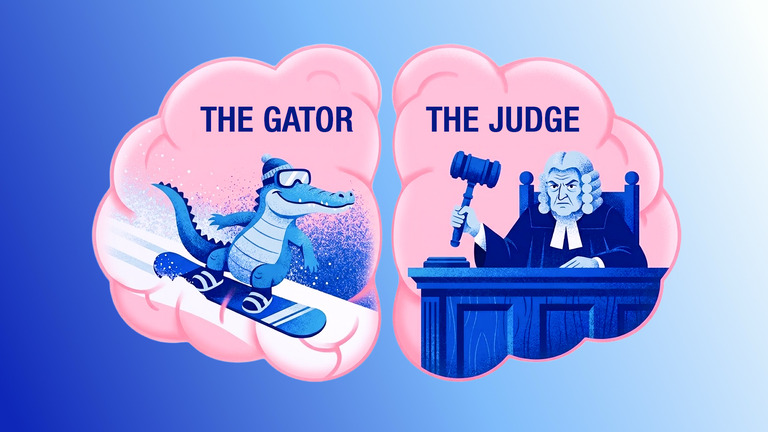
Meet the Gator and the Judge
Your brain has two modes when it shops online.
The Gator is your autopilot: the subconscious mind that's just moving, scrolling, clicking, buying.
Science backs this up: roughly 95% of daily decision-making happens here, without conscious thought.
The Judge is the other 5%. It shows up the moment something feels off: a confusing layout, a headline that makes you work too hard, copy that reads like a legal document.
The Judge bangs the gavel, and the sale is dead.
Your entire job as an ecommerce operator is to keep the Gator in control and the Judge off the bench.
Purchase Intent Velocity: How the Gator Gets to Checkout
Here's where the Gator and Judge framework gets tactical.
Ander calls it purchase intent velocity. This is the idea that a shopper's emotional buy-in must build strong enough throughout their session to eventually overpower the psychological pain of spending money.
Think of it like a ramp. Every page, every image, every line of copy either adds momentum or slows down the potential transaction.
If the ramp is steep enough by the time they hit the buy button, the Gator carries them through. If it isn't — if there were too many confusing moments, too much friction, too little storytelling — the Judge shows up at checkout and they bail.
That cart abandonment problem you've been blaming on your checkout flow? It probably started three pages earlier.
How to make your site more gator-friendly:
1. Write for the Gator, not the Judge. Never write copy above a 10th-grade reading level.
Run your product descriptions, headlines, and email copy through ChatGPT and ask it to simplify.
Hard-to-read copy forces the Judge to engage and that's where you lose people. Clear, simple language keeps the Gator moving.
2. Fix your headline before anything else. Your headline should be the dream outcome: the life your customer wants after buying.
The sub-headline is how you get them there. Most brands flip these, leading with the product or mechanism instead of the transformation.
If you're selling joint supplements to middle-aged women who want to walk without pain, your headline isn't "Amazing Daily Gummies." It's "Get Back to Walking How You Should Be."
3. Don't waste effort below the fold. According to heatmap.com, only 13% of visitors see a footer on average.
Stop polishing the bottom of the page and fix what 100% of visitors see — your headline, your above-the-fold experience, and your primary call to action.
4. Ask your customers what they actually want. Ander's simplest advice: "Ask your customers what they want, give them what they want, and you get what you want — which is money."
A quick post-purchase survey or a reply-to email asking one question will give you valuable insights.
The takeaway?
The stores winning right now aren't necessarily running better ads. They just understand how their customers think, feel, and decide.
Build a gator-friendly experience from homepage to checkout, keep the Judge out of it, and watch your conversion rate follow.

💰 New Seller Savings 2026
Sell better. Sell more. Sell with Walmart.
Sign up now to unlock up to $75K in New-Seller Savings to build your business on Walmart Marketplace* 🛒
🛍️ Reach more customers. Shoppers on Walmart are looking for products like yours.
⚡ Tap into a network of millions. Each week more than 270 million customers shop with Walmart.*
🌐 Expand globally. Easily extend your business to any of their global marketplaces.
Maximize your reach with discounts on referral fees:
*Walmart first-party data.
*Conditions apply. Offer subject to eligibility criteria, promotional savings will vary by seller. See full terms and conditions for offer details.
* sponsored

😂 Best April Fools' Pranks: From Chocolate Heists to Wacky Condiment Flavors
Plenty of brands pulled out their best tricks yesterday, hijacking the year's biggest trends to entertain, and occasionally fool, their social media followers.
Here were some of our favorites.
The Glossier Sardine
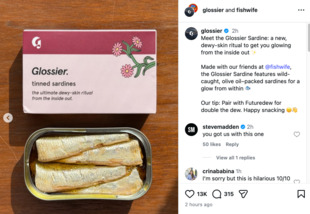
The unexpected collab of the year: Glossier teamed up with Fishwife on a can of tinned fish featuring wild-caught, olive oil-packed sardines, marketed, naturally, to keep you glowing.
Tinned fish has been all the rage for the past few years, and since sardines genuinely are great for your skin, this partnership has fans wishing it was the real deal.
💡 Unexpected collabs generate buzz because they force a double-take. If your prank collab feels like it could be real, you've hit the sweet spot: people will share it just to ask "wait, is this actually a thing?"
Heinz’s Matcha Mayo
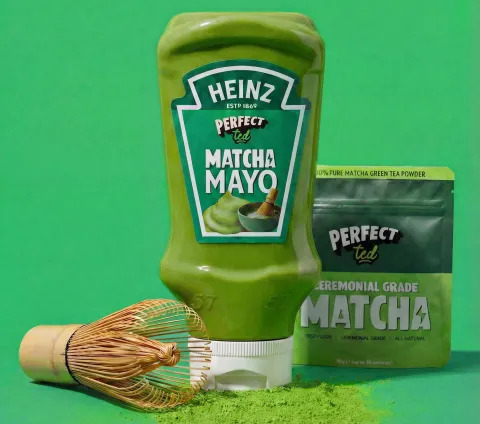
Heinz jumped on the matcha craze, partnering with PerfectTed to launch a new Matcha Mayo, advertised as "a bold take on your favorite sauce."
As matcha fans here at DTC, even we have to admit this one left us feeling a little green.
💡 The best prank products are plausible enough to spark genuine debate. Tying your gag to a real trend (like the matcha boom) earns you relevance even after the joke lands.
The KitKat Heist
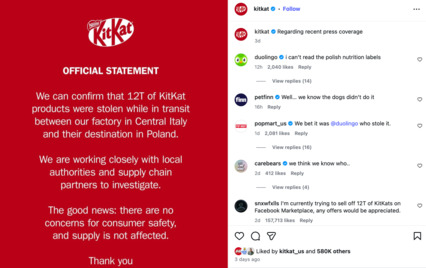
The internet is still debating whether this one is real, but here's what we know: 400,000 KitKat bars went missing earlier this week while in transit from the production facility, and they still haven't been found.
The story was wild enough on its own, but what followed was even better.
Brands like Wendy's, Dr. Squatch, and Domino's jumped into the conversation, launching their own KitKat-inspired creations.
KitKat itself leaned in hard, announcing a job opening for a very important role: Chief Chocolate Protection Officer.
Whether this was a genuine theft or the most elaborate April Fool's long game we've ever seen, KitKat is the undisputed winner of the week, racking up billions of earned media impressions and getting the entire internet talking as we head into the Easter weekend.
Well played, KitKat! 👏
Chris Richards, ecommerce strategist at Pilothouse, recently joined Jordan on The World’s Best Email and Retention Podcast to break down how top DTC brands actually choose which customers to go after and why chasing “easy conversions” can quietly destroy your LTV.
Meta’s ad improvement. Its updated Adaptive Ranking Model uses less compute to deliver more relevant ads and better ROAS. Read more →
OpenAI’s $122B funding round. The record-breaking amount raises the AI company’s valuation to a whopping $852B. Read more →
Allbirds sells for $39M. The wool sneaker brand agrees to hand over assets and IP to American Exchange Group. Read more →
📥 Got a B2B Biz?
Join dozens of B2B companies finding demand-gen success through our niche community of 150k brand leaders and founders this year. Talk to our team to learn more.
Don’t forget to rate the DTC Podcast on Apple (⭐️⭐️⭐️⭐️⭐️)
DTC Newsletter is written by Rebecca Knight and Frances Du. Edited by Eric Dyck.
Please note that items in this newsletter marked with * contain sponsored content.
.svg)


.svg)


.svg)


.svg)
.svg)
.svg)