Good morning,
Here’s what you’ll find in today’s DTC:
1️⃣ How PatPat can build trust faster and increase AOV
You’re reading this newsletter along with new subscribers from: Vish, Campbell's, and Acme. 👋

🐰 Where PatPat Can Build More Trust
PatPat is a Silicon Valley-born kids' apparel brand founded in 2014 by Albert Wang and Ken Gao, two dads who set out to make family fashion affordable, fun, and easy to shop online.
The company offers a wide range of baby and kids’ clothing, and is best known for its matching family outfits and licensed character collections.
Over the past decade, PatPat has scaled into a global ecommerce player, serving 23+ million customers across 100+ countries while building a social following of over 17 million users.
But could the site be doing more to reinforce trust and drive conversion?
Below are Pilothouse’s CRO team recommendations for how PatPat could strengthen the experience even further.
1️⃣ Evaluation of UI/UX (Interface & Experience)
PatPat uses a "More is More" visual strategy, which is common in budget-friendly retailers.
Bold colors and high-res visuals create an immersive experience right away.
This creates a high-energy “treasure hunt” feel that can be engaging for visitors, but it can also introduce friction at key moments.
One opportunity is to rework the visual hierarchy to support conversion more clearly.
On mobile, the primary visual hook is often price/discount messaging.
While that tactic can work well for value-conscious shoppers, it can also push critical product information, like fabric composition and care instructions, below the fold.
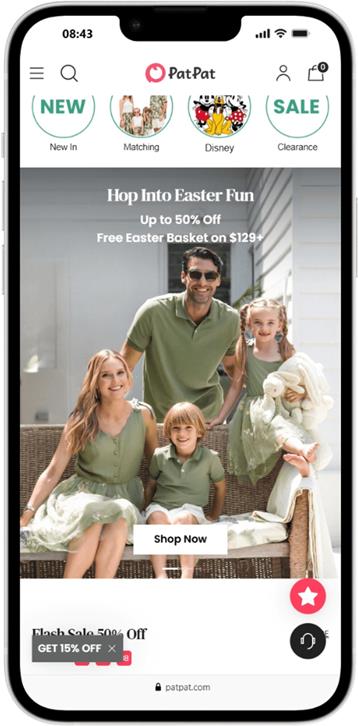
Can you spot how many discount call-outs appear in this screenshot?
The bigger question is whether the information parents care about most is just as easy to find.
Details like whether the fabric is breathable and machine washable are worth surfacing higher on the page.
When this information appears further down the page, visitors have to work harder than expected to find it.
If a user has to scroll through multiple product rows and discount banners just to confirm whether a romper is machine washable, that extra friction can increase drop-off risk.
Pilothouse Tips:
✅ Make common parent questions more prominent: Audit the homepage using a heat map tool to review engagement.
Consider replacing the least engaged section with higher-value product details like fabric, care instructions, or comfort-related callouts.
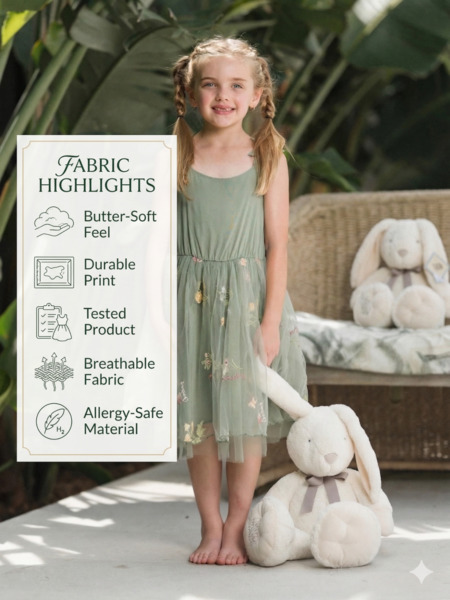
✅ Show and tell: Highlight USPs in the copy, but also include lifestyle information on gallery images on PDPs to convey if it’s allergy-safe, fade resistant, machine washable.
2️⃣ Navigation & Site Flow
PatPat has hundreds of apparel SKUs available.
Parents can choose from a wide range of styles and patterns for their kids. Alongside their own designs, they also have licensing deals with major brands like Disney, Paw Patrol, and SpongeBob SquarePants.
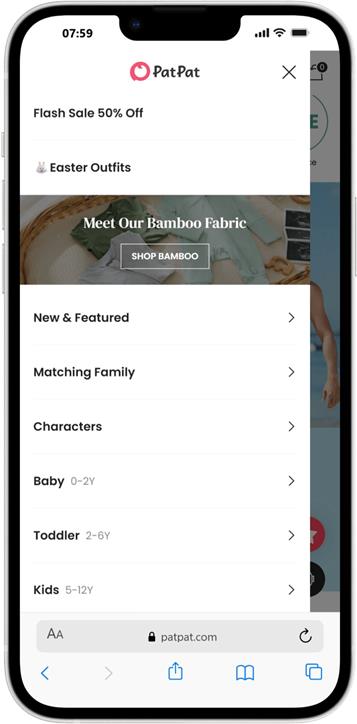
However, the mega menu can feel overwhelming at first glance.
While it's helpful for SEO (e.g. Kids Spring Outfits is a timely keyword to include), it can also create choice paralysis.
With so many choices presented at once, it may be harder for users to know where to start. That added friction makes it harder for users to commit to a path and move toward purchase.
Pilothouse Tips:
✅ Offer a clearer roadmap. Guide customers along the shopping path. Implement "Guided Navigation" or a "Shop by Occasion" wizard (e.g., "Find Easter Outfits in 3 Clicks") to simplify the flow.
✅ A/B test navigation menu: Test replacing broad age collections (Baby/Toddler/Kids) with a “Best Sellers by Age” option, while pushing more of the sorting work into collection-page filters.
Keep reading for more on the PatPat CRO breakdown!
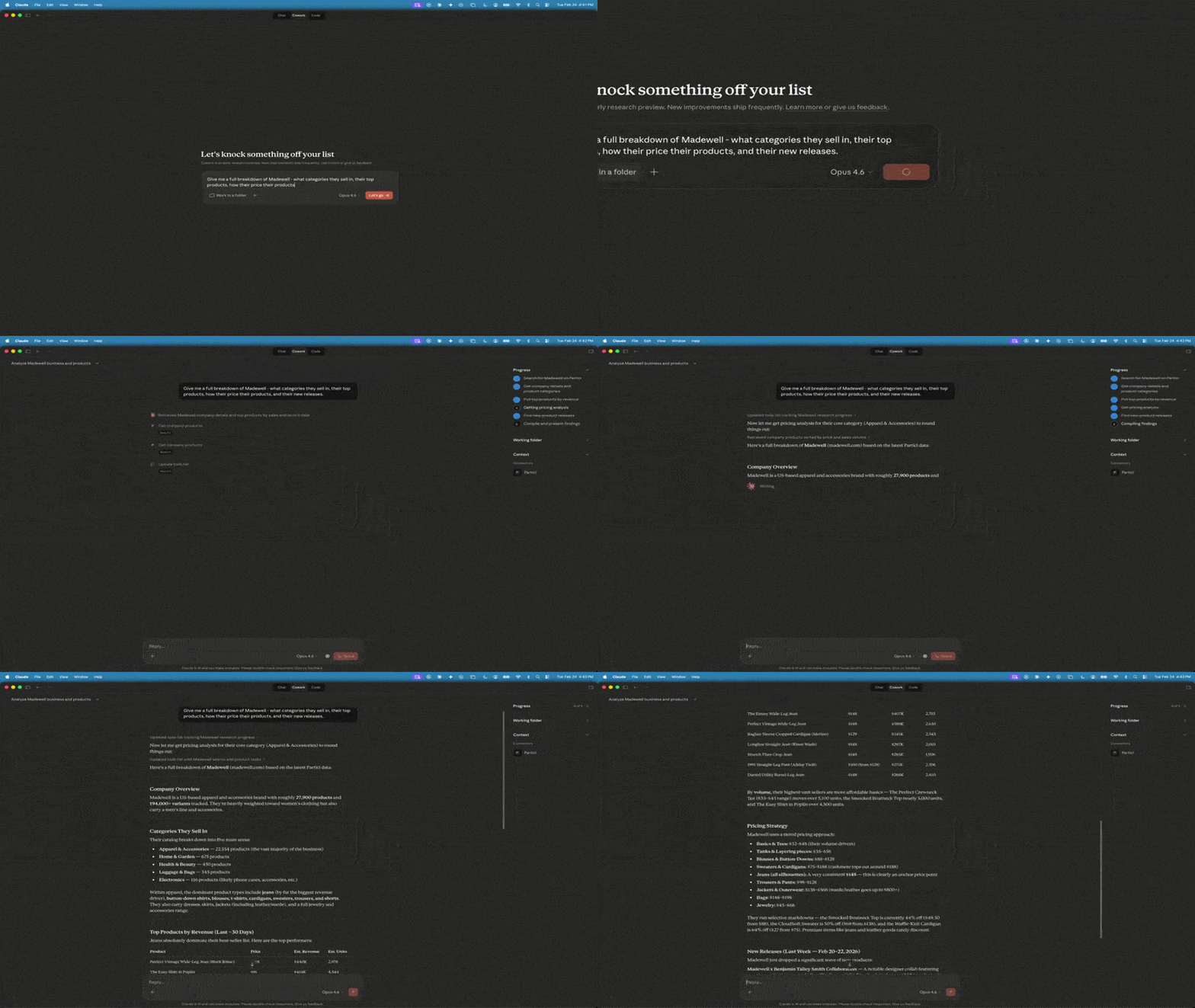
🧠 Ecom Intelligence Meets Claude & ChatGPT
What if you could just ask about your competitors... and instantly know everything?
👉 Particl now connects directly to Claude and ChatGPT, so you can ask anything about your market and get answers backed by real data. 💡
👏 No prompting tricks required. No dashboards to dig through. No reports to build.
Stop guessing what competitors are doing.
Just ask and get actionable insights powered by Particl. ⚡
* sponsored

3️⃣ Mobile Responsiveness
The mobile web experience feels stronger than desktop, thanks to bottom-bar navigation and app-like gestures.
However, load speed appears to be a concern, likely due in part to the heavy use of unoptimized high-res imagery.
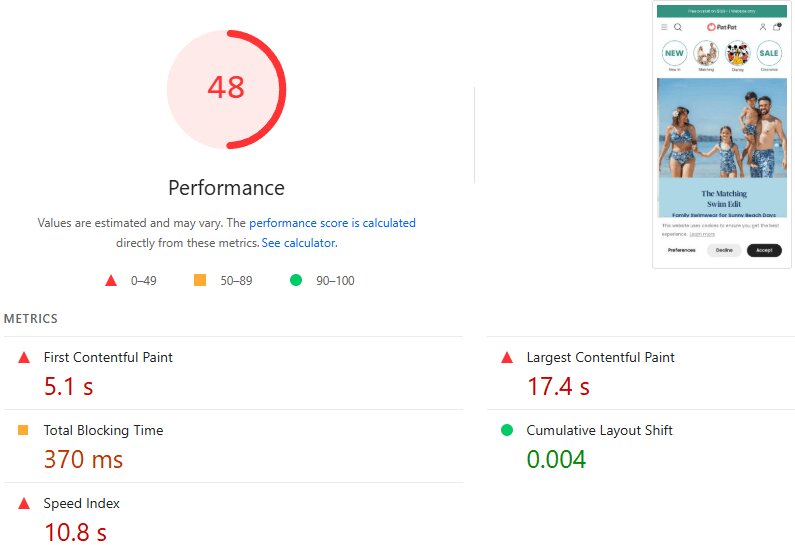
According to PageSpeed Insights for PatPat.com on mobile, the site is currently failing the Core Web Vitals assessment.
The result appears to be driven mainly by speed-related metrics, specifically how long it takes for the page to start appearing (FCP) and how long it takes for the main content to become visible (LCP).
The Time to First Byte (TTFB) is also elevated at 1.7s (the target is <0.8s). This means the browser is waiting close to 2 seconds just to hear back from your server before it can even begin downloading the page.
If your site is using a global CDN (like Cloudflare or Akamai), ensure Full Page Caching is active so that static versions of the homepage are served from the "Edge" closer to the user.
Optimize the Largest Contentful Paint (LCP: 2.7s): LCP measures when the largest element (usually your hero banner or a product image) is rendered. At 2.7s, it is in the "Needs Improvement" zone.
Pilothouse Tips:
✅ Preload the LCP image: Use <link rel="preload"> for the main hero banner to preload the LCP image so the browser starts downloading it immediately.
✅ Image compression: PatPat relies on strong photography, so serving those assets in next-gen formats like WebP or AVIF could reduce file size meaningfully without sacrificing quality.
✅ Disable lazy-loading for the hero: Ensure that the very first image a user sees is not "lazy-loaded," as this adds an unnecessary delay.
✅ Eliminate render-blocking resources: Your site likely has several large CSS and JavaScript files that must be fully downloaded before the page displays. Inline "Critical CSS" (the styling needed just for the top of the page) and defer the rest of the stylesheets.
4️⃣ Messaging and Content Strategy
PatPat’s content excels at emotional resonance and creating a strong sense of community.
For example, the "Two Dads from Mountain View" brand story is a powerful trust-builder since it’s a product made by parents, and for parents.
However, the story is tucked away in the About page and footer.
Bringing that story into more prominent parts of the site could help reinforce trust earlier in the journey.
At the same time, the messaging could do more to reinforce quality assurance.
Parents want confidence that what they’re buying will hold up over time.
Some customer feedback also suggests a gap between expectation and fabric feel, with words like “synthetic” appearing in reviews.
Pilothouse Tips:
✅ Showcase brand story: Bringing “dad-tested quality” into PDP messaging could help distinguish the brand beyond a value-first positioning.
✅ Set clearer quality expectations: Use more descriptive copy regarding fabric "hand-feel" (e.g., "Buttery-soft Bamboo" vs. "Durable Cotton Blend") to better align product expectations with the actual feel of the item.
5️⃣ Conversion-Critical Elements
PatPat clearly leans on urgency to drive conversion, though the use of countdown timers and “Flash Sale” tags can feel aggressive in places.
Over time, heavy reliance on discounts can start to chip away at perceived value.
A tactic to try: Test "Bundle & Save" logic over "Flash Sales" to increase Average Order Value (AOV) without sacrificing margins.
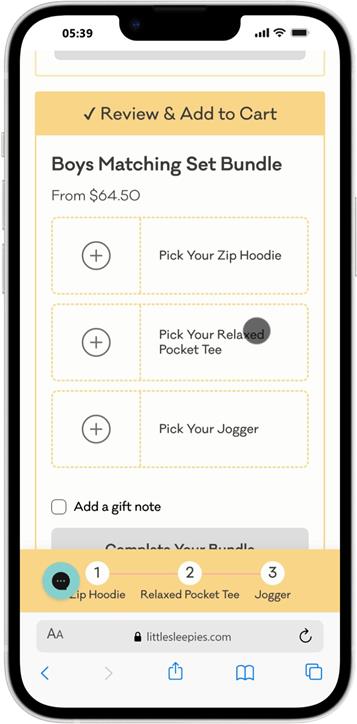
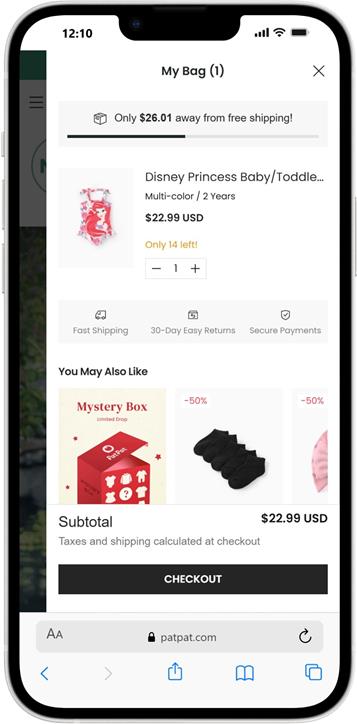
It’s also worth watching potential drop-off points. “Free Shipping over $49” is a strong motivator, but longer delivery windows may introduce hesitation for some shoppers.
In apparel, where customer acquisition costs continue to rise, increasing AOV is one of the clearest levers for scaling profitably.
Pilothouse Tips:
✅ Add a “Complete the Look” section: An easy way for PatPat to increase their AOV is to include accessories like a scarf or a beanie with certain listings, along with a "Complete the Look" section directly below the main "Add to Cart" button.
✅ Leverage bundling: “Bundle & Save” can be added as a widget on selected PDPs just below the fold, or as a dedicated landing page just for selected collections or characters, like Little Sleepies.
✅ Include the automated delivery dates: (e.g., "Arrives by Friday, April 15"). Display this at Checkout, in the Shop app, on "Thank You" pages, and in order confirmation emails.
6️⃣ Retention
The PatPat Rewards program is a benchmark for gamified ecommerce.
It uses daily app check-ins to engage with users. Customers can accumulate points for signing up, leaving product reviews, following on socials, and making purchases.
Users are also given a major birthday perk: 500 points. This is a huge opportunity for customers to stock up on new items or matching sets for the family.
Pilothouse Tips:
✅ Send birthday recommendations: Integrate "Child’s Birthday" triggers into the retention flow, sending personalized matching outfit suggestions 30 days before the date.
✨ Conclusion
PatPat has built an impressive ecommerce engine by leaning into value, variety, and high-energy merchandising.
That same “more is more” approach may also be introducing friction at key conversion moments.
By refining visual hierarchy, simplifying navigation, and prioritizing critical product information upfront, there’s a clear opportunity to turn browsing momentum into higher purchase intent.
New way to evaluate PMax performance. Google advertisers can now get a timeline breakdown of what’s working across Search, YouTube, and Display. Read more →
Crocs’ Mouse Ears. The shoe brand partners with Disney on a jibbitz version of the iconic mouse ears available April 15th. Read more →
WHOOP raises $575M. The wearable health company’s latest funding round brings its valuation to $10.1B. Read more →
📥 Got a B2B Biz?
Join dozens of B2B companies finding demand-gen success through our niche community of 150k brand leaders and founders this year. Talk to our team to learn more.
Don’t forget to rate the DTC Podcast on Apple (⭐️⭐️⭐️⭐️⭐️)
DTC Newsletter is written by Rebecca Knight and Frances Du. Edited by Eric Dyck.
Please note that items in this newsletter marked with * contain sponsored content.
.svg)


.svg)


.svg)


.svg)
.svg)
.svg)