SPONSORED BY:


Good morning,
Magic Spoon is a category-defining cereal brand that has successfully blended DTC growth with retail expansion, serving over 1 million customers and partnering with major retailers like Target and Walmart.
As the brand continues to scale across channels, its site experience plays an increasingly important role in shaping first-time buyer conversion.
The Pilothouse CRO team reviewed Magic Spoon’s website to identify incremental opportunities to unlock meaningful gains.
Here’s what you’ll find in today’s DTC:
You’re reading this newsletter along with new subscribers from: Night Zookeeper, Bimble, and Amuse Drops. 👋
🚀 These 11 Brands Are About To Inspire Your Next Marketing Upgrade
Learn how 11 standout brands, including Dollar Shave Club and Tatcha, are evolving their marketing and service approach. 💯
Klaviyo’s 2026 edition of Behind the Brands breaks down the strategies brands are using to improve the customer experience.
See the patterns behind how these brands drive consistent growth year after year. 📈
Curious how top brands put this into practice?
* sponsored
💰 Magic Spoon’s Buyer Journey: From Discovery To Checkout
1️⃣ AI Search and Discovery
Product discovery is changing as AI search tools gain momentum. Google’s AI Mode is quickly becoming a popular way for users to discover new products and brands.
Here’s how Magic Spoon appears in AI Mode:
When we searched for “best high protein cereal,” Magic Spoon appeared, but not as the top recommendation.
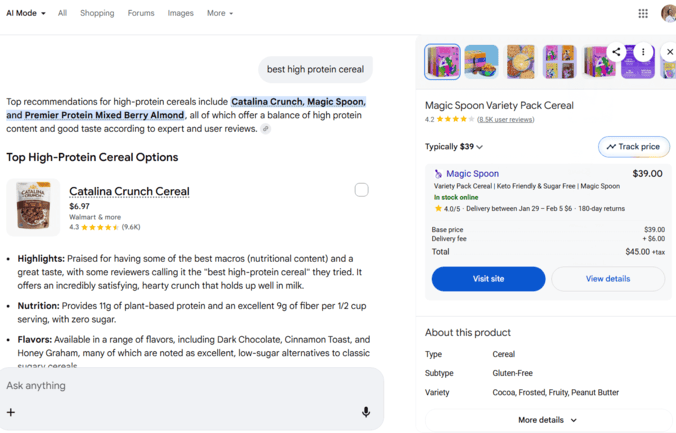
In some searches, competitors like Catalina Crunch appear slightly ahead, with Magic Spoon often ranking close behind.
One opportunity is adopting an “Answer-First” content structure to improve visibility in AI-driven search.
AI tools tend to prioritize pages that clearly articulate what a product is, who it’s for, and why it stands out.
💡 Pilothouse Tips:
✅ Consider adding a concise TL;DR at the top of PDPs that clearly defines the product, audience, and key benefit in 2–3 sentences.
✅ Include FAQ sections with schema: Add an FAQ section on PDPs to directly answer common questions.
✅ Use H2 or H3 tags for questions like "Is this cereal good for those on the keto diet?" and provide a concise, factual answer immediately below it.
✅ Use scenario-based headings: Instead of using generic headings like "Features," use headings like "Why [Product] is Best for [Specific Use Case]."
2️⃣ Website Speed
Now, let’s take a look at site speed. Site speed isn’t just a UX factor—it also influences SEO and conversion.
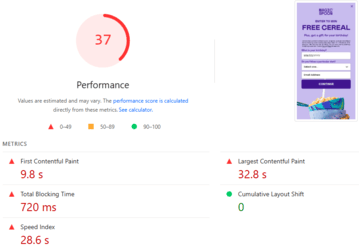
Magic Spoon’s site relies on heavy assets: video backgrounds, high-res product carousels, and third-party scripts (from reviews, tracking, video, and other apps), which can slow down site speed.
Key Observations:
First Contentful Paint (FCP) in PageSpeed Insights is 9.8s. Google recommends FCP under 1.8 seconds for a good user experience.
The Speed Index is 28.6s, indicating that visual content loads slowly across the page.
A one-second delay in mobile load times can impact conversion rates by up to 20%.
The video hero may be contributing to layout shifts and slower load times.
💡 Pilothouse Tips:
✅ Enable caching: To improve First Contentful Paint, minimize CSS and JavaScript, use faster servers, and enable caching.
✅ Create mobile-specific assets: Replace desktop video assets with compressed, static mobile alternatives.
✅ Use "Lazy Loading": Apply to images for the "Best Sellers Grid" so that below-the-fold assets do not block the critical rendering path.
3️⃣ User Experience
Magic Spoon does a great job showcasing the breadth of its product lines, from cereal to granola and treats.
The breadth of options is a strength, but it can also introduce friction for first-time visitors.
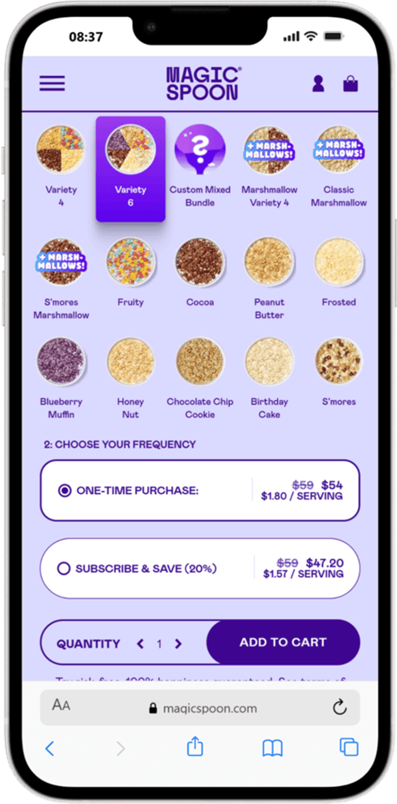
To guide product selection, Magic Spoon implemented a “Bundle Builder.” While this acts as a guided selling tool, it can also create a higher entry point for first-time buyers.
For new users, the bundle flow requires selecting multiple flavors before seeing a price, which can add friction early in the decision process.
💡 Pilothouse Tip:
✅ Launch a "Starter Kit": Create a low-commitment offer geared towards first-time buyers that contains 4 single-serving boxes for $15-20.
Positioned below the fold on PDPs and collection pages, a Starter Kit could complement the existing bundle strategy by giving new customers a lower-commitment entry point while preserving bundles as the primary growth lever.
Keep scrolling for more on Magic Spoon! 👇
👀 Everyone’s About to Market Like This. You’re Early.
People don’t shop in one channel anymore, and they haven’t for a while.
They scroll, tap, bounce, come back, and buy whenever it suits them.
Most marketing tools are stuck treating those moments like separate jobs to manage, stitched together with workarounds and crossed fingers. 🤞
✨ Klaviyo’s latest updates are designed to change that:
These updates aren’t about adding complexity. They’re about making your marketing feel connected, responsive, and built for how customers actually behave.
* sponsored

4️⃣ Social Proof and Trust
Social proof is one of Magic Spoon’s biggest strengths.
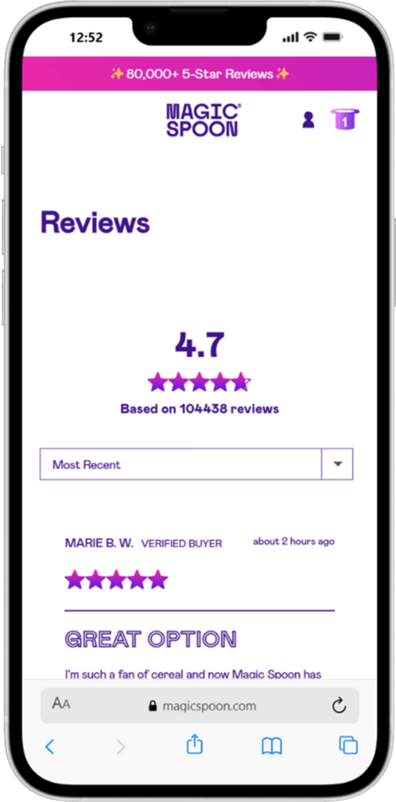
The cereal brand has accumulated a ton of positive reviews and rightfully showcases it across the header and hero sections with an “80,000+ 5-Star Reviews” message.
In some cases, slightly imperfect ratings can feel even more authentic and trustworthy to new customers.
💡 Pilothouse Tip:
✅ Provide social proof (but be honest!): Instead of promoting 5-star reviews, leading with a more factual “100k+ 4.7 Star Reviews” would make the testimonials feel more believable.
Making this change has driven higher conversion rates and lower bounce rates for Pilothouse clients, including a 33% Q4 sales lift in one case.
5️⃣ AOV, Cart Experience, and Free Shipping
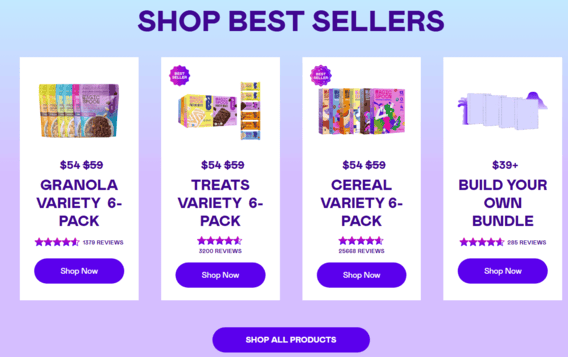
Magic Spoon offers various variety packs and even a custom BYOB (build your own bundle) option to customers as an upsell technique.
They smartly utilize strikethrough pricing and positive reviews to make these options more compelling.
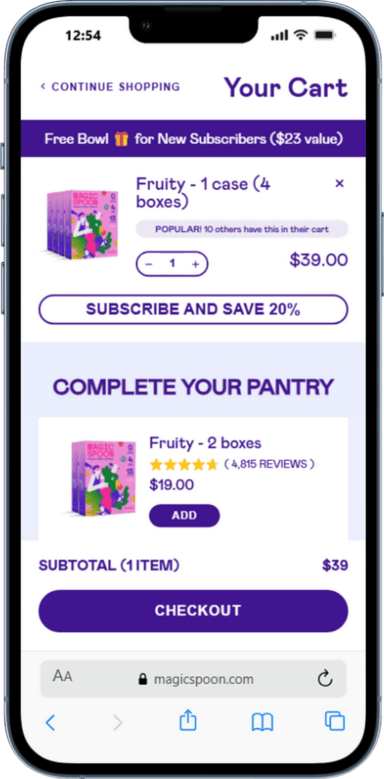
Currently, free shipping isn’t tied to cart value.
Introducing a free-shipping threshold could encourage more customers to add variety packs to their cart, amplifying upsell potential.
Price is another important consideration in the Magic Spoon buying journey.
At approximately $10 per box (when purchased in a 4-pack bundle for $39), Magic Spoon commands a premium of nearly 200% over legacy competitors like General Mills or Kellogg’s.
While Magic Spoon’s cereals differentiate themselves by being keto-friendly and high-protein, this positions Magic Spoon clearly in the premium tier of the category.
💡 Pilothouse Tips:
✅ Introduce free shipping: Add free shipping incentives tied to cart value. This helps justify premium pricing and increases AOV.
✅ Reinforce trust signals: Additional trust signals could strengthen the purchase stage as well (e.g. payment methods, security badges, fast checkout options, etc.)
✨ Conclusion
Magic Spoon has already built a strong foundation across product, brand, and distribution.
The next phase of growth may come from refining moments of friction across discovery, choice, performance, and trust, unlocking incremental gains without compromising the brand’s premium positioning.
📈 Leading brands already have their 2026 strategies in place. Don't get left behind. Explore the strategies shaping 2026 growth in the new Behind the Brands guide. Grab your free copy. *
* sponsored
📥 Got a B2B Biz?
Join dozens of B2B companies finding demand-gen success through our niche community of 150k brand leaders and founders this year. Talk to our team to learn more.
DTC Newsletter is written by Rebecca Knight and Frances Du. Edited by Eric Dyck.
Please note that items in this newsletter marked with * contain sponsored content.
.svg)


.svg)


.svg)


.svg)
.svg)
.svg)