Good morning. It’s Friday, which means it’s time for another brand breakdown. Today we’re tackling Bellroy, the wallet brand who’s been consistently killing it for the past 16 years. Our crack team at Pilothouse found a lot to like, but found there’s still room for some key additions to their Meta Ad Library.
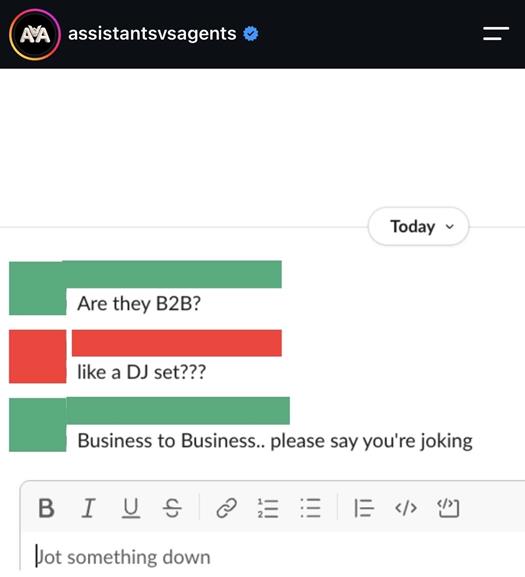
Before we get into that, here are a few key news items to keep in your back pocket with your Bellroy wallet (and a meme to start your Friday):

❌ Doing this in your TikTok livestream can impact your Account Health Rating score
TikTok Shop formally banned scripted AI-generated voices, pre-recorded audio tracks, and radio-style narration from livestreams. Sellers who violate this lose points in their Account Health Rating System.
And the new point system isn't as forgiving as the old one (so probably not the time to just do it and hope for forgiveness). Violations used to reset after 90 days - now they compound over a rolling 180-day window. Hitting 150 points locks you out of new campaigns, 100 points freezes program access for two weeks, and reaching zero points kills the account.
There's no real-time detection yet. Start looking into getting a human host to stay compliant.

Shoppers are asking AI what to buy. Is your brand on the list?
Our new report from DTC Reports benchmarks how shoppers are using AI to find products and what brands are doing to show up when they do.
We're surveying consumers and brands both. Add your data to the 3-minute merchant survey (anonymous) and get the full report before it goes public.
💰 Shein and Temu just cut EU ad spend. That's your cheaper auction
Shein is heading into its Hong Kong IPO at a $40 to $50 billion valuation, well below the $100 billion figure floated back in 2022. Intense ecommerce competition is part of that, and a new EU import fee is adding pressure on top.
Like we mentioned last week, the EU now charges €3 per customs code on any ecommerce parcel under €150, so a five-item order can pick up €15 in duties that didn't exist last month.
Shein and Temu have both responded by slashing ad spend in Europe while they wait to see if shoppers eat the price increase, according to an analysis of Google auction data.
If you're running Google ads into EU markets, that's two of the biggest bidders pulling back at the same time, and auction pressure doesn't stay flat when that happens. Worth checking your EU CPCs against last month's baseline. If Shein and Temu keep pulling back through the summer, this is a real opportunity.
🛠️ Google is letting you turn off Performance Max's worst inventory
Some advertisers are seeing a new "Partners (Alpha)" toggle inside Performance Max that lets you opt out of Search Partners and the Display Network.
Until now, those were bundled in by default with no way to exclude them, which is a big reason PMax spend sometimes lands on inventory that never converts.
This is a limited rollout, so it might not show up in your account yet. If you've been sitting on PMax campaigns with soft ROAS and no visibility into where the spend actually goes, this is the control you've been asking for.
Check your account for the setting, and if you have it, test excluding Display and Search Partners against your existing setup before you assume PMax's automation knows best.
🧠 AI tools are reshaping ecom ops, not just ad copy
@AdamGillman says he runs a nine-figure supplements brand and shares how his AI use breaks from the usual content-and-ads framing everyone defaults to.
His team runs creative ideation through AI to generate dozens of hook variants in the time it used to take to write a handful, and creative testing volume tripled as a result.
Raw customer reviews, support tickets, and competitor data get fed into AI for strategy documents that used to take a human strategist a week.
Their team still reviews the final ad copy so no slop gets sent out.

😬 Rogue resellers and copycats are more than just annoying
Rogue resellers and copycats are quietly draining your margins, tanking your buy box, and eroding the brand you've spent years building.
ESQgo, the company that combines marketplace insider expertise (with actual legal teeth), goes past just identifying something is up.
Here's a few things they've seen recently:
Make sure your daily margins and long-term value are protected. Grab a free Brand Audit Report to see how much revenue you can reclaim.
* sponsored

🦉 Bellroy has a strong brand identity. Creator partnerships are the next lever
Bellroy is an Australian accessories brand founded in 2009, known for minimal, functional designs built from responsible materials. The company launched its first range of five slim wallets in 2010 and has since expanded into bags, mobile phone cases, key covers, luggage, and tech organizers.
The brand reached roughly $300 million in size by 2022, up from an $83 million valuation in 2019. Bellroy generated about $87 million in revenue on its site in 2024, with projections indicating a 15-20% increase in 2025.
We tapped the Pilothouse team and asked them to take a peek into Bellroy’s Meta Ads Library to see what they’re cooking up. Here’s a few examples and thoughts they shared back with us:
1️⃣ Pair the durability visual with concrete time markers
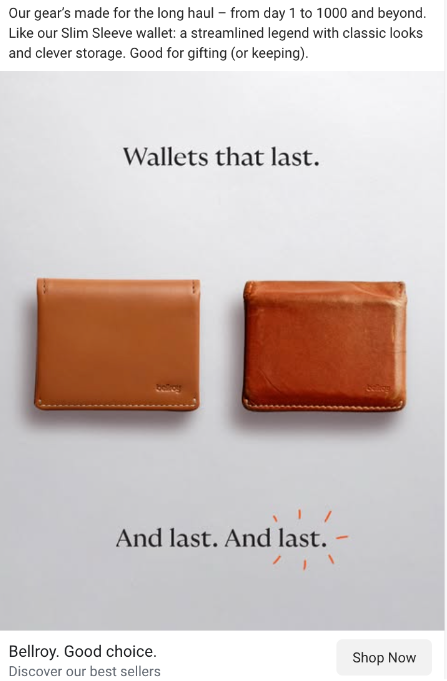
This creative shows a Bellroy wallet's durability over time, contrasting Day 1 against extended use. It visually represents one of Bellroy's main differentiators (durability) and executes it well.
Adding a time estimate underneath each wallet, specifying how long the worn wallet has been in use, would strengthen the claim.
Durability is a core selling point, and a specific timeframe makes the visual more credible. Is the second image from a month, a year, 10 years? We’re not sure, but we’d like to know.
2️⃣ Expand wheel-focused messaging beyond the current angle
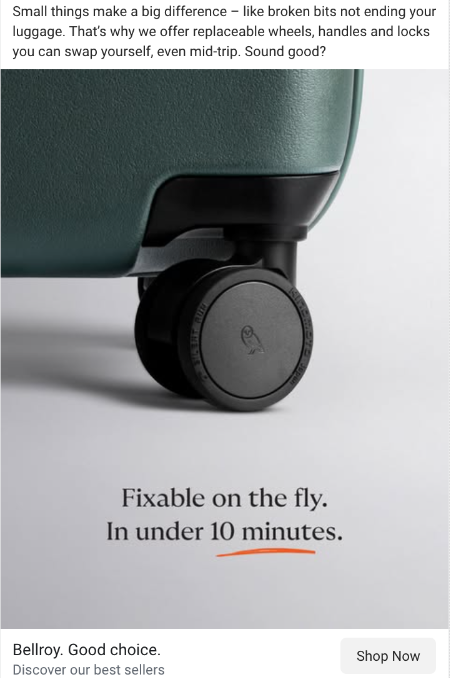
This creative focuses on a suitcase wheel, addressing a common pain point - broken luggage wheels at the airport (aka, the reason there’s luggage stores in the airport… right?).
Bellroy offers replaceable wheels and handles that customers can swap themselves. That's a functional-value angle in a market where most competitors compete on price.
Testing additional wheel-focused copy, covering attributes like glide ability, would give this angle more range.
A short video demonstrating the swap mechanism would also communicate the USP more clearly than copy alone. Show people how easy it is to swap instead of investing in a whole new luggage set.
3️⃣ Show the product from multiple angles
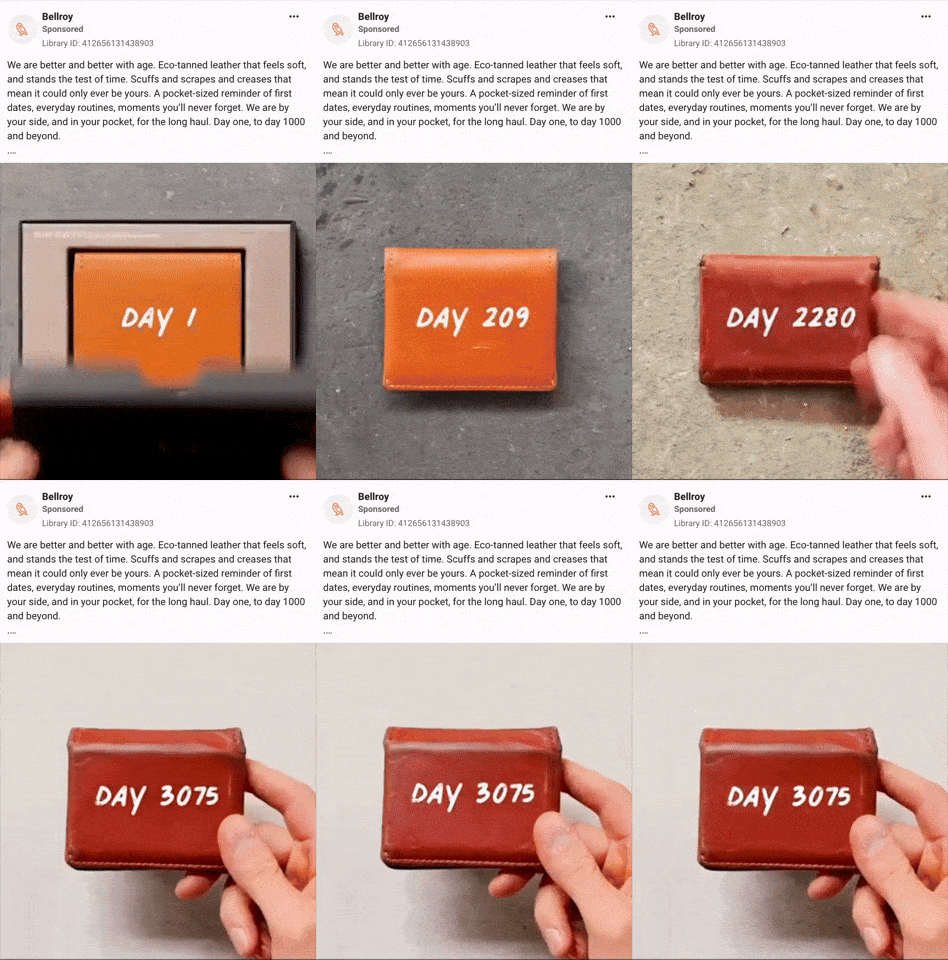
Ah, the days have appeared - love to see it!
This video demonstrates durability by showing wear that occurs off-camera (from unboxing on day one to 3075 days of use), it reads as authentic rather than staged.
The current creative focuses primarily on the front of the wallet. Showing the back, side profile, and interior would give customers a fuller sense of the product's capacity and construction.
4️⃣ Build persona-specific cuts for Meta rather than one broad video

The upbeat music and quick cuts make this an engaging watch. This format fits broad brand awareness goals and suits the video structure that works on platforms like YouTube.
Pilothouse recommends keeping the opening three to five seconds consistent across cuts, then branching into pain points specific to each persona for Meta placements.
‼️ An area of opportunity: Invest in creator partnerships for video content
Bellroy does not currently appear to invest heavily in creator content. Strategic partnerships with travel-focused creators, combined with dark-posting to reach their audiences, would extend the brand's reach and add market value.
Conclusion
Bellroy has a clear handle (this is not a luggage pun) on its brand identity and shows up consistently with strong visual angles.
The next step is platform-specific content strategy: building more short-form video with persona-driven messaging, expanding wheel and durability angles with added specificity, and developing creator partnerships to extend video content organically.
Did you find this valuable? Support us by checking out our businesses:
Please note that items in this newsletter marked with * contain sponsored content.
.svg)


.svg)


.svg)


.svg)
.svg)
.svg)