SPONSORED BY:


Good morning,
Here’s what you’ll find in today’s DTC:
1️⃣ How Nori Press can win back business in a cutthroat paid search landscape
You’re reading this newsletter along with new subscribers from: Thesis, Zoocasa, and BetterMe Rx. 👋
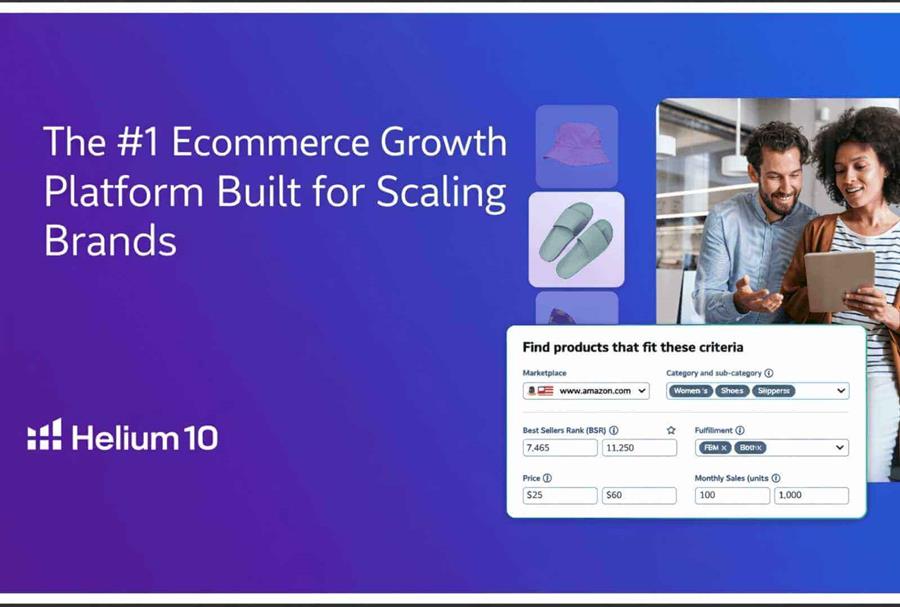
🏆 The Brands Winning on Amazon in 2026 All Have One Thing in Common
They treat it like a growth channel, not a second job.
For most brands managing multiple channels, Amazon can either compound your momentum or quietly drain it.
The difference usually comes down to whether you have a clear view of what's actually working:
Helium 10 gives your brand that clarity.
One platform covering keyword research, advertising, listing optimization, and profit tracking across Amazon, Walmart, and TikTok Shop, trusted by 14,000+ brands worldwide.
Turn your data into profitable decisions. See how to grow your brand across marketplaces. 📈
* sponsored
👕 Inside Nori Press’ Paid Search Strategy
Nori Press is a clothing care brand founded in 2019, built to modernize how people remove wrinkles from their clothes.
Its hero product, a handheld steam iron that can be used without an ironing board, quickly gained traction for its travel-friendly design and ease of use.
As a convenient alternative to traditional irons and steamers, Nori appealed to a younger, convenience-driven audience seeking simple, efficient garment-care solutions.
The product quickly went viral on TikTok and Instagram, got picked up by major media outlets, and reached over 100K customers without relying heavily on paid search.
But virality cannot ensure long-term growth, and Nori’s paid search footprint remains relatively limited.
Pilothouse’s Google team shares how the brand can make these high-impact fixes to their search and paid strategy to scale even further across search, shopping, and video.
Google Shopping
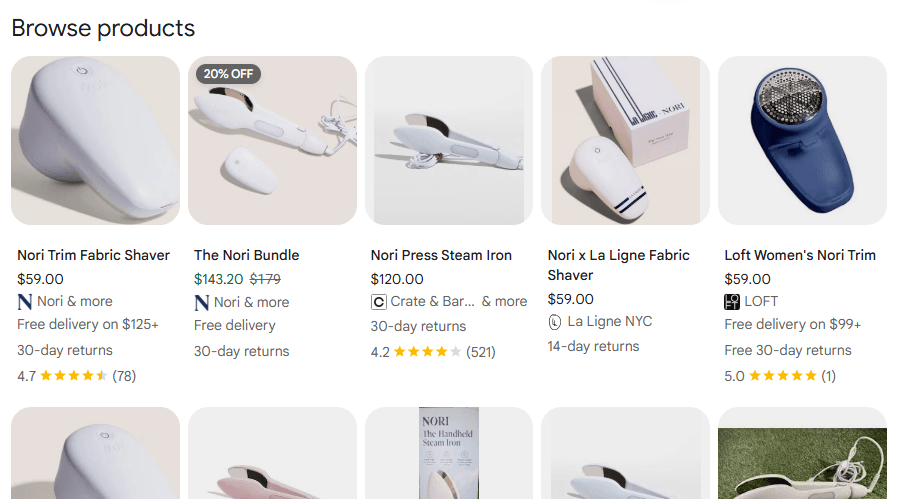
Nori is visible in Shopping, but not in a way that reinforces control.
On branded searches like “nori press,” the product appears consistently with strong presentation: clean imagery, reviews, and pricing.
But alongside those listings?
Resellers. Often undercutting the price by 25% or more.
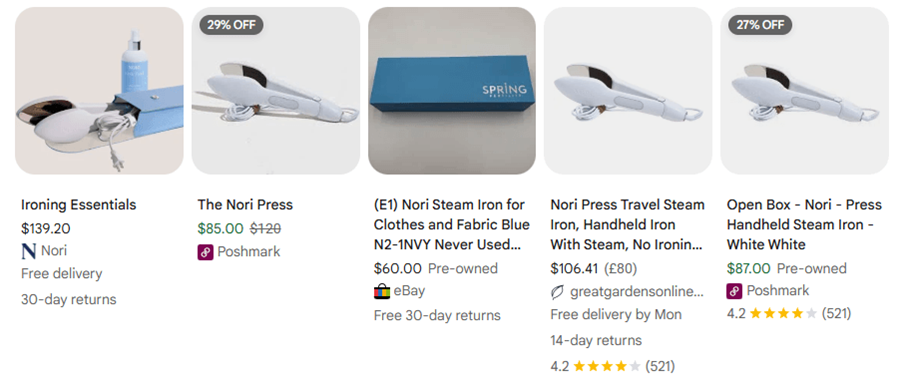
That changes the buying dynamic.
Instead of reinforcing a premium position, the Shopping experience introduces hesitation.
Customers are forced to question pricing consistency, product authenticity, and where they should ultimately purchase.
Why is the same product cheaper elsewhere? Is this the same item? Should I wait? Should I buy from a marketplace instead?
While Nori is present, they aren’t controlling the narrative.
On non-brand queries like “handheld steam iron” or “travel steam iron,” the challenge shifts. These results are dominated by competitors, with little to no direct visibility from Nori. That means high-intent, comparison-driven traffic is being captured elsewhere.
💡 Pilothouse Tips:
✅ Run branded Shopping campaigns to take control of the SERP. Paid placements allow Nori to dominate the top of the page, push resellers down, and anchor pricing around their own offer.
This is especially important when third-party sellers are undercutting or presenting inconsistent pricing.
✅ Use paid Shopping to control messaging. Promotions, pricing, and product titles become standardized. Instead of competing listings with mixed signals, Nori can present a single, clear value proposition at the top of the feed.
✅ Layer in non-brand Shopping to capture new demand. Queries like handheld steam iron, travel iron, and fabric shaver are high-intent comparison searches. Right now, that traffic is going to lower-priced competitors by default.
✅ Test pricing and promotional strategy against resellers. If marketplaces are consistently undercutting, that’s a signal. Paid Shopping gives Nori the ability to respond with controlled discounts, bundles, or value-based positioning without losing visibility.
✅ Protect the premium position. The product stands out visually, but in a feed full of discounted alternatives, price becomes the default comparison point.
Owning top placements allows Nori to reframe the decision around design, quality, and use case instead of just price.
Search
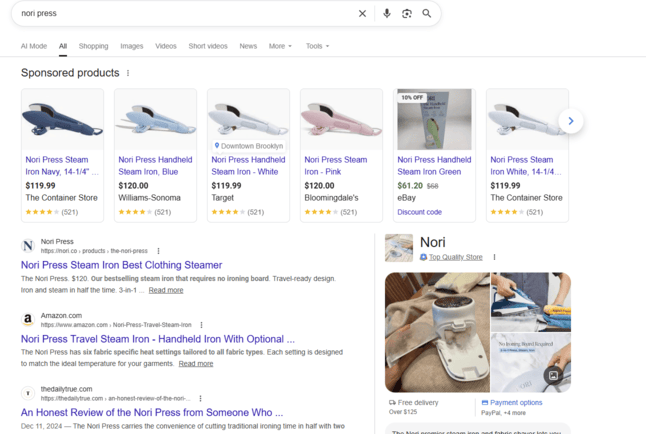
Nori’s keyword coverage is almost entirely brand-focused with limited presence across high-intent, non-brand queries.
The account appears focused on variations of “nori iron,” “nori steamer,” and similar queries.
There is some coverage through blog-driven content, and to Nori’s credit, that content ranks well and connects to product pages. But the strategy leans more toward education than transaction.
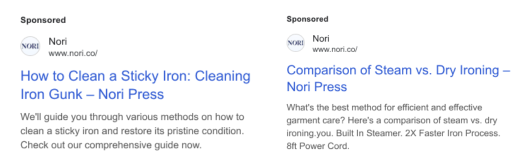
Searches like “dry iron vs. steam iron” build awareness.
Searches like “buy handheld steam iron” capture revenue.
Right now, Nori is underrepresented in the latter.
Meanwhile, competitors (including legacy brands and marketplaces) are consistently present across these product-driven queries. In many cases, Nori is either absent or buried.
And even within branded search, there are execution gaps.
In some instances, ad copy for core product searches leads with accessory messaging, such as the travel case. When a user searches for the Nori Press and lands on an accessory page, that disconnect creates an immediate drop-off.
There’s also an emerging signal worth addressing: queries like “nori press dupe.”
That points to a segment of users who understand the product but are actively looking for a cheaper alternative.
These people want a Nori Press, and their only objection is the price! In 2026, it’s incredibly important for brands to bid on ‘dupe’ keywords.
Sites like Shein and Temu have entire sourcing operations designed to identify products gaining traction, reverse-engineer them, manufacture cheaper versions, and flood the market with them.
And once they have a product, they have the ad budget to massively outbid on essentially any relevant term if they deem the vertical valuable.
That means even high-intent users can be intercepted before ever reaching Nori’s site.
💡 Pilothouse Tips:
✅ Fix branded ad alignment. Every ad should map cleanly to the core product. No accessory-first messaging on product searches.
✅ Expand into high-intent non-brand search. Travel steam iron, handheld steam iron, fabric shaver. These are purchase-driven queries where competitors are already active.
✅ Address dupe intent in copy. These users already get the product. The job is to justify the price. Durability, build quality, and replacing dry cleaning costs all matter here.
✅ Refresh social proof. The Oprah placement is strong, but referencing a 2022 feature in 2026 makes the brand feel behind. Either update it or replace it with scale-based proof.
Video
Nori’s YouTube presence is minimal. Most of their Shorts are repurposed from social media, and there’s limited investment in their paid video strategy.
Small channel, mostly Shorts repurposed from social, with no clear paid video strategy.
This is a missed opportunity for the brand.
The Nori Press is inherently visual. The value proposition is demonstrated in seconds: before, after, done. That format aligns perfectly with YouTube in-stream and Shorts.
The advantage here? Nori doesn’t need to do a lot of heavy lifting. The content already exists.
There’s also a discovery layer being missed. Queries like “best travel iron” or “how to iron without a board” pull in high-intent users actively researching. Right now, all that traffic goes to review channels and competitors.
💡 Pilothouse Tips:
✅ Test YouTube using existing social creative. Start with a simple 15-second demo, a clear hook, and a direct value prop. No need to overproduce.
✅ Build remarketing audiences from site traffic. These users already showed intent; the video just reinforces the decision.
✅ Invest in one strong evergreen asset. Something that covers the product, the use case, and real customer proof. It becomes usable across ads, landing pages, and social.
✅ Capture discovery traffic. Create content based on popular “best” and “how-to” queries to capture first-time customers.
Conclusion
Nori’s product is differentiated, the brand has real awareness, and demand is clearly established.
The opportunity now is ensuring that momentum carries into Google.
This isn’t about rebuilding the account, but about aligning execution with the strength of the brand.
In Shopping, it’s about control. Owning the narrative instead of competing within it.
In Search, it’s about coverage. Expanding beyond brand to consistently capture high-intent demand.
In Video, it’s about leverage. Using existing creative to meet users where discovery is already happening.
These are relatively simple, high-impact changes.
And when executed well, they ensure Nori shows up as clearly and consistently on Google as it already does everywhere else.

Meta shakeup. Hundreds of employees across different departments were laid off this week due to heavy investments in AI. Read more →
Amazon partners with FedEx. The ecommerce giant expands its Free Return programs to over 10K U.S. drop off points. Read more →
EU-US trade deal. Most EU goods will now have a 15% tariff rate, reduced from 30%, while the EU eliminates duties on most US industrial products. Read more →
📥 Got a B2B Biz?
Join dozens of B2B companies finding demand-gen success through our niche community of 150k brand leaders and founders this year. Talk to our team to learn more.
DTC Newsletter is written by Rebecca Knight and Frances Du. Edited by Eric Dyck.
Please note that items in this newsletter marked with * contain sponsored content.
.svg)


.svg)


.svg)


.svg)
.svg)
.svg)