Good morning DTC readers! Happy Friday.
Friday objective: turn off marketing brain.
Friday reality:

Anyway, one last round before we clock out.
Let’s go.
📅 Why August performance might look off, and what to test before BFCM
@rokhladnik has a read on why August feels soft. Buyers in higher-AOV categories delay purchases on purpose knowing Labor Day is coming, on top of the usual post-vacation lull, and this year Meta's shrinking Ads Manager controls add another layer to a slow month.
He's treating Labor Day as the last real test before BFCM: offers, landing pages, creative angles, and discount depth. Whatever you learn over the next two weeks is what you run in Q4.
❗ Shopify's CEO is threatening to ban Claude Code over a file format
Shopify's CEO Tobi Lütke is publicly threatening to ban Claude Code from their engineering org over a text file. AGENTS.md is becoming the standard way teams instruct AI coding agents, and Claude Code still doesn't read it, it uses its own CLAUDE.md instead.
Tobi calls the mismatch "a stupid complexity tax that shouldn't have to be paid." If your dev team runs Claude Code, Cursor, or Copilot on your Shopify build, ask whoever manages your custom code whether they're duplicating instruction files to work around the same mismatch.
💰 Medline just got $243 million in tariff refunds
A medical supplies distributor just got $243 million back from the government. The Supreme Court ruled in February that the IEEPA tariffs from the last year were never legally authorized, and refunds are now working their way through the system.
Medline already passed $89 million of its refund straight to customers. If you paid tariffs under that authority anytime in the past couple years, make sure to claim your refund.
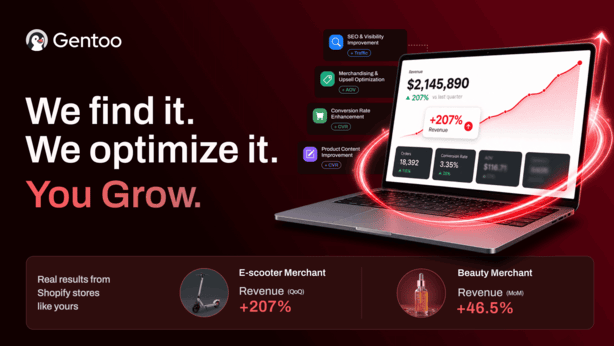
💰 Let AI put your Shopify optimization on autopilot, and watch your revenue grow
There’s plenty of AI tools that’ll audit your Shopify store, spit out 47 recommendations, and then leave you with a spreadsheet.
Gentoo is taking a different approach. It finds the changes that could move revenue, generates the improvements, and publishes them after you approve them. Then it keeps looking for the next thing.
Their merchants are seeing some pretty serious movement: an e-scooter brand was up 207% in revenue and 116% in orders QoQ. A beauty brand was up 46.5% in revenue MoM, while a premium gourmet brand saw revenue up 28% YoY.
You’re already paying people to find these opportunities and implement them. Software that continuously finds the ways you can improve? Now that changes the math.
* sponsored
💡 A fast-growing wellness brand with a clear path to higher conversion
Moodi has built one of Australasia's fastest-growing wellness brands in a short amount of time.
Founded in Auckland in 2022 by Kate Gatfield-Jeffries and Nick Ward, Moodi set out to make science-backed supplements that women would look forward to using, moving wellness away from the anti-aging and weight-loss narratives that had long dominated the category.
The brand's own tagline, “putting the fun in function,” still comes through clearly in its product strategy.
The next lever for growth is making sure the site converts as efficiently as the brand attracts attention.
Pilothouse’s CRO team audited the site's conversion path, from the first ad click through checkout, and found a strong foundation with several clear opportunities to improve conversion rate and average order value.
Executive Summary
Functional products like adaptogenic blends, hormone gummies, and digestive drinks can create a few immediate questions for first-time shoppers: What exactly is this? Will it work for me? And will it actually taste good?
When scaling paid traffic across Meta, TikTok, and Google, the post-click experience becomes especially important. Cold visitors need to understand the product and its value quickly.
The biggest opportunities Pilothouse identified are around post-click clarity, navigation, purchase friction, AOV, and site speed.
Conversion opportunities identified
🎨 Interface & Visual Design
The visual identity is doing a lot of heavy lifting already.
Pastel blues, a coordinated pink-to-orange CTA gradient, and consistent product cards across the homepage carousel, category grids, and PDP recommendation modules all give the site a cohesive, premium feel.
Star ratings, benefit tags, and pricing repeat reliably across cards, which supports fast scanning.
Tighten up the heading hierarchy
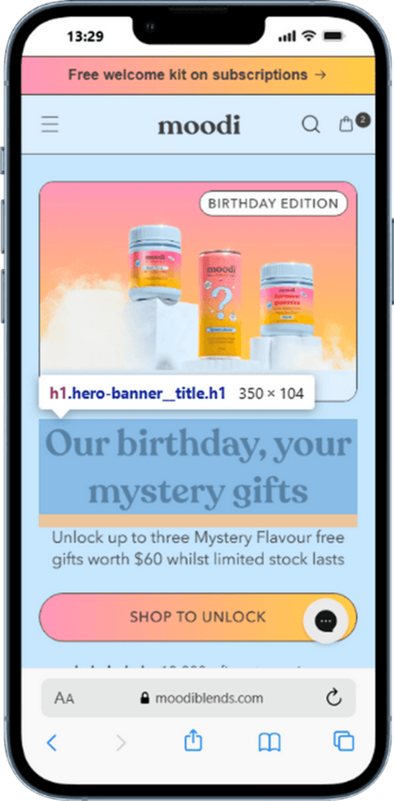
The homepage currently uses two H1 elements and jumps from H1 to H3 and then straight to H6, skipping H2, H4, and H5.
Screen reader users can navigate pages by heading level, so a logical hierarchy makes the page easier to understand and navigate. A clean heading structure also gives search engines and other systems a clearer representation of the page's content and hierarchy.
Pilothouse recommends rebuilding the heading structure around one clear H1, with logically nested subheadings underneath it. It's a relatively low-cost fix that improves accessibility and gives search engines a cleaner content structure to interpret.
🔎 Navigation, Search & Information Architecture
The mega-menu is well designed. It offers two parallel ways to browse, by product range and by health benefit, which respects that shoppers arrive with different mental models. Breadcrumbs are present on category and product pages too, which is good practice.
Turn search into a predictive tool
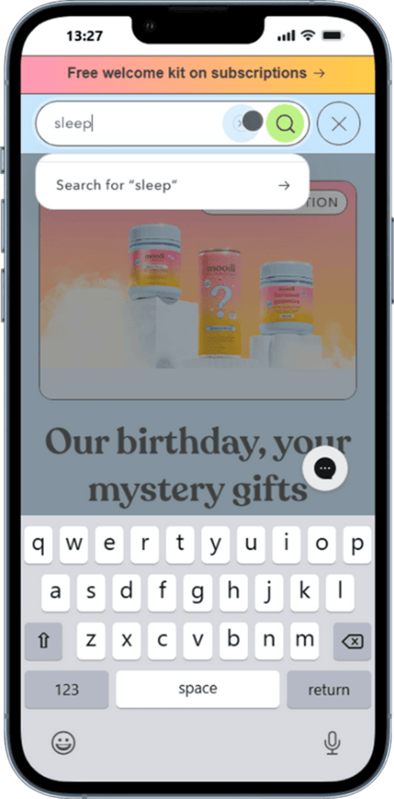
Search is one area where the experience could catch up to the rest of the site. Typing a query like "sleep" produces no live or predictive results, only a generic "Search for 'sleep'" link that requires a full page load before showing anything. Once that page loads, it correctly returns 12 results led by the PM sleep-support line.
Show thumbnail predictive results inline as customers type. That removes a click and a full page load for shoppers using search as their primary way to navigate, creating a faster path to the relevant product.
🎯 Landing Page & CTA Optimization
Moodi already has clear, high-contrast CTAs across its landing pages. Two additional tests could make them work harder.
Swap generic CTAs for benefit-driven copy
Buttons like "Shop" and "Submit" are functional. They don't yet give a visitor an extra reason to click, which is an easy opportunity to test.
Test more specific CTA copy tied to the offer or product benefit, using language that tells shoppers what they'll get after the click.
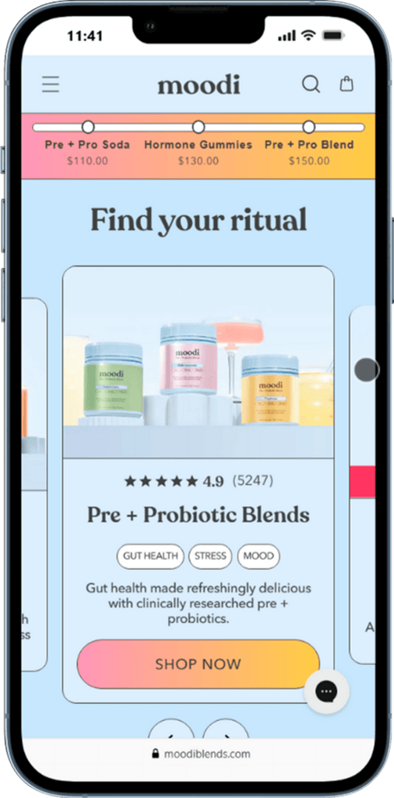
Add a sticky add-to-cart bar on mobile
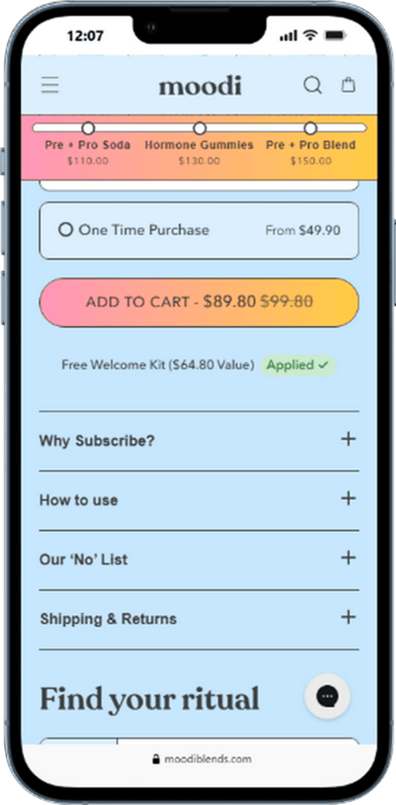
Once a shopper scrolls past the primary product hero, there's currently no way to add to cart without scrolling back up.
Add a sticky footer bar with product selection and an Add to Cart button that follows the shopper down the page, keeping the purchase action accessible throughout the PDP.
⭐ Social Proof & Customer Testimonials
Trust cues, verified reviews, and press mentions ease last-second purchase anxiety, and Moodi has real proof points to draw on.
Bring trust signals above the fold
There's an opportunity to surface more of that proof earlier in the page, before a visitor has to scroll to find it.
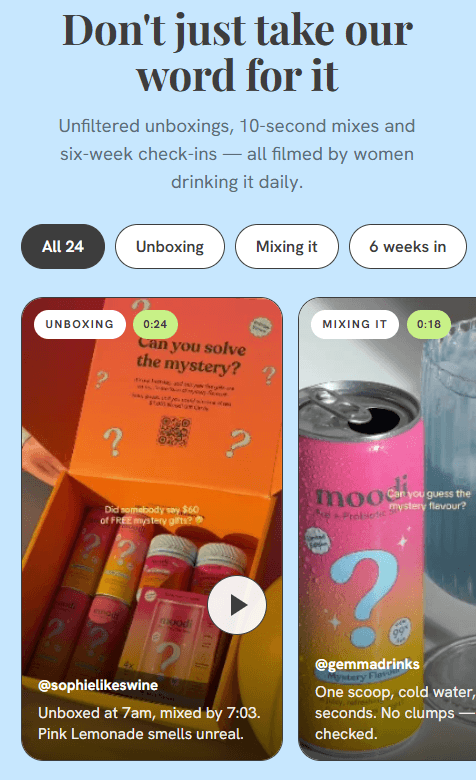
Test surfacing Moodi’s actual review score and volume directly around the hero CTA, adding a press logo bar beneath the hero, and bringing real customer UGC, unboxings, and short mixing clips higher on the page.
Here’s what that could look like:
🛒 Cart & Checkout Experience
The checkout page itself is a strength worth calling out. Social proof sits right at the top (“Loved by 200K+ women”), trust signals appear just above Shop Pay and Google Pay, and upsell items show before the total, giving shoppers several useful confidence cues before purchase.
Add micro-upsells to the cart
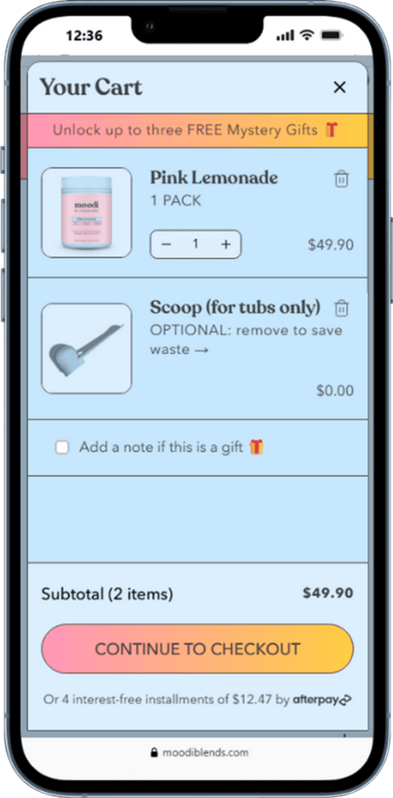
There's open space above the subtotal in the cart drawer that isn't being used yet.
Test a low-friction, single-item add-on there, like a branded frother or travel shaker, as an additional opportunity to increase average order value without adding another step to checkout.
Surface delivery timing at checkout
The checkout flow is already dialed in overall. The one recommendation here is showing estimated delivery dates directly below the total pricing, giving shoppers a clearer sense of when their order should arrive before they pay.
⚡ Page Load Speed
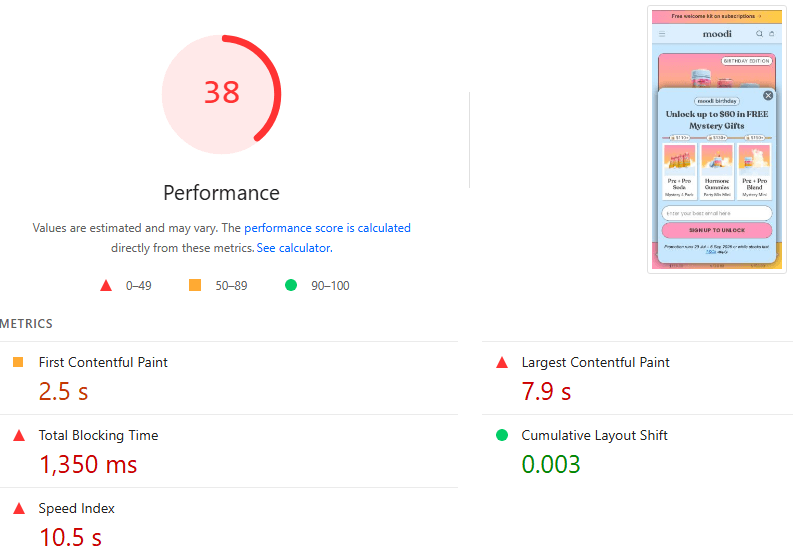
This is the section with the clearest immediate upside. At the time of audit, Moodiblends.com scored 38 out of 100 on mobile performance and did not pass the Core Web Vitals assessment, with a 7.9-second Largest Contentful Paint and a 10.5-second Speed Index. The fixes here are well understood and rank clearly by impact.
Clean up JavaScript execution
The main thread is heavily blocked by script processing, with Total Blocking Time at 1,350 milliseconds.
Identify and remove unnecessary JavaScript, including unused third-party apps, plugins, or tracking tags where applicable. The audit identified an estimated 912 KiB of potential JavaScript savings.
Streamline asset and image delivery
Overall page weight sits at 6,361 KiB, or about 6.3 MB, which is heavy for mobile and cellular connections.
Reduce overall page weight, prioritize loading the hero image responsible for the Largest Contentful Paint, and lazy-load non-critical imagery below the fold.
Lock in long-term caching
Some static assets could be cached for longer, reducing the amount returning visitors need to reload.
Configure longer browser caching for eligible fonts, images, and scripts. The audit identified an estimated 468 KiB in potential savings for repeat visits.
🤖 Building an AI-Ready Site
AI search and shopping experiences increasingly rely on structured product information and accessible web content to understand and surface products.
Structured product data, clear page content, accurate pricing and availability, and crawler access can all make it easier for these systems to understand a retailer’s catalog.
Make the site legible to AI shopping agents
Moodi is already ahead on one piece of this. The ingredient and benefit FAQs already give search and AI systems clear, useful information about Moodi’s products and the questions they address.
Start by validating Moodi’s product structured data and making sure key product details like price, availability, ratings, ingredients, and benefits are clearly represented. Review robots.txt and crawler settings too, so relevant AI search crawlers can access the content Moodi wants surfaced.
Conclusion
Moodi already has a strong brand and a site with a lot working in its favor. The biggest opportunity now is tightening the experience around the edges so more of the attention the brand is already earning has a clearer path to purchase.
Most of the recommendations are relatively contained tests and technical fixes that can improve the shopping experience without requiring a major site overhaul or additional ad spend.
Did you find this valuable? Support us by checking out our businesses:
Please note that items in this newsletter marked with * contain sponsored content.
.svg)


.svg)


.svg)


.svg)
.svg)
.svg)