SPONSORED BY:



Good morning, it’s me, Eric and yes, Tom Cruise from Magnolia is judging you. Maybe for the 40 ad sets in your Meta account when 3 would do. Maybe for the Amazon titles you still haven't trimmed to 75 characters (deadline: yesterday). Either way, everything you need to get back in his good graces is below.
✂️ Amazon chopped your product titles down to 75 characters yesterday
Amazon's new title rules kicked in yesterday. Titles across every category except media now have to fit in 75 characters, and that’s WITH spaces included. Anything else you'd normally cram in there now goes into a separate Item Highlights field instead, capped at 125 characters for materials or use cases.
If you don't review your AI-generated title recommendations in the 14-day window Amazon’s giving, don't worry, Amazon will just do it for you. Aka, your non-compliant title gets swapped to whatever Amazon's AI recommends, gradually, whether you signed off or not.
I did a quick scroll on the update on Seller Central and saw that one seller is already feeling some friction with an error message, so worth checking your listings today rather than letting Amazon's AI decide what your title says.
💸 The tariffs on China now have a ceiling (supposedly)
China's Commerce Ministry said this week that Washington committed to a 20% ceiling on the replacement tariffs that took effect when the old 10% global duty expired last week. The current rate sits at 12.5%, so by China's account there's still 7.5 points of room before hitting that ceiling.
The US hasn't confirmed this publicly yet, but fair to treat the 20% figure as a planning ceiling rather than a locked-in number.
If you’re already in the swing of Q4 planning, model your China-sourced COGS against that 20% ceiling. Whatever you're paying today at 12.5% is the floor so don’t be surprised when it moves again.
📺 Still looking for a reason to try CTV advertising with Paramount Ads Manager?
Here are four:
Ready to get your brand on TV? Launch your first campaign and claim your bonus credits.
* sponsored
🛍️ TikTok Shop’s testing the waters with subscriptions and paid memberships
Product subscriptions on TikTok Shop went live June 1 to select US sellers across eight categories (beauty, food, health, home supplies, personal care, pet, select auto, and fashion), letting a shopper subscribe to one replenishment item at 5 to 20% off.
TikTok is also testing a paid membership, Shop Plus, at $6, $10, or $15 a month with free shipping and exclusive coupons.
TikTok Shop projects it will clear $23B in 2026. That's still a fraction of Amazon's roughly $500B, but worth testing if you sell anything replenishable.
🛠️ Google keeps stacking AI onto Merchant Center
If you’ve been keeping an eye on Google updates (there’s been a ton lately), then you’ll know that Google added Merchant Advisor and AI performance reports to the Merchant Center earlier this year.
The dashboard now shows AI summary insights that flag product issues, a search box with suggested queries, and a saved section for past chats. Pull up Merchant Center this week, it's now flagging feed and listing issues you'd otherwise have to dig for yourself.
🎙️ Moiz Ali sold Native for $100M in 2.5 years. This is what he tells other operators now.
@moizali started personal care brand Native with $500 and no team. Two and a half years later, P&G bought it for $100M.
Repeat purchase rate sat above 40% at exit. That number, not revenue, drove most of his decisions.
Moiz shared insights on how to scale a brand on an episode of Elevator Talks. I listened and noted down a few things to share with you guys:
Pay attention to subscription math. He flags operators who opt customers into auto-renew and skip the renewal reminder email. Send the reminder and the inflated repeat rate gets honest.
Focus on the product itself, not the brand. A brand forms on its own once the product wins. Early on, Native stayed focused on one deodorant SKU, was DTC only, and had no Amazon listings. And it worked.
Ask yourself: who's underserved, and why is this product different for them?
Getting into retail. Focus first on DTC sales, then email every customer for feedback, and keep iterating for six to eight months until the reorder rate holds up.
Buyers rarely respond to cold inbound. Lead the pitch with the repeat rate and a specific problem solved, and offer exclusivity to get the yes.
Nothing beats Meta (even when it’s being unreliable). When operators ask Moiz how to cut their reliance on Meta, his first question back is where they'd even go?
The only way to diversify is getting onto a shelf, though that still runs through Meta to drive the sell-through once you're there.
Perform regular revenue checks. He checks revenue every 30 minutes during a sale and the bank account about once a day. Revenue shows where the business is headed. The bank shows where it's already been.
🤯 Credo Beauty did what with their app?
Credo had a 6-month revenue goal for their branded app. They hit it in 2 months.
What makes this even more impressive is that they did it without hiring anyone, without building custom features, and with only about 90 minutes a week to manage the whole thing.
The app is now driving 23% higher AOV and 30% higher UPT than their online store, and early access turned into one of their best-performing channels.
Want their winning moves? The full case study breaks down exactly how they did it. Get it here.
* sponsored
💡 Improve Meta performance using one campaign with 30 ads
If your Meta ad account looks like a mess of segmented ad sets, it might be time to simplify with a new testing structure.
Pilothouse is finding strong results with a $12M apparel client by stacking 30 ads within a single campaign, giving Meta's algorithm room to scale.
If you’re thinking you might want to try that in your account, here’s the setup the team told me they use:
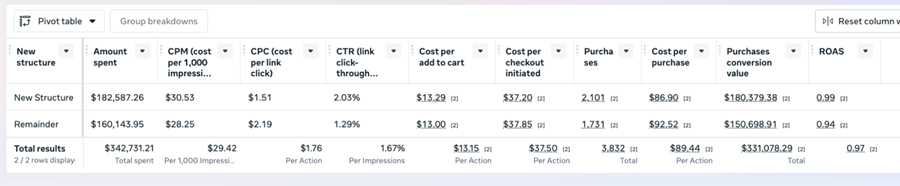
Pilothouse saw an improvement in cost per purchase and ROAS running this structure compared to 1 campaign with 10 ads, along with stronger click metrics from a wider range of creative reaching new audiences. You can check out more data in this chart they shared.
I asked the team why they think this particular setup is working, and this is what they said:
Maximizing budget. Consolidation directs daily spend to the highest-converting audiences and ads, keeping costs down and ROAS up.
Creative diversity. Ten ads per ad set gives Meta a solid stream of data to find new audiences without spreading that data too thin across dozens of segmented ad sets. The algorithm gets the chance to find stable pockets of buyers across a range of concepts.
Ad set spend minimums. The 20% floor stops Meta from picking one "favorite" ad and underdelivering on the other 29. It forces the system to test into all 3 ad sets, giving each concept a real chance to perform.
Test out this structure in your own account and gather insights before Q4 hits.
🎧 Cracking Profitable, Incremental Scale on AppLovin with Pilothouse
Jacob runs Meta at Pilothouse and has been buying on AppLovin for almost two years, back when it was invite-only with brutal minimums.
As we’ve mentioned a few times over the last few weeks, it just opened to the public, and it turns out it's the ad platform running inside pretty much every mobile game and food delivery app you've ever used, up 60% year over year, publicly traded, sitting on nearly $2 billion in Q1 revenue alone.
He walks through:
He also gets into how attribution works across platforms in general, and exactly how Pilothouse verifies true incremental new-customer CPA before scaling anything.
There's a real case study in this one too, a $50 wearable health product that went from launch to profitable in two months, along with the actual weekly creative volume it took to get there.
Go listen.
▶️ YouTube here | 🎧 Spotify here
🏃➡️ Treat your checkout as the starting line, not the finish line. Test your post-purchase strategy against millions of shopper sessions and discover what the highest-performing ecommerce brands do differently. Check it out here. *
🛒 Running an online business? Your experience can help design the future of ecommerce tools. Join Blink UX’s research panel, share your insights, earn gift cards, and influence the platforms you use every day. Join here. *
* sponsored
Did you find this valuable? Support us by checking out our businesses:
Please note that items in this newsletter marked with * contain sponsored content.
.svg)


.svg)


.svg)


.svg)
.svg)
.svg)