Good morning, it's Eric, and I hope you're staying cool as Lil' Nancy. It's the last full week of July, which means Q4 is closer than it feels. FedEx just posted its peak-season surcharges and they start September 28, so that one goes into your cost model this week. Pilothouse also treated the Fourth of July like a test run for the holidays and pulled three creative patterns worth copying into your Labor Day promo.
Here's what else you need to know to start your week:
🏷️ Quick but important note about AI models if you sell on Amazon
If you've got any AI-generated people in your product photos or listing videos, you need to know that Amazon just told sellers they have to tag any image or A+ content featuring photorealistic AI-generated people before uploading it, starting now.
The trigger is that New York law we mentioned that kicked in last month requiring disclosure whenever a "synthetic performer" replaces a real human in an ad. Real people edited with AI are fine. Fictional characters are fine. This is specifically about fully fake humans, the stock-model-style photography a lot of brands switched to for cheaper listings.
Amazon's adding a visible label to flagged listings so shoppers know what they're looking at. What they haven't said is what happens if you don't tag it, or how they're actually deciding which listings get flagged. If you’ve got any AI-generated models on Amazon right now, go tag them.
💬 A fake WhatsApp chat beat every other ad in this account
Antonio Ventre (@antonioventre_) is running WhatsApp voice message ads, screen-recorded fake chats with voice notes going back and forth, someone asking about the product, someone answering, a text or photo mixed in. Same idea as the FaceTime call ad format, just moved to WhatsApp.
The whole thing hinges on looking real. Real chat layout, real pauses between voice notes, audio that sounds like it was recorded on a phone in a bedroom, not a studio. Get that wrong and the format falls apart, the entire appeal is that it reads like a conversation you weren't supposed to see. Same instinct Ari talked about last week on the pod, ads that work because they don't look like ads.
He said this format was the highest-spending ad in the account, $90K, and it still pulled a 5.55 ROAS against a 3.93 account average. If you try it out, let us know how it performs.
📦 FedEx's holiday shipping fees start September 28, budget for it now
FedEx dropped its 2026 peak season fee schedule. Most of the surcharges start September 28 and run clear through January 17, basically stapled to your entire Q4.
Ground residential demand surcharges are the one to actually budget for. They top out at $0.80 a package this year, up from $0.65 last year, the exact shipment type most of your orders fall into. Oversize and handling charges climbed too.
FedEx also said flat out it's prioritizing higher-margin segments like healthcare over general ecommerce when capacity gets tight, which is corporate speak for you're not who they're rushing to protect once things get busy.
Get these numbers into your Q4 cost model now. UPS hasn't published theirs yet, but I wouldn’t bet on them coming in lower.
🩳 Chubbies sold for $100M+, and Preston Rutherford says almost none of it came from the ROAS playbook
Preston Rutherford, who co-founded Chubbies and sold it about ten years later for over $100 million, posted the short list of things he thinks actually built the brand. TL;DR: none of it is the daily Meta-ROAS-CAC grind everyone's stuck in right now.
A Friday email called the Weekender had zero revenue goal (no product links in there at all) and its only job was making customers laugh before the weekend. People started forwarding it to friends on their own, and it turned into an unexpected acquisition channel.
They also treated box inserts like a game, first order gets a gift, second order gets a better one, third order better still. Customers started posting unboxings, other customers started asking how to get the same gift, and it ended up recruiting new customers as much as it rewarded existing ones. Even the product names got the same treatment, "5.5 inch inseam khaki shorts with an elastic waistband" became "Khakinators."
Everyone's running the same performance playbook right now, which makes the weird, human, slightly off-brief stuff the only differentiator left.
💡 Fourth of July Learnings to apply before Labor Day
The Pilothouse Meta team wrapped their Fourth of July promo data, and I wanted to share the three patterns that stood out clearly enough to carry into Labor Day.
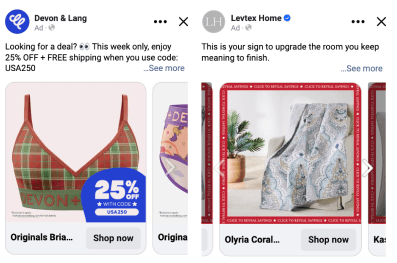
Catalog ads scaled hard for anyone with a big catalog. Brands with 100+ SKUs saw catalog campaigns dominate their ad accounts and keep scaling through the whole promo window, letting Meta match inventory dynamically against broad targeting instead of hand-picking creative kept efficiency up without burning out the creative.
Pilothouse's own data showed catalog ads pulling 18% stronger ROAS on average, and for three brands with catalogs over 100 SKUs, catalog ads ate more than half of total spend. Promo-specific frames inside those catalog ads did especially well this cycle too.

Patriotic colors just worked. Bold red, white, and blue creative captured attention consistently across accounts, so if you've got SKUs in those shades, save them for the next patriotic-adjacent promo.
The team's flagged this pattern before for other holidays too, lean into the actual colors of the moment, emojis included.

The real winner was combining contrast and iteration. Two clients ran iterative creative alongside genuinely contrasting styles and both saw big YoY growth, one hit 146% YoY growth in Shopify with a 35% increase in new customers, the other hit 150% YoY growth in Shopify.
Running both approaches together found new buyers while still reinforcing whatever was already converting.
Before Labor Day, test a few different product sets now to find your strongest SKU mix, and get a couple of contrasting catalog frame styles running in evergreen so you've already got a proven style to iterate on once the promo actually starts.

🎧 How One Brand Recovered $1.5M in Amazon Sales From Unauthorized Sellers
After building and selling two Amazon brands while in law school, attorney Mario Simonyan turned his own experience with copycats into a business helping brands fight unauthorized sellers and marketplace infringement.
On this episode of the DTC Podcast, Mario shared that unauthorized sellers and infringers can siphon away an estimated 15% to 25% of a brand’s revenue, while driving down prices and damaging the customer experience.
We chat about why brands need to control their Amazon presence, the three-part enforcement framework covering IP, marketplace policies, and regulatory compliance, and how one eight-figure fitness brand recovered control of 95% of its listings after walking away from $1.5 million in annual Amazon sales.
▶️ Watch here | 🎧 Listen on Spotify
📦 Selling on Walmart Marketplace is one of this year's smartest investments. New Seller Savings 2026 is happening now. Sign up to unlock up to $75K in New Seller Savings to build your business on Walmart Marketplace.* Conditions apply.
* sponsored
Did you find this valuable? Support us by checking out our businesses:
Please note that items in this newsletter marked with * contain sponsored content.
.svg)


.svg)


.svg)


.svg)
.svg)
.svg)