Good morning,
Here’s what you’ll find in today’s DTC:
1️⃣ How this unannounced Shopify Checkout tanked conversion rates for multiple brands
2️⃣ How to give your new Meta creatives the budget they need to perform properly
3️⃣ Turning founder personalities into actual growth channels
You’re reading this newsletter along with new subscribers from: Mindful Maki, Chillys, and Sqairz. 👋
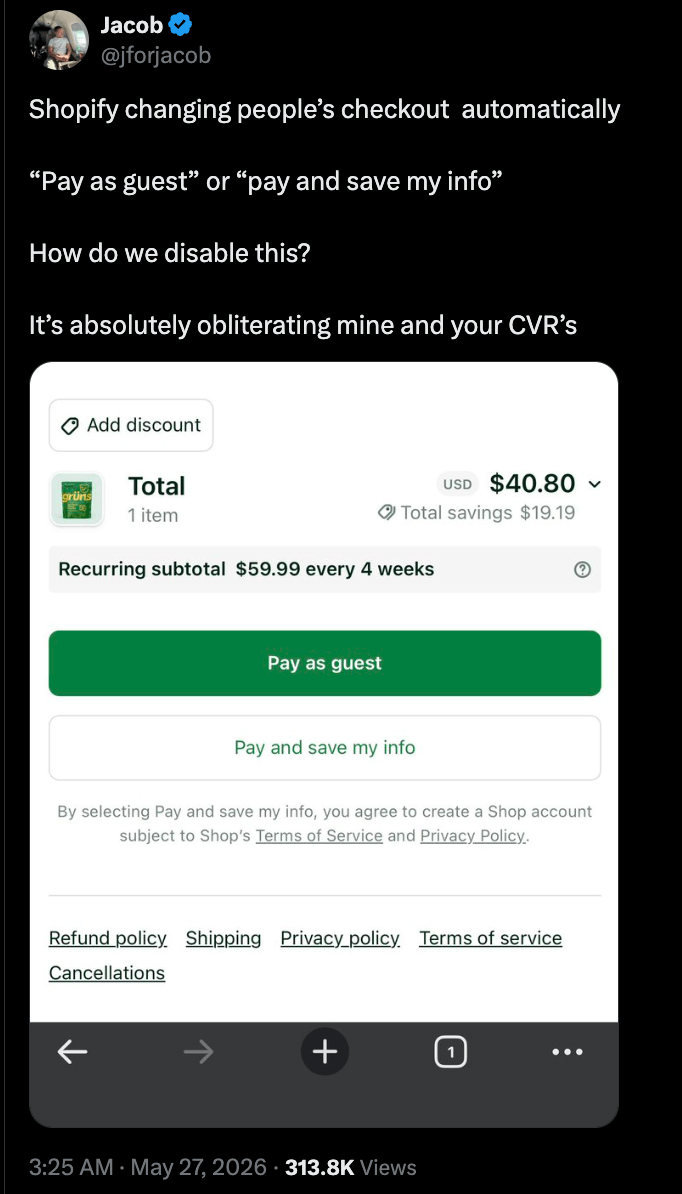
Shopify pushed an unannounced checkout change that merchants say tanked their conversion rates.
The update replaced the standard single "Pay Now" button with a two-option screen asking shoppers to choose between "Pay as guest" or "Pay and save my info."
That decision screen inserted friction into a flow that previously had none.
Jacob (@jforjacob) flagged it publicly on X, writing that the change was "absolutely obliterating mine and your CVR's" and asking how to disable it. The thread went wide fast.
Shopify CEO Tobi Lütke responded directly, confirming it was an A/B test. He said he checked the conversion impact results including Jacob's specific store and found "zero negative impact (slightly positive actually) when adjusting for confounders." Jacob's response: "I can assure you, it wasn't." He offered to share their store data privately and noted that CVR picked up 30% immediately after the change was reverted.
In the thread, DTC operator DTCMidas corroborated this independently, reporting that add-to-cart and reached-checkout were both down on the day of the change, with the only variable being the new checkout button.
The geographic scope: UK and all EU markets running Shop Pay.
Tobi followed up with a second reply: "hundreds of these type of micro changes happen all the time. 95% of them to optimize conversion in some way in some geography. Sometimes its regulations that trigger them. All of this is the reason why your checkout converts as well as it does and stays state-of-the-art." That framing, that constant untransparent testing is a feature of the platform, sharpened the debate.
The deeper dispute in the thread was not just about whether the data showed impact. It was about consent. Multiple merchants argued that running A/B tests on live checkouts without merchant notification or opt-in is inappropriate at the most critical point in the customer journey. Kody Nordquist put the merchant position plainly: "We absolutely should be able to opt out of tests that can have a potential negative impact on business." Jacob pointed out that Meta offers credits and toggle options when running tests on merchant accounts. Shopify offered neither.
Merchants report the change has been reverted. At the time of writing, Shopify has not confirmed this publicly.
👀 The Reactive Loop: Data from 540+ DTC Operators
No one thinks they’re being reactive.
They think they’re being responsive, data-driven, and on top of performance.
But when nearly 70% of teams only trust forecasts 3–6 months out, every decision gets pulled closer to the present. Add in the fact that 70%+ are reviewing performance weekly, and it creates constant pressure to act.
So they do.
Not because the strategy is wrong, but because it hasn’t had time to work.
That’s how long-term plans quietly turn into short-term corrections.
This report breaks down why it’s happening across 540+ DTC brands.
* sponsored
🧠 Using Ad Set Spend Minimums for Testing
Launching 20 new ads per week and seeing them only get 2% of spend can be a drag, especially after spending hours on concepting, planning, design, revisions, and building into your ad account.
The Pilothouse team sees this type of roadblock come and go, and they’ve found it can happen across a range of branded and polished creative. It’s tricky to predict what will get favored and what won't.
So, they’ve found a workaround to leverage Meta’s Advantage+ capabilities while dedicating a portion of spend towards test ads by using ad set spend minimums.
Here is exactly how they structure it in Ads Manager:
1️⃣ Build out one new campaign with two ad sets using these settings: Campaign Level: Turn on Advantage+ campaign budget.
2️⃣ Ad Set 1: Scale ad set
Duplicate your top 8-10 ads into the ad set.
3️⃣ Ad Set 2: Test ad set
Add in 8-10 new ads into the ad set and set an ad set spend minimum of 10-20% of the daily budget to start.
👉 If your campaign budget is $1,000 and you set the spend minimum of 10%, at least $100 will go to new test ads, and the remaining $900 will be dispersed between the two ad sets.
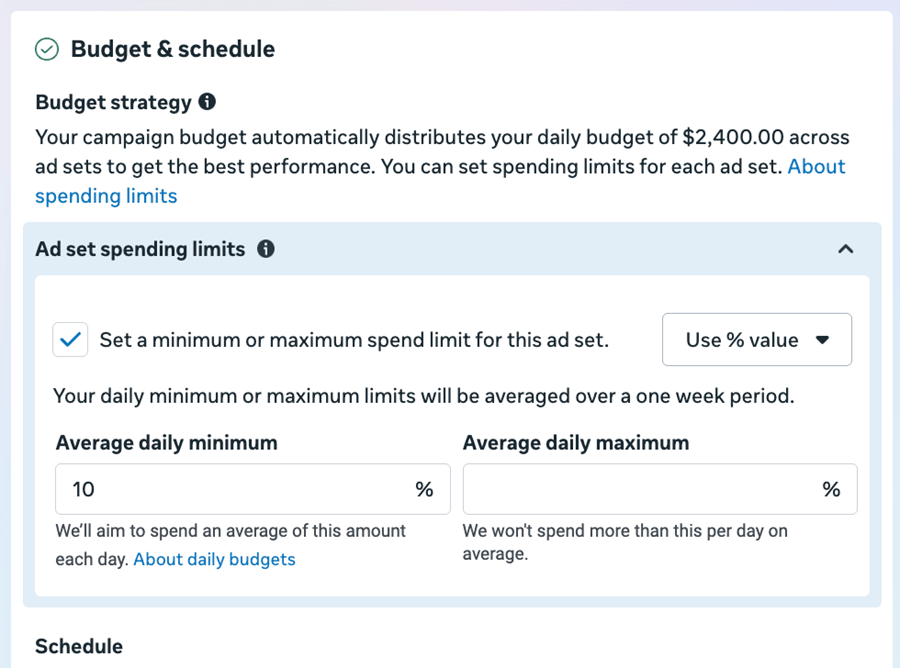
This structure also works for page and audience tests. It allows you to keep your account consolidated and leverage Meta’s AI while dedicating a specific percentage of your budget to testing new variables.
The team launched this structure to test new creative for a client in the health space generating $50M on Shopify, and these are the initial results:
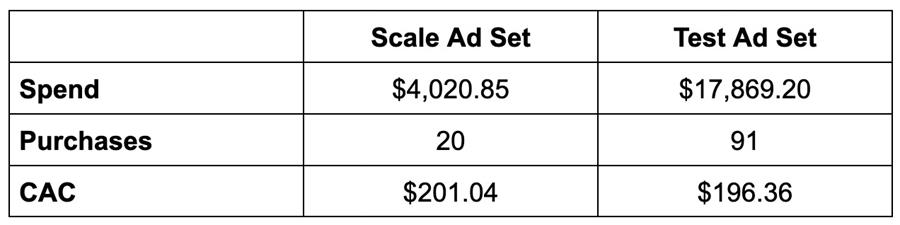
The brand initially set a 10% spend minimum on the test ad set to guarantee baseline delivery. However, Meta's algorithm quickly began heavily favoring the new ads and scaling their delivery automatically, which accounts for the final $17,869.20 spend figure.
The team dedicated spend to new ads, found new winners, and scaled them up quickly without disrupting the learning phase or moving ads into different campaigns within the account.
This has been an effective setup for both testing and scaling in a single campaign, and it isn’t limited to 5-7 days like the creative testing tool is.
If you’re a higher-volume brand launching over 10 new creatives per campaign per week, the Pilothouse team recommends giving this setup a try in your account.

Avery’s Four Rules for Founders That Actually Want to Scale
Most founder content fails at step one: the story.
Aves argues that “I made this because I love coffee” is a surface-level comfortable answer that tells the audience nothing they couldn't have guessed, and that the real story is usually one layer deeper.
In this episode, she walks through the four things that actually make founder-led content scale, including a distinction worth paying attention to: the difference between building in public (struggle + solution = value) and pity farming (just ranting about problems online). One scales brands. The other doesn't, and Aves is direct about which cultural moment we're in right now.
🛍️ Selling on Walmart Marketplace is one of this year's smartest investments. New Seller Savings 2026 is happening now. Sign up to unlock up to $75K in New Seller Savings to build your business on Walmart Marketplace.* Conditions apply.
* sponsored
$20B tariff refund. The Trump administration returns billions in tariffs to importers with more to come. Read more →
Anthropic’s $965B valuation. The AI startup raised $65B in its latest funding round, tripling its valuation from February. Read more →
Google unlocks AI shopping data. The new shopping insights on Merchant Center measures ‘share of voice’ in an AI shopping environment. Read more →
Meta’s AI subscriptions. Meta plans to monetize its AI features and create two subscription plans for businesses. Read more →
Did you find this valuable? Support us by checking out our businesses:
DTC Newsletter is written by Rebecca Knight and Frances Du. Edited by Eric Dyck.
Please note that items in this newsletter marked with * contain sponsored content.
.svg)


.svg)


.svg)


.svg)
.svg)
.svg)