SPONSORED BY:


Good morning to everyone except the brand that launched the same UGC ad 4 weeks in a row and is wondering why ROAS dropped,
Why Meta now rewards brands who refresh creative weekly. Not monthly.
Creative velocity has quietly become the #1 performance lever on Meta. Here's how to calculate exactly how many assets you need all year round.

✨ What If Your Website Adjusted Itself for Every Visitor?
Today’s customers expect experiences that feel made for them, not broad messaging built for everyone.
When Kraft-Heinz implemented personalization, they saw a 78% increase in conversion rate.
When Ruggable tailored experiences to specific audiences, they achieved 7x higher CTRs.
The numbers don’t lie. Personalization drives higher revenue.
👉 With Contentful Personalization, you can turn anonymous traffic into meaningful, high-performing journeys:
If higher engagement and stronger conversions are on your roadmap this year, personalization might be your fastest path there.
* sponsored

🚀 Creative Velocity on Meta: The Math Behind How Many Ads You Actually Need to Win
Picture a DTC brand doing solid numbers: $450K/month in Meta spend, reasonable CPA, a creative team working hard. They brief a new batch of ads every month. Production takes two weeks.
But by the time the new batch launches, the old ones have already fatigued. The algorithm has been running on fumes for 10 days. ROAS dips. The team scrambles.
Sound familiar?
This isn't a creative quality problem. It's a creative velocity problem.
And it's now the single biggest gap between brands that scale on Meta and brands that plateau.
The shift happened quietly. Meta's algorithm (increasingly automated, increasingly dependent on broad targeting) now optimizes around signals rather than audiences.
And the richest signal source it has? New creative.
Fresh ads give Meta more angles to test, more hooks to match against intent, and more data to surface winners faster.
The Velocity Breakdown
So what does "enough creative" actually mean in numbers?
The team has developed a straightforward formula based on two variables: monthly ad spend and your target CPA.
The core principle: spend at least 4x your target CPA to properly test each asset. From there, allocate roughly 5–8% of your monthly budget to testing. The result is the minimum number of new assets you need each month to give Meta enough signal to work with.
Here’s an example so you can see this in action:
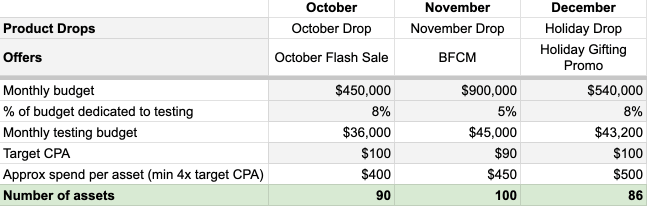
At $450K/month, you need 90 new assets in October alone. That's roughly 22 new pieces of creative per week.
For November's BFCM push? You need 100 assets.
Here's the thing that surprises most brand teams when they see these numbers: it's not about making 90 premium production pieces. Many of these are variations on winning angles.
Using the winning angle across different formats, editing new cuts and text overlays on video assets. The velocity is in the testing infrastructure, not the production budget.
The four reasons creative velocity has become non-negotiable on Meta today:
💡 Lower-spend brands should launch at least weekly. Brands at $150K+/month should aim for 2–3× per week.
An apparel brand doing $12M/year on Shopify found success with a hook like: "[BRAND] transformed my day-to-day life and here's exactly how" — the hook itself self-selects for intent.
That's where performance agencies earn their keep. They take on the full execution load (production, testing, and analysis), so your internal team can stay focused on brand strategy and creative direction.
✂️ The Creative Volume Calculator (Copy This Framework This Week)
1️⃣ Take your monthly Meta spend and multiply by 0.08 (~8% testing budget) or 0.05 during peak spend months like BFCM.
2️⃣ Divide that testing budget by 4x your target CPA. That's your minimum number of assets for the month.
3️⃣ Break assets into three pillars: Evergreen 45% / Product Drop 30% / Sale 25% (this split will vary depending on your initiatives)
4️⃣ Divide monthly assets by 4. That's your weekly launch cadence. If it's more than your team can brief and produce, that's where agency support makes sense.
5️⃣ For each winning format, plan 6–8 variants (hook swaps, ratio changes, opening frame edits) before investing in new production.
Meta is introducing a change to its payment system, asking advertisers to switch from credit card payments to monthly invoicing by March 31, with the transition beginning March 2.
The credit line amount will be determined based on historical ad spend, with the option to request increases if needed.
Advertisers can move multiple ad accounts under one credit line and assign accounts to new, existing, or shared billing structures.
Important to note: Ads will continue delivering during the transition, and any outstanding balances will be charged to the current payment method. If monthly invoicing isn’t available, advertisers may instead switch to direct debit using a bank account.
Does AI referral traffic convert better? New data reveals ChatGPT ecommerce traffic converts 31% higher than non-branded organic search. Read more →
Liquid Death launches the Eternal Playlist Urn. The water brand teams up with Spotify to bring music to the afterlife. Read more →
Anthropic acquires Vercept. The AI company acquires the Seattle startup to advance Claude’s capabilities. Read more →
The brands I see struggling most right now are still thinking about creative like it's 2020. Back then you could find one hero video, put $50K behind it, and ride it for three months. That era is over.
Meta's algorithm today wants to be constantly surprised. If you're not feeding it new material every week, it starts recycling your audience.
Your frequency climbs, your CPMs climb, and suddenly your "proven" campaign starts looking broken when really it's just bored.
The math in today's piece is the part that always shocks people. The good news is most of that is variation work, not original production. The question isn't "can we afford this?" It's "do we have a system for this?"
What's your actual creative output per month right now?
Hit reply — I'm genuinely curious.
How Infomercial Tactics Drive DTC Growth
Aves calls out brands that lean too heavily on “vibes”, and not enough on selling.
She shares how we can learn a thing or two from infomercial tactics and how problem agitation actually drives conversions.
📥 Got a B2B Biz?
Join dozens of B2B companies finding demand-gen success through our niche community of 150k brand leaders and founders this year. Talk to our team to learn more.
Don’t forget to rate the DTC Podcast on Apple (⭐️⭐️⭐️⭐️⭐️)
You’re reading this newsletter along with new subscribers from: Clementine’s, Equator Coffee, and Motto Mortgage. 👋
DTC Newsletter is written by Rebecca Knight and Frances Du. Edited by Eric Dyck.
Please note that items in this newsletter marked with * contain sponsored content.
.svg)


.svg)


.svg)


.svg)
.svg)
.svg)